
What a Real Book Proposal Looks Like When You’re Traditionally Published
by Laurie Ruettimann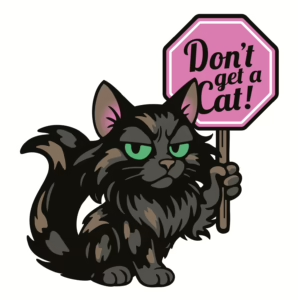
I’m not writing a book called Don’t Get a Cat. I told you about that already, and I’ll link to it here again so the context is clear.
Instead, I’m sharing the full book proposal I wrote for it. You can find the view-ony version here.
This is a real book proposal, written by a traditionally published author, for a major literary agency and a Big Five publisher. The document still has value, and I want people to be able to read and learn from it.
How the Book Proposal Process Actually Works
A book proposal is not a manuscript. It’s a sales document. It explains what the book is, who it is for, why it belongs in the market, and why the author is the right person to write it.
It should be both efficient but also repetitive on purpose. What I learned the first time is that you need to make the same argument in different ways because literary agents skim. Editors skim. Everyone is overwhelmed, busy, and scanning for signal.
I also learned to format proposals for tired eyes. I use a large font. I think about my spacing. I want the work to feel readable and calm, even when the topic is chaotic or emotional.
What to Notice If You’re Learning How Proposals Are Written
If you’re reading my book proposal to learn, look at the structure first. The proposal tells you what the book is, then it tells you again, then it tells you again. It does that because clarity wins over charm and jokes.
Pay attention to the “spine.” Every proposal has a center of gravity. There is always one chapter or one section that holds the whole thing together. In this proposal, that chapter is about my pee-cat named Scrubby. It is the strongest example of my writing, and it shows you what the book could be at its best.
Also notice how I handle audience. A proposal needs a specific reader. It needs a defined promise. It needs a point of view that stays steady from the overview to the chapter samples.
The Chapters, the Cats, and What Stayed With Me
If you’re just reading the proposal for the cats, you’ll meet Lucy and Scrubby.
Lucy is in there because she shaped how I think about rescue, responsibility, and the gap between what people want and what a cat actually needs.
Scrubby is in the proposal because he carries the emotional weight of the book. He is also the clearest example of the kind of cat story I can tell without turning it into performance art. The Scrubby chapter is the one I would hand someone if they wanted to understand the whole project in one sitting.
You’ll also meet Crow, a cat I had for six months. Crow did not stay, but Crow mattered. That story is in here because temporary relationships still change us. People who foster cats know that truth in their bones.
Read the Full Book Proposal
This post includes a full example of a real book proposal written for traditional publishing.
You can read the full book proposal here: What a book proposal looks like.
Even though it’s just a submitted draft and needs work, I’m sharing it for two reasons: People ask what a real book proposal looks like, and most examples online are either sanitized or hypothetical. This one is neither. I also believe my unpublished work can still be useful. It can teach, clarify, and move the conversation forward about cats.
I hope it helps. I hope it’s useful. I hope you enjoy spending time with Lucy, Scrubby, and Crow.
You must be logged in to post a comment.