Tag: ethical employees

  • HR Check-In with Susan Richards

    HR Check-In with Susan Richards

    March is Women’s History Month, and all month long, I’m excited to feature badass women having real conversations about the world of work today. That’s why I’m excited to bring you this special bonus episode of Punk Rock HR in which I speak with a woman in HR who I really respect, Susan Richards. She’s the CEO and founder of Sapient Insights Group and, above all else, describes herself as a “people fixer.” Susan and I talked about how investments in technology can help counter employee burnout, as well as the importance of focusing on well-being as part of the employee experience. Listen to our conversation and find out how HR leaders can take the lessons we learned in 2020 with them into the future.

    HR is Now in the Spotlight Like Never Before

    Now that we’re already a couple of months into 2021, it’s a great moment to check in and reflect once more on the tumultuous year that we just left behind and to figure out whether we’re going in the direction that we hoped. Since companies scrambled to adapt and find new ways to care for their employees during the pandemic, nowhere has the need for continued growth been more apparent than in the world of HR. “2020 really forced us into the center of everything that was happening in our organizations,” Susan tells us.

    Though it’s been a challenging time, she says that this moment is the seat at the table that HR has long been asking for. As we settle into the new year, Susan reminds us that it’s still the right time for HR leaders to step up and show their ability to provide answers for clients and employees.

    Fixing Burnout With Investments in Employee Experience

    I believe that burnout and resilience are closely intertwined. Every company wants to focus on resilience as we continue to press forward into the new year, but this can’t be successful without first addressing the issue of employee exhaustion. Susan talks about how investments in technology can help tremendously with solving this phenomenon. “Some of the things that we’re seeing organizations do is really try to understand how to engage their employees in a better way by utilizing some of the innovations that have happened over the last year.”

    She says that the best investment a company can make right now is in technology, and this can be proven by looking back at the data we’ve gathered from the events of 2020. “I really hope that our listeners will remember that there is a plethora of data out there that supports the business case for making those technological investments. The organizations that had already proactively made changes in their platforms and connected all of their HR and business applications fared much better.”

    Putting the “Human” Back in Human Resources

    No HR check-in would be complete without stopping to re-evaluate what “human resources” even means these days. According to Susan, this is a crucial moment in time to get back to the basics and focus on employee experience. “I think the last year has really given us a different perspective on even the word ‘human resources,’” she says. “We were so busy with being compliance-focused that we really took the ‘human’ out of ‘human resources.’ And I think that’s coming back.”

    So, as we go deeper into 2021, don’t forget to periodically stop and ask yourself and your team whether you are going in the direction you intended with the knowledge you gained from 2020.
    People in This Episode

  • Creating an Ethical Environment in Your Company: Leaders, It Starts with You!

    Creating an Ethical Environment in Your Company: Leaders, It Starts with You!

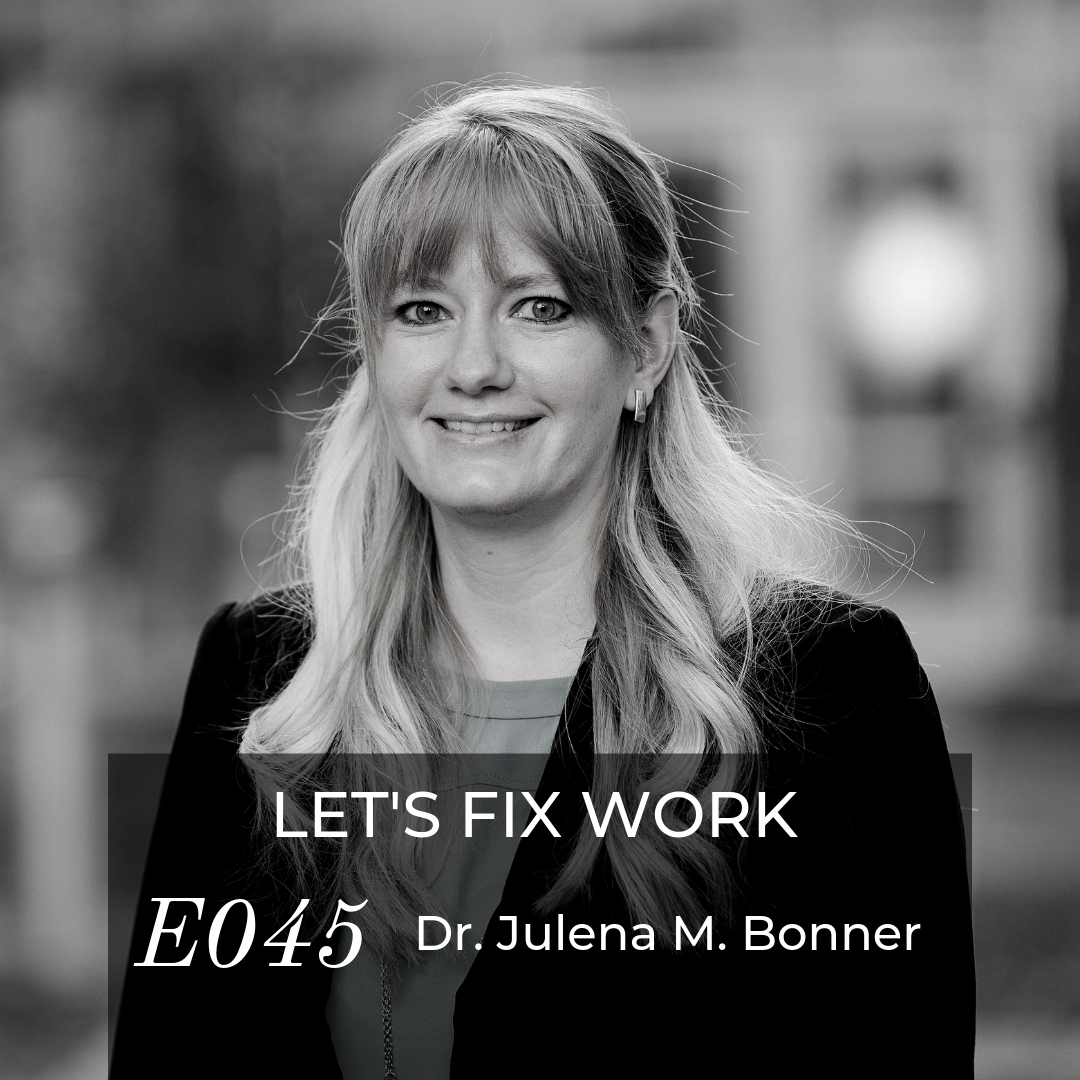
    I recently welcomed Dr. Julena M. Bonner to my podcast, Let’s Fix Work. Dr. Bonner is an Assistant Professor in the Management Department of the Jon M. Huntsman School of Business at Utah State University.  She recently wrote a research paper on unethical employee behavior and creating an ethical environment in your company. In layman’s terms that means she researched why employees do things like spit in people’s food or assault customers who mistreat them.

    Not only did we talk about why employees participate in this kind of bad behavior, but Dr. Bonner also provided some sound advice for employers, managers, and organizations that will help them mitigate it too. And guess what? It all comes down to company culture and ethical work environments.

    So how can organizations be sure the employees they hire won’t spit in a customer’s food? Dr. Bonner says first we must, “disrupt this process.”  Her research found that companies that cultivate and maintain an ethical culture, a culture where employees perceive that the policies, practices, and procedures strongly underscore ethical principle, can help disrupt this intuitive process of doing bad things. Why is this so? Dr. Bonner says because by being surrounded by ethical policies and practices, people tend to think more naturally about the ethics of the situation.

    The next question that comes up after learning how to mitigate this bad behavior is, “Well, how can we create an ethical environment for our company? We do have an ethical code of conduct. That should be enough. Right?”

    Not exactly. As Dr. Bonner points out, it’s important to understand that having a statement of conduct or ethical code of conduct does not mean you have an ethical working environment.

    True ethical cultures where informal values are exemplified come from leaders, from the top down. That’s right, folks, ethical environments start with leaders.

    Leaders play an important part in developing and maintaining an ethical culture. Dr. Bonner explains that’s why it’s so important for organizational leaders to develop themselves as ethical leaders. In doing so, they put themselves in a position to role model ethical behavior, which in turn builds an ethical climate.

    Dr. Bonner summed it up best when she said, “When a work environment has a strong culture of ethical behavior to your formal policies and informal values exemplified by other employees and managers, employees are more likely to control their reactions and behave professionally when they’re mistreated by the customer.”

    The bottom line is this: Ethical culture can help mitigate employee responses to customers who mistreat them. And Dr. Bonner is optimistic about this approach.

    So is it time for you to fix your work environment? If so, listen to my full conversation with Dr. Julena M. Bonner.  In addition to discussing ethical environments and how to foster good employee behavior, we talk in-depth about moral philosophy, Dr. Bonner’s research, and more. Listen to our full conversation here.