Year: 2026

  • Get On My Blogroll

    Get On My Blogroll

    Hi, I’m Laurie Ruettimann. I’ve been blogging since 2004.

    In the beginning, I wrote about life behind the scenes in the HR department at Pfizer. My blog covered why I hated my job, why team building is for suckers, and all the vulnerable thoughts in my head around careers, internal corporate politics, and even my weight.

    The old blog blew up. I had millions of views. I was invited to write for AOL. (Yes, that old thing.) They had a thriving homepage that needed content. So, I asked for a package from Pfizer and started contributing on the internet under my own name.

    You can read all about the early days in my book Betting On You.

    I Burned The Boats

    Once I started writing as myself, things took off.

    My career advice (not my body) was featured on The Suicide Girls. The Conference Board asked me to write for their magazine (which is now shuttered), Forbes named my website as one of the top websites and asked me to write for them. I also wrote for websites like Business Insider and Vox. CNN named me as one of their top career advisors in a digital campaign, and I spoke on stages like SXSW and Harvard Business School.

    This is all before you ever heard of Twitter.

    Mistakes Were Made

    The biggest mistake I ever made was leaving that job at Pfizer. Full stop. It was so cushy. It paid well. I was competent enough to get paid for decades without ever getting fired. I could’ve blogged anonymously until I had more knowledge about how to run a business.

    The second biggest mistake I ever made was leaving Pfizer without my MBA. My first boss, Tracy, practically yelled at me for not going back to school. I was leaving money on the table. Was I really comfortable with that?

    Apparently, I was fine being dumb.

    I remember telling her, “I’m just working to pay for landscaping and vacations.”

    Goddamn, the hubris of it all.

    Lessons Learned

    When it comes to life, the best time to plan for the future is 20 years ago. The second best time is today.

    I could’ve launched my business with so much more stability and knowledge. Instead, I let my severance package and gut instincts drive my decision-making. Those lessons are now folded into my coaching practice, where I sing the praises of doing a premortem. Let’s figure out how things can go wrong (while you still have a paycheck) before you burn the boat.

    Now, clearly, I did a few things right. But it took years to learn that being a consultant and creating content is a business like anything else. Just because someone likes you today doesn’t mean they’ll hire you tomorrow.

    (Thankfully, I learned these lessons long before most of you ever found me.)

    But if you’re in my shoes and ready to break free from a toxic job, learn from my mistakes and start marketing your business today so you can make money in 2027.

    How To Be Successful Online And IRL

    I’m here with one message, folks. You need to talk about yourself. But don’t do it on Substack. Don’t post memes on Instagram. Do it on your own website. Yes, I’m telling you to blog.

    I know, I know. You hate talking about yourself. Guess what? You can’t be a narcissist. It’s not in your DNA. You launched your company to be of “service” to an industry. But if you don’t showcase your business to potential clients, you won’t have any.

    Already have a blog but nobody reads it? (Join the club!) If you are somewhere on the internet, and you are writing about stuff that I might enjoy reading, leave a comment with your URL.

    I will absolutely help you spread the good word. Even though this seems like a 2004 move, I’m happy to add you to my blogrolll on the right-hand side of this page.

    Your work isn’t your worth. But you need to work and earn money. A blog helps to showcase your big, world-changing ideas.

    Do you write about HR, work, politics, or money? Are you a benefits blogger? Do you publish research on payroll or hiring trends? Let me know who you are and where people can find you. I’ll add you to the blogroll ASAP.

    (No AI vendors allowed. Sorry. Real people only.)
  • Back to 2006

    I have a new website, and the best way to explain why I’ve made this change starts with a trip in the wayback machine to 2006.

    2006 Was A Massive Shift

    That December, a writer named Nicholas Carr published a post on his blog, Rough Type, called “Sharecropping the Long Tail.”

    He compared the new social web to sharecropping, the farming system that took hold in the American South after the Civil War. Sharecroppers worked land they didn’t own, and the landowner kept most of the value. Carr saw the same deal on sites like MySpace and Facebook. Millions of people made the content for free, and the people who owned the platforms collected the money.

    A few years later, Sonia Simone wrote a piece for Brian Clark’s Copyblogger that gave the term a second meaning. If you build your business on a platform you don’t control, you’re farming somebody else’s land. The platform can change the algorithm, change the rules, or close your account, and your audience goes with it. Her advice was to put most of your time into things you own, like your website and your email list.

    The word sharecropping carries a lot of history, and I want to acknowledge why I’m using it in a Woke 3.0 world. The sharecropping system started with formerly enslaved Black people. They were freed with no land and no money, and many were forced by violence, need, or deception into contracts with white landowners. Poor white farmers were pulled in later, but Black families had far fewer ways out. So the comparison has limits. Nobody forced me onto social media, and I can leave whenever I want, which is a choice sharecropping families didn’t have.

    But I’m writing about it here and now because Carr kept coming back to the idea as Facebook grew. By 2012, he was calling it the largest digital-sharecropping operation the internet had produced. He figured the average user’s work was worth about $1.21 every three months, or enough for one bad cup of coffee. It’s only grown since then. Meta now makes $17.72 per person every three months across all of its apps.

    (That’s not even Google, YouTube, X, or Substack. This is why I support UBI. You built all of this. You should profit.)

    In any event, twenty years later, I’m done working for free.

    Back To The Future

    I’m pleased to announce that I’m going back to 2006 with my website, Laurie Ruettimann.

    It’s blog-first, fast to load, and easy to read. It’s organized in a way that makes sense for people. It’s wholly unconcerned with influence, and it’s 100% owned by me. I actually had fun on the internet in 2006, so that’s part of the push, too.

    I even went back to the WordPress OG, Andrew Norcross, and asked him to help me use tools that already exist to build a website that never needs to be updated again.

    There’s no Laurie GPT. There’s no AI digital twin. No pop-ups, premium content, or pushy videos asking you like and subscribe to my channel. It’s me, writing. You can also find information about my books and my talks. There are resources for speaker bureaus, an easy way to find my podcast, a link to my LinkedIn Learning courses, and an easy way to find out how I can be your coach.

    It’s made for middle-aged eyes. It’s written for humans. And it’s built by humans, too.

    I’m proud of this new iteration of my business, which is all about going back to basics. But if you find a bug, I’ll send you a gift card for a good cup of coffee. Just send me a note.

  • There Are Only So Many Spots on Stage

    My old speaking coach told me there are only so many spots on stage. While potential is limitless, the opportunities are not. You have to work hard on yourself, your messaging, your choreography, and your stories in order to earn the honor to take the stage and change the world.

    Unfortunately, most brains are hardwired to be negative and the critical. Plus, the world can be mean and cruel. So, as much as possible, you need to surround yourself with people who love you and think the sun and moon rise and set with your presence. It’s not that they need to be an irrational hype squad (okay, maybe they do, life is full of contradictions), but they must be overwhelmingly in your court and hyper-invested in your ability to do great things.

    The people around you? They can’t be the ones who “keep you grounded” because, as a speaker, you’re already grounded in your own limitations and, also, by the regular reminders that you suck. They’ve got to always and forever whisper in your ear: keep going, you’re amazing, you look terrific on that stage, you probably deserve an A+, and the world needs you. At the very least, they can never put you in a position to doubt yourself.

    I call Ken after every speech, and he asks me what went well. When I balk, he’s got the script to lift my spirits. And if that doesn’t work because I’m too negative, I call Jennifer McClure. Those two have my back.

    And it’s your job as the speaker to cultivate that crowd, make it clear in your relationships, and tell the people you love that you need more of it, not less.

    A while back, a longtime colleague came to see me speak and laughed at something awkward I said on stage. Actually, he laughed more at the way I said it. Then he told me how funny it was to see me up there like that. He never acknowledged that maybe his opinion was wrong. Or maybe other people thought everything I did was awesome. Also, maybe having him in the audience was part of what made it awkward. So I told him that.

    Expressing these thoughts? Well, that’s being ugly-vulnerable. But once I started doing that, I could feel how much more I benefited from the right people in the room asking me, “What do you need so that you can be great?”

    There are only so many spots on stage. To grab them, you need your life designed accordingly. If you want a career on stage, you need a life that supports every part of that goal. I’ll never go back to living in a world where people I love feel the need to keep me humble. Neither should you!

  • Half a Marathon, All of the Feelings

    This was not my year for running. My last half-marathon was hard despite the smiles, and the London Marathon before that was an interesting experience but also a (minor) blow to my ego. 

    I’m not a natural athlete, but I’ve tried really hard to make improvements over the past twenty years. I’ve tracked all my statistics heavily, but I’ve also just chucked the data in the bin and run based on feelings. I’ve bought all the devices, and I’ve run with none of the devices. This year, my times still went the wrong way, but I’m not ready to quit.

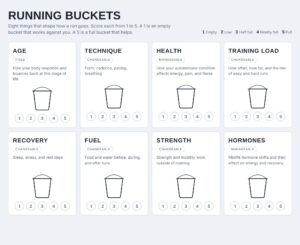
    So I broke it down into buckets to see what’s going on. Some of them I can fill. Some of them are what they are. Together, they provide a plan for 2027.

    Running Buckets scorecard with eight empty buckets for age, technique, health, training load, recovery, fuel, strength, and hormones, each scored from 1 to 5.

    Things I Can’t Change

    Part of the limiting factor is my age, which I never counted as a deficit until recently. I’m probably not going to improve in major ways, and maintaining what I’ve got will take more work. I’m okay with that, I guess, because I have no choice. Also, small gains around the edges still count.

    Then there’s technique and ability. I’m short, my gait is my gait, and I’m not naturally built to do anything other than nap with my cat Spicy. My anatomy is wonky. I have something called bilateral hip impingement with tears in my labrum. I’ve known this for nearly my whole adult life, and I choose to run long distances anyway. I have been to PT to learn the exercises and stretching required to keep this up, but there’s only so much you can do with the body you’re given. I’m really doing my best without medicalizing every ache and pain.

    Then there are my autoimmune challenges. I have both rheumatoid arthritis and Sjögren’s, and these two conditions make even the “good runs” mediocre. I can actually see the impact in my numbers. My HRV runs naturally low, and the research says I’m not imagining it. Studies of people with RA and people with Sjögren’s find lower HRV and a nervous system that spends less time in rest-and-digest mode.

    So my body spends more of its time on alert, even when I’m resting, and then I ask it to run a lot of miles. 

    Everybody has something. I’m not a #sickfluencer, and I look pretty good for someone whose body is trying to attack itself, so some of my friends and colleagues think I’m overstating how much RA and Sjögren’s affect me. I’m not, although I’m glad it’s not worse. Gratitude is part of my daily prayer-meditation practice.

    Thankfully, I don’t need the people around me to validate my conditions. Understanding how my body works, and being honest with myself about it, helps me train smarter instead of beating myself up.

    Buckets I Can Actually Fill

    I can make improvements on recovery, for sure. My Whoop (referral link) is always mad at me for not sleeping on a consistent schedule, even though I always get enough sleep because I go to bed at a decent hour. My mornings need a better routine, because sometimes I’m up at five and sometimes it’s eight. A steadier wake-up time is an easy win.

    I can make improvements to fuel, too, although I’m doing pretty well on that front. I’m not going overboard on protein or creatine, but I get both, plus enough water and electrolytes. But I also eat a lot of McDonald’s and ice cream.

    I’m adjusting my training load to build fast-twitch muscle, the fibers that give you speed and power. That means strides at the end of easy runs, short hill sprints, box jumps (okay, steps), and kettlebell swings. 

    And my hormones are what they are. I’ve been on HRT for more than eight years. I’m literally doing the best I can with advice and guidance from a real doctor, not someone who has a certificate on the internet. 

    See You in Scotland

    This year was hard, and I’m committed to fixing it in 2027. I have a fun half-marathon in Scotland on the calendar, and Ken is coming along to golf. I want that to be a nice trip for both of us, so I’m filling the buckets I can fill. 

    Skee-Lo wrote:

    I wish I was a little bit taller, I wish I was a baller

    I wish I had a girl who looked good, I would call her

    I wish I had a rabbit in a hat with a bat

    And a ’64 Impala
     

    Same, bro. Same.

    Mostly I want those miles to come with a little more ease, comfort, and maybe a dash of speed. I think I can get there.


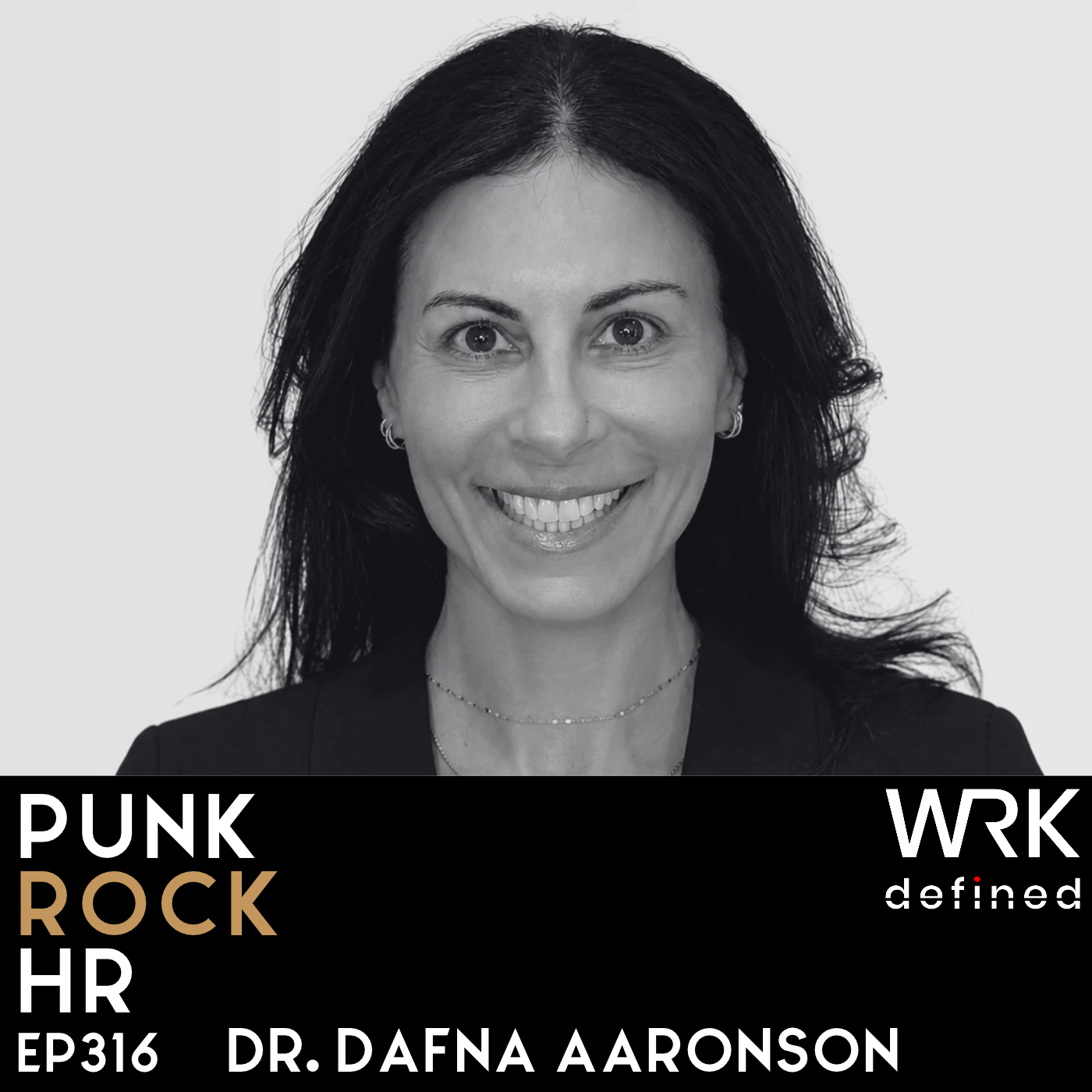
  • 316: Be Sports Minded About AI with Dr. Dafna Aaronson

    316: Be Sports Minded About AI with Dr. Dafna Aaronson

    Dr. Dafna Aaronson

    I keep hearing two stories about AI at work. One says it will help people do more than they ever thought they could. The other says it will box them in. I asked Dr. Dafna Aaronson, who has a PhD in AI and machine learning and a master’s in sports psychology, to help me figure out which one is true.

    AI works in probabilities, Dafna explains, so it estimates how likely something is without ever being sure. That’s useful for measuring performance, which is about execution and comes with real metrics. It gets shakier with potential, which is a projection. Outside the top 1%, she says, AI’s read on potential only looks objective. In sports, it works well as a filter, trimming a pool of 1,200 athletes by 30% so scouts know where to focus.

    Dafna describes coaches and general managers as mini data scientists who still make the call, because their experience lets them process a game almost like an algorithm. AI gives them a chance to check their gut before they commit. As a Chicago Bears fan, I recently watched a 38-year-old third-string quarterback come off the bench and win a game. AI might help a coach weigh that decision, but I doubt it would have bet on him.

    I’ve watched organizations use AI as a rip and replace for human judgment and the labor budget. HR tech has sold technology as the fix for human problems for decades, listening platforms included. We bought tools to hear employees, then surveyed them without doing much with what they said. Dafna’s advice starts before anyone signs a contract. Ask whether you actually want AI and can absorb it, then find out how the tool was trained. Otherwise you end up as first-to-market roadkill.

    I’ve been suspicious of sports metaphors at work ever since an early HR boss sat our all-women team down for a Lou Holtz video. Dafna agrees the analogy has limits, because companies run at a different scale and on a different schedule than any team. She’d rather you keep AI next to you instead of across from you, helping you see more without deciding for you. She even thinks it can help people, and companies, self-actualize. I’m not sure I need my employer to self-actualize, but if AI helps it live up to its mission and values, I’m on board.

    In this episode, you will hear:

    • How AI handles performance differently from potential
    • How AI can narrow a pool of 1,200 athletes before scouts step in
    • What to ask about how an AI tool was trained before you trust it
    • Why listening platforms often end up surveilling employees
    • Whether AI would have sent the Bears’ 38-year-old third-string quarterback into the game
    • The first question Dafna wants every organization to ask about AI
    • Where the sports analogy works at work and where it breaks down

    Watch on YouTube:

    Resources from this episode:

    Follow and Review:

    We’d love for you to follow us if you haven’t yet. Click that purple ‘+’ in the top right corner of your Apple Podcasts app. We’d love it even more if you could drop a review or 5-star rating over on Apple Podcasts. Simply select “Ratings and Reviews” and “Write a Review,” then add a quick line with your favorite part of the episode. It only takes a second, and it helps spread the word about the podcast.

  • Keynote Speeches 2027: Two Talks From Laurie Ruettimann

    If you’re planning a conference or leadership event for 2027, you’re probably trying to solve one of two problems. Your people are worn out and stuck, or your managers don’t know how to keep good people from leaving. I have a keynote for each.

    Laurie Ruettimann Keynote Speeches 2027

    “Ready for More” is the talk I took on the road in 2026. Stops included OC Tanner’s internal SKO, Perceptyx’s EX:ACT, a global EY meeting, Chicago SHRM Elevate, and more than two dozen leadership teams onsite. It’s about leading yourself (your energy, your attention, your learning, and your willingness to take smart risks).

    “Be the Manager People Won’t Leave” comes from my LinkedIn Learning course, which has reached more than two million learners. It’s about leading other people, because bad bosses are the most expensive mistake companies keep making.

    The two talks work together. Your team can’t see good leadership if you can’t be it. And you can’t be it if you’re running on empty. Below, I’ll cover what each keynote includes, who it’s for, and how to book one (or both).

    Ready for More: For People Who Are Tired of Being Tired

    “Ready for More” is a talk about leading yourself. Most people wait for their company to fix their careers, and they wait a long time. I spent more than two decades in HR, and I can tell you the cavalry isn’t coming. But the good news is that you have more control than you think.

    The talk covers four ideas. First up is self-leadership, or taking responsibility for your career instead of handing it to your boss or HR. Next is cognitive wellbeing, or how you protect your focus and energy when work keeps asking for more. Third is continuous learning. Boredom is one of the fastest routes to burnout, and learning something new is one of the fastest ways out. Finally, there’s the premortem, my favorite tool. You set a timer for two minutes, imagine your plan already failed, and write down every reason why. Then you fix those problems before they happen.

    “Ready for More” works for all-hands meetings, HR conferences, and employee events. It’s also a good fit for leadership teams who want their people to stop running on empty. I offer a longer workshop version, too, for groups who want to put the tools to work in the room.

    Be the Manager People Won’t Leave: For Bosses Who Want Fewer Exit Interviews

    “Be the Manager People Won’t Leave” is a talk about leading other people. Bad bosses are the most expensive mistake companies keep making. Most managers got promoted because they were good at their jobs, and then nobody taught them how to lead. People stayed anyway because they needed the paycheck and the benefits. But that deal is breaking down.

    In this talk, I show managers how to keep their best people. That means treating them with respect, telling them the truth, and having their backs. We also cover practical habits, like making time for your team to learn. Another is running a premortem where the manager reads their list of risks out loud first.

    I also talk about where work is headed. AI agents are taking on more work at big companies. Someday there may also be an income floor, like universal basic income, so people don’t have to work to survive. When that happens, the best managers will be the ones people would still work for if they didn’t need the job.

    This talk is for first-time supervisors, senior executives, and everyone in between, at companies of every size. It fits leadership offsites, manager training programs, and conferences. It’s also available as a half-day executive workshop.

    Which One Should You Book?

    If your people are burned out, bored, or stuck, start with “Ready for More.” If good people keep leaving and your managers don’t know why, book “Be the Manager People Won’t Leave.” Planning a leadership event and want both? I can pair them. That way, your managers learn to lead themselves first, and then they learn to lead their teams.

    I’m booking keynotes and workshops for 2027 now. Reach out through my contact page and tell me about your audience and the problem you’re trying to solve. Then I’ll help you figure out which talk fits.


  • Ten Things I Believe About Work and Life

    People ask me all the time what I actually believe about work. I’ve spent more than two decades in and around HR, written a book, coached a lot of people through layoffs and career messes, and changed my own career more times than I can count.

    So I sat down and wrote out my principles. There are ten of them. Some come straight from “Betting on You,” and the rest came from coaching people and fighting for universal basic income.

    If you’ve followed me for a while, none of this will surprise you, but I’ve never put it all in one place before.

    1. Your work is not your worth. A good career is the outcome of a good life. A job is more like a meal or a supplement than a limb or an organ. It should mostly sustain you, but it can also make you sick. I try to build an identity that’s bigger than my job, and I practice professional detachment by treating work like a puzzle to solve instead of an extension of who I am. Everybody good gets fired once, and it doesn’t change who you are.
    2. Fix yourself first. You fix work by fixing yourself. I believe in radical responsibility for your own life because nobody else can do that part for you. That’s why my coaching is built so clients own their decisions and eventually stop needing me.
    3. Pay yourself first. Financial security is the base of professional freedom. Money wins, and companies pay you the least they think you’ll accept. Take care of your own interests before you give extra effort to an employer.
    4. Be a (strategic) slacker. I protect my time and energy. Working too hard without a plan is a trap, and working less is often how you perform better.
    5. Plan for failure before it happens. I run a premortem on big decisions. If you can see the failure now, you can beat it while you still have options.
    6. Want more, and be ready to earn it. Wanting more is not indulgent, so I state my ambition plainly and I don’t apologize for it. If people underestimate you, you have to be twice as good. It isn’t fair, but it’s true.
    7. Don’t trade your values for a paycheck. I’ve turned down paid work because I need to be able to sleep at night, even when it costs me money.
    8. Every day is a do-over. If you end up back at square one, you start again.
    9. See work as it really is. HR sits where work, power, politics, and money meet. I try to deal with systems as they actually are instead of how I wish they were.
    10. Economic freedom is a human right. This is the reason I push for universal basic income.

    That’s my list.

    I believe my work isn’t my worth, that I have to take care of myself and my money before I take care of an employer, and that planning for failure and wanting more can live side by side. I believe in seeing work clearly, keeping my values even when it’s expensive, and starting over when I have to. And I believe everyone deserves economic freedom. Now I’d like you to try this yourself.

    Grab a notebook and write down what you believe about work and life, what you’ll never do again, and what you want for the next part of your life, without editing yourself or worrying about typos. Then cut it down to ten. The next time someone asks you what you stand for, you’ll have an answer, and you’ll have something to check your decisions against when work gets hard.

  • Rage Against Tom Morello

    I’ve loved Rage Against the Machine for a long time. I was a punk rock kid before I went corporate, and Rage was my soundtrack. They have thousands of my dollars. But Tom Morello is officially off my list.

    Morello told Rolling Stone he “certainly did not” vote for Kamala Harris in 2024. He said he couldn’t vote for a candidate “responsible for what happened in Gaza.” He’s worked inside the system his whole career, so it’s strange to see him opt out the one time it would have cost him something.

    Testify, but only sometimes

    Morello has gone after Democratic politicians before, and I’m okay with it. He called out Obama over Guantanamo and drones.

    But he knows how to play the game. In 2012, Morello campaigned against Mitt Romney and Paul Ryan. He knows how to hold his nose when the candidate is a man. In 2024, with a woman running against Donald Trump, he couldn’t do it because of Palestine.

    Last I checked, under Trump, shit is still pretty bad in Gaza. Oh, and the conflict has expanded.

    On February 28, in the first hours of the US-Israeli war on Iran, a missile hit a girls’ school in Minab and killed more than 170 people, most of them young girls. Trump blamed Iran. The New York Times reported it was likely a US Tomahawk and a targeting mistake.

    If your politics is about protecting innocent civilians from war, how do you sit out the election where the choice was bad or worse? Who did that protect?

    Morello lives in California, so his vote probably didn’t change anything, but his voice reaches the guy in Michigan or Pennsylvania who was already looking for a reason to stay home. When one of the most famous leftist musicians in America says he couldn’t vote for Harris, that guy hears permission.

    Know your enemy

    I’ve spent my whole life watching men call themselves allies. If standing with a woman costs them anything, even a twinge of ego or a little of their image, they find a so-called principled reason to sit it out.

    If you’re gonna brag about your principles, you’ve got to be consistent. That’s why I’ve always admired Zack de la Rocha more. He walked away from the biggest band in the world in 2000 and said the way the band made decisions had undermined its political ideals. He skipped the Rock Hall in 2023 and marched for Palestine the next day.

    I’m Jewish, and I admire his chutzpah.

    Tom Morello seems rage-adjacent. He speaks up, but he also likes money. He says he fights for women and reminds you of his late mother, a civil rights activist, but doesn’t quite grasp the through-line of her life’s work.

    Raging against the machine means fighting the one person who can wipe out humanity, even when you have to hold your nose. He’s campaigned against the greater evil before, but those choices usually involve two men.

    Being punk rock means voting for the woman and holding her accountable, the way he held Obama accountable by criticizing him out loud.

    What do you think? I’d love for you, or Tom, to tell me I’m wrong.

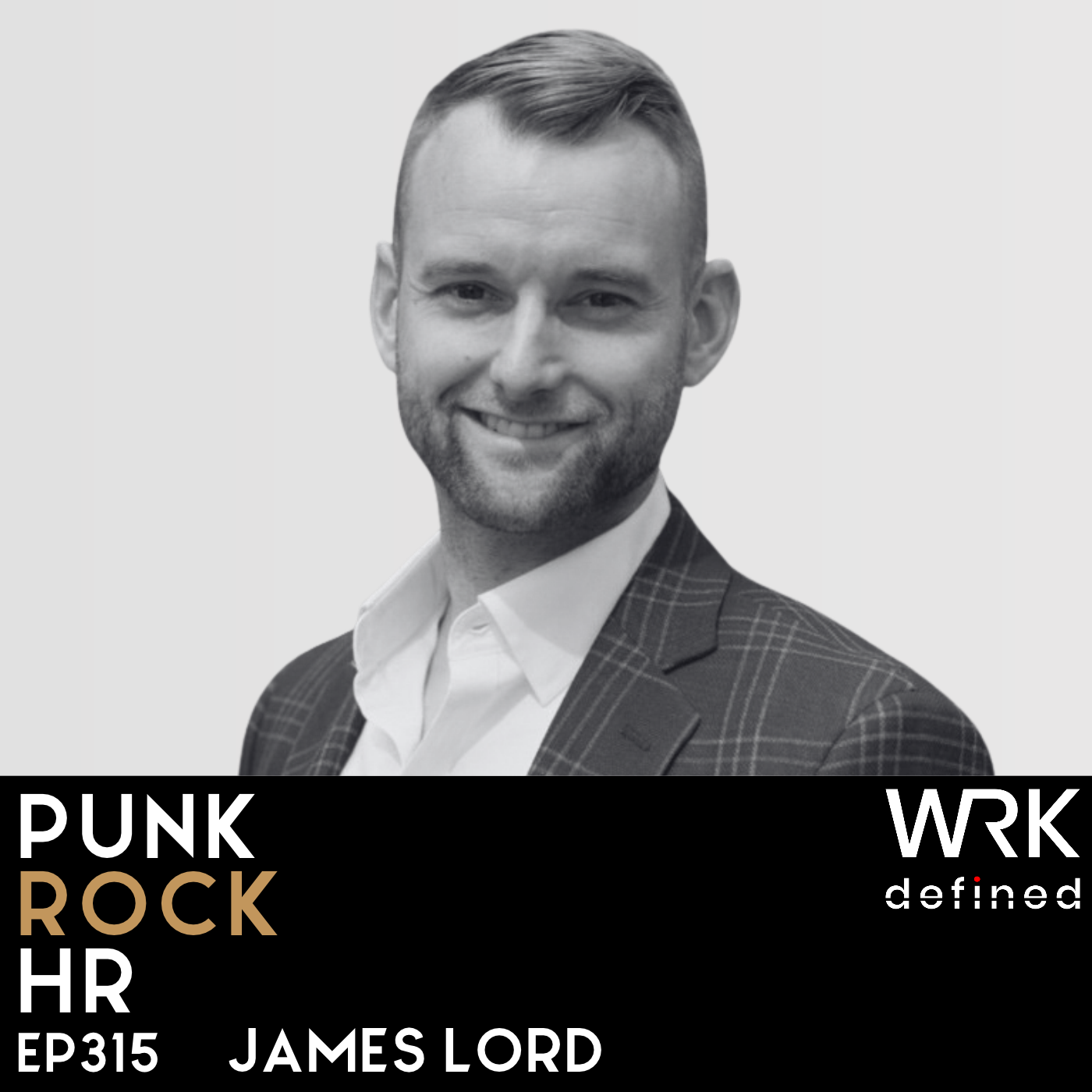
  • 315: Reference Checking with James Lord

    315: Reference Checking with James Lord

    Early in my recruiting career, checking references was my job.

    James Lord

    A candidate would give me an old colleague who liked them. I’d call to ask if they enjoyed working with so-and-so, and we’d have a really dull, rote conversation. It’s how I learned to understand recruiting and hiring, and it’s also when I started to see that those references may not be worth the paper they’re written on.

    James Lord wants to fix that. He has spent nearly 20 years in HR technology, and in 2025 he joined Refapp, a Swedish reference platform that lives inside the applicant tracking system. His argument starts with a distinction people blur all the time. A background check tells you whether someone was convicted of a crime. A reference, he says, tells you about character and observed behavior, the stuff you only learn by working next to someone.

    According to James, structure is what makes references useful. Employers should have a say in who gives the reference and should ask evidence-based questions built around what high performers in a role have in common. References know the candidate won’t see their answers, and they can respond from their phone without writing an essay. When a former colleague’s company has a no-references policy, James suggests reaching them through a personal Gmail or LinkedIn instead, because people who worked together are usually willing to help each other out.

    James points out that resumes are polished, often by AI, and most people are still only in the office two or three days a week. He’s especially focused on counterproductive work behaviors like bullying, which a candidate is unlikely to admit in an interview. If you’re hiring someone with keys to the building or time alone with an older patient, he says a clean criminal record doesn’t tell you enough.

    James borrows an old line for all of this: “People only do what is inspected, not what is expected of them.” It’s cynical, and I like it, even if I want to believe humans are a little better than that. A good reference check gives you a clear look at who you’re hiring before the offer letter goes out.

    In this episode, you will hear:

    • How reference checking differs from background checking, and why people mix them up
    • Why letting candidates pick any reference they want gets you nothing useful
    • The 180% ROI James calculates for structured reference checks
    • How to get references from people whose companies forbid giving them
    • Why interviews miss counterproductive work behaviors like bullying
    • How one reference turned into a brand-new candidate
    • James’s upcoming DisruptHR talk, “The Reference Check Is a Lie”

    Watch the video:

    Resources from this episode:

    Follow and Review:

    We’d love for you to follow us if you haven’t yet. Click that purple ‘+’ in the top right corner of your Apple Podcasts app. We’d love it even more if you could drop a review or 5-star rating over on Apple Podcasts. Simply select “Ratings and Reviews” and “Write a Review,” then add a quick line with your favorite part of the episode. It only takes a second, and it helps spread the word about the podcast.

  • AI Agents, Taxes, HR, and UBI: The Full Series

    I’ve had a lot on my mind because people keep telling me that AI agents are taking over. And I’m like, sure, but what’s next?

    When an agent takes a job, the taxes on that paycheck disappear too. Over the last four posts, I followed that money. The paycheck has a second job, which is funding the public, and when agents do the work, we have to decide what replaces it. This is the whole series, in order.

    Part One: The Paycheck Was the Tax System

    Government runs on your paycheck. I used North Carolina as a case study. Just under half of the state’s General Fund comes from personal income tax, and most of that is withholding. An agent doesn’t get a W-2, so when a company swaps a person for an agent, the state loses that money. The state’s own forecasters have flagged AI as a risk, and North Carolina keeps cutting its tax rate while agents shrink the base. Washington can borrow through a bad decade. States can’t. Read Part One.

    Part Two: The Token Tax

    A lot of smart people want to tax tokens, the unit AI companies use to bill their work. The problem is that tokens measure how much a computer runs. They can’t tell you who lost a job or what that loss costs a community. Two agents haggling over a hotel block both pay, while a company that laid off forty people barely shows up on the bill. Someone has to make the call about whether an agent replaced a person or helped one, and that call has usually belonged to HR. Read Part Two.

    Part Three: Where HR Goes

    As agents take over more work, HR shrinks inside companies. A small team stays to own the hard calls about agents, and the rest of us should follow the people, into public service. Workforce boards, labor departments, school boards, and city councils are about to make huge decisions about work, and many of the people making them have never run a layoff. It’s a pay cut, and it’s worth it. And maybe one day the cut will be offset by UBI. Read Part Three.

    Part Four: Universal Basic Income

    We need a floor before we can have a conversation about the future of work responsibly, and Universal Basic Income (UBI) could be that floor. It’s a regular payment to every adult, with no strings attached, and you still work for everything above it. With a floor in place, people can do work because it matters, like caregiving, teaching, public service, and the hard problems nobody has solved yet. Read Part Four.

    One More Thing About UBI

    Will UBI drive up costs if everybody has money? It might. My high school civics teacher told me that inflation is what happens when rich people feel like their money is worth less, and we saw that during COVID, or at least that’s how it felt. If everybody has money and wants a new flat-screen TV, why wouldn’t we raise prices? That’s just the American capitalist thing to do. Rich get richer. Poor get a new LG flat-screen that spies on them.

    The same thing can be said for healthcare. If everyone gets it and demand is high, wouldn’t that just make dentists and eye doctors charge more for the privilege of being seen by a human? If everyone gets housing, doesn’t that drive up demand and hit up against inventory?

    We’ll have to sort all of it out. None of it’s in a vacuum, and that’s why we need smart people like you to cleave yourself from that shitty paycheck and start working on solving real problems.

    That’s the promise of agents doing the busy work, and that’s the promise realized if we can couple those agents with something like UBI.

    I’ve said for years that HR sits at the intersection of work, power, politics, and money. Agents are changing all four. The people who understand how work works should help decide what comes next. That’s my dream for you, and it’s my dream for myself.

    Sign the Pledge

    If this series made you uneasy, good. Do something with it. Read and sign the AI Pledge for Humanity.