Tag: HR

  • Holistic Performance Management With Doug Dennerline and Jamie Aitken

    Holistic Performance Management With Doug Dennerline and Jamie Aitken

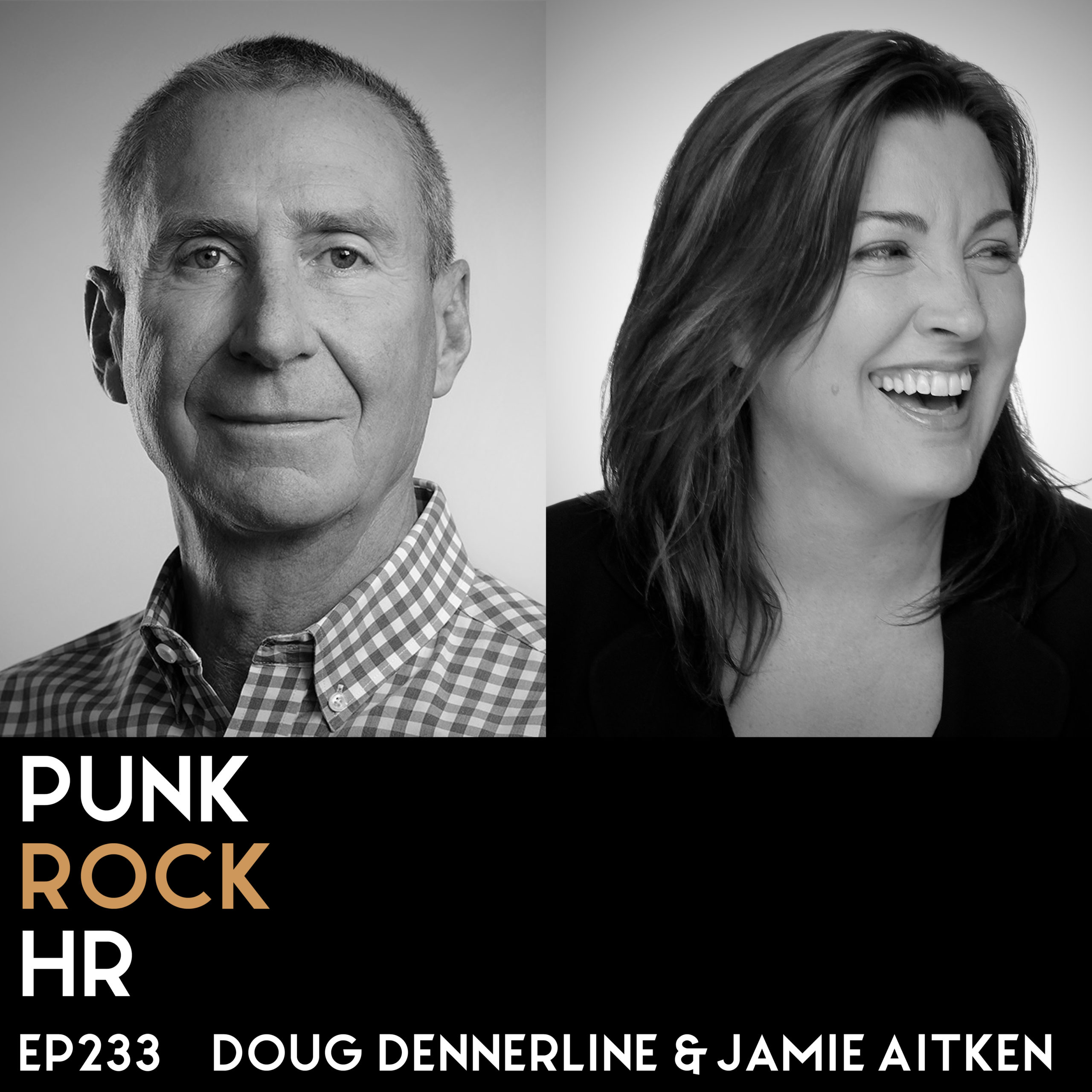
    My guests on this episode of Punk Rock HR are Betterworks CEO Doug Dennerline and Vice President of HR Transformation Jamie Aitken. Betterworks is an organization that’s near and dear to my heart and is focused on rethinking performance management.  In this conversation, we talk about the future of HR and work, why annual reviews don’t work and how to think about holistic performance management.

    Doug has a long history in software, including being president of SuccessFactors (now SAP SuccessFactors) and an executive at Cisco. He’s seen the inner workings of what HR technology looks like. “My goal in life is to really reimagine performance management in a way that actually is a benefit to an organization versus what people do with it today,” Doug shares.

    Jamie has been in HR for 25 years and has always “been drawn to puzzles to solve.” Betterworks is leading the transformation movement in an era where HR leaders get to be a part of the change. “We have a perfect storm as HR leaders to really innovate and have a significant impact on business outcomes, more so than I’ve seen in the 25 years I’ve been doing this,” Jamie says.

    Doug and Jamie aren’t just co-workers; they’re also co-authors on an upcoming book that combines their perspectives of HR leader and CEO. This book is called “Make Work Better” and is scheduled for release in May 2023.

    “The goal here is we take you through a journey and basically say, ‘Here’s when this process was invented, here, why it was invented, here’s why it doesn’t work, and here’s the research that says it doesn’t work,’” Doug says. “‘Here’s what the ideal process we think should look like, and here’s how we can help you get there.’”

    Punk Rock HR is proudly underwritten by The Starr Conspiracy. The Starr Conspiracy is a B2B marketing agency for innovative brands creating the future of workplace solutions. For more information, head over to thestarrconspiracy.com.

    The Future of HR

    HR is significantly different than it was just a few years ago. The HR industry needs people who want to innovate, who want to lead and work at the intersection of purpose and meaning.

    These HR leaders need to be actual leaders in the company, and the head of HR should report to the CEO. “If I’m being told that I am somewhere down reporting into a different function, then that tells a story for me, and it will inform whether I decide to go there or not,” Jamie says.

    The HR function has a lot of responsibilities, including hiring and compliance, but the modern HR leader is deeply involved in the overall business.

    “My favorite HR people are men and women who are strong enough and are mobilizers, and they’re curious about the business,” Doug says. “It’s not just HR stuff; it’s ‘What is the business we’re in?’ ‘What do we need to do to succeed?’ ‘What are the skills of the people we need to have?’ And then they hold that mirror up to the CEO and say, ‘You know what? These two people on your team aren’t going to get you there, and you need to do something about it.’”

    Performance Management That’s Holistic

    Performance management has evolved beyond a grading system where you tell people what they do wrong or right. Instead, performance management is about providing guidance, recognition and a meaningful career map that connects employees’ work to the company’s growth.

    This modern approach to performance management requires frequent conversations; the annual or semiannual review won’t cut it.

    “When you’re able to connect the points between recognition, feedback, conversations and goals, all of those things together form a body of work,” Jamie says. “If I’m an individual and I’m in a traditional performance management conversation once or twice a year … my boss is going to be looking at maybe three months if they can remember, five months if they’ve taken notes all the time. There’s a huge recency issue there.”

    Recognition is an essential part of the employee experience. Betterworks’ mission is about making performance management more human, where the manager’s mindset is, “I’m your champion in this company and I’m going to make you successful,” Doug says.

    Empathy For the End User

    Department of Labor data reveals that productivity has declined in 2022 by the largest amount since the government began tracking it in 1948. I think that a big component of this drop is burnout. I believe that empathy can be the antidote to burnout, and so does Betterworks.

    “I don’t believe in work-life balance. I call it work-life integration,” says Doug. “And candidly, you’re integrating work into your life, especially today. It’s about accomplishment to me. If you’re doing your job, I don’t care when you do your job, I don’t care how you do your job, as long as you’re being respectful and all those things, then that’s the kind of people I want in my company.”

    Doug recommends giving people time and room to recharge. This can look like spacing out meetings or offering a wellness day, as Betterworks does on the second Friday of every month.

    Empathy can help leaders understand the employee experience and even design for it.  “A lot of customers I’m working with now are saying, ‘Let’s look at what that employee experience feels like now. Let’s identify the pain points. Let’s see where we can make those moments that matter,’” Jamie says.

    [bctt tweet=”‘We have a perfect storm as HR leaders to really innovate and have a significant impact on business outcomes, more so than I’ve seen in the 25 years I’ve been doing this.’ ~ @JamieAitkenHR, @Betterworks. Tune into #PunkRockHR!” via=”no”]

    People in This Episode

    Doug Dennerline: LinkedIn, Twitter

    Jamie Aitken: LinkedIn, Twitter

    Full Transcript

    Laurie Ruettimann:

    This episode of Punk Rock HR is sponsored by the Starr Conspiracy. The Starr Conspiracy is the B2B marketing agency for innovative brands creating the future of workplace solutions. For more information, head on over to thestarrconspiracy.com.

    Hey everybody, I’m Laurie Ruettimann. Welcome back to Punk Rock HR. My guests today are Doug Dennerline and Jamie Aitken from Betterworks. Betterworks is an organization that’s near and dear to my heart, that is focused on really rethinking performance management. And in today’s conversation we talk about the future of human resources, the future of work and, really, how to rethink performance management in a more holistic way.

    So if you’re like me and you used to get an annual review or do an annual review once or twice a year, well, those days are ⁠— or at least should be ⁠— over. And Jamie and Doug are here today to talk about what the future is like, how it could be more inclusive, more encouraging and really help us think about careers as more than just a moment in time. So if you’re ready to talk about performance management and get super-nerdy about the world of work, well, sit back and enjoy Doug Dennerline and Jamie Aitken on this week’s Punk Rock HR.

    Hey, Betterworks team, welcome to the podcast.

    Jamie Aitken:

    Thank you.

    Doug Dennerline:

    Thank you.

    Jamie Aitken:

    Nice to be here.

    Laurie Ruettimann:

    Yeah, it’s great to have you. We’ll get started by having you identify who you are so that my wonderful community can understand whose voice belongs to who. So, Jamie, why don’t you get started? Who are you and what are you all about?

    Jamie Aitken:

    Hi, Laurie. Jamie Aitken. I’m the VP of HR transformation at Betterworks. I have been in the HR space for 25 years. I’m a sucker for transformation. So throughout my entire career, I’ve been drawn to puzzles to solve. And so why I’m so excited about the work that we’re doing here at Betterworks is because we’re constantly talking about transformation. And if you think about what’s happening in the world today, not only in terms of the world of work, but just in general, we have a perfect storm as HR leaders to really innovate and have significant impact on business outcomes, more so than I’ve seen in the 25 years I’ve been doing this. So, happy to be here and excited to talk about this.

    Laurie Ruettimann:

    Well, I’m so pleased to have you, and I want “sucker for innovation” on your LinkedIn profile if it’s not up there already. Well, Doug, it’s so nice to have you on the podcast. Why don’t you tell everybody who you are and what you’re all about?

    Doug Dennerline:

    I will do that. My name’s Doug Dennerline. I’m the CEO here at Betterworks. I’m actually the ex-president of SuccessFactors, so I have been around the HR software industry for quite a while. I also am an ex-executive at Cisco Systems, where I had 6,000 employees. So I was on the other side of all those processes we lived in inside of HR with a big team. And so, my goal in life is to really reimagine performance management in a way that actually is a benefit to an organization, versus what people do with it today.

    Laurie Ruettimann:

    We’re at a really strange inflection point in the economy right now, and I wonder if I can get both of your takes ⁠— starting with you, Jamie ⁠— on where things stand for the modern HR department. Where are they today, kind of post-COVID and maybe pre-recession?

    Jamie Aitken:

    Well, yeah, I talk to HR people every single day. That’s probably the best part of my job. And frankly, I think everybody’s a little bit burnt out. There’s been a lot going on, and certainly COVID brought a lot of that also to the shore. But even before, we were dealing with demand for higher engagement with our employees, and what does that look like as it relates to performance? This is a process that people have been complaining about.

    HR’s been hearing complaints for a long time, but even secretly amongst ourselves, we’ve been moaning every time we had to push this process out to an organization that was frankly telling us all the time that it was not really providing the value. So we were sort of unwelcome. It was not one of the more pleasurable parts. But also, if you think about how “quiet quitting” is emerging now as something that people are talking about, this is really a unique time for us to address a lot of things that haven’t perhaps been going well previous to COVID, but that COVID really brought it to a head. Which is why, as I said, this is a puzzle that HR people can really be part of solving.

    Laurie Ruettimann:

    Well, I love that answer. And, Doug, I’d like to just go a little bit further with that because we’ve gone through this period of time of rapid change and an opportunity for rapid innovation. And so many HR professionals are really there. They’re at the executive level having those conversations, and yet so many processes haven’t kept up. And one of them is the annual performance review. That still happens, and maybe a company’s innovated and done it twice a year. But why, Doug, are we still doing that annual performance review when all the research says that is not the way to do it? What are your thoughts on that?

    Doug Dennerline:

    I think we have all been living in this incredible environment from a productivity perspective for the last 15, 16, 17 years. We have not seen a recession or even a downturn in the economy. Things are growing, the company’s growing, we’re doing well. Why change? 75% of companies still do an annual review. I’ve not been an HR person that says, “Oh, the performance review process is awesome in my company.” Everybody knows that it’s bad. To me, with coming out of COVID, and the difficulty HR people have had in the last couple of years, are starting to realize, with this work-from-home environment, that process isn’t going to hold up in this environment.

    And Jamie and I are in the middle of writing a book about it, actually. It’s this notion of we really need to change the process. If you want to find good people and retain good people, being talked to once or twice a year about how you’re performing in the rearview mirror isn’t going to cut it. And so I’m a fan of Geoffrey Moore as a researcher and a consultant, and he talks about “crossing the chasm.” We see great companies that are using Betterworks today that are the early adopters. They realize that they need to change these processes. And we’ve seen the effects of that in these great companies, but it hasn’t reached Main Street yet.

    And I think somehow, because the world of work has changed, and we’re going to be managing people like this forever, I think, at least in a hybrid environment, that it’s time to change.

    Jamie Aitken:

    I think HR has got puzzles to solve, but we also have to be courageous and jump in, right? Because change is difficult. And if there’s an entrenched process of, “well, this is the way we’ve always done it,” the curious and the innovative HR people are the ones that are going to say, “OK, let’s do this.” This is the time. We’re not going to wait.” This is the time for us to actually answer the call, which is to fix what’s wrong, but also to make sure that people are ⁠— there’s a longing for people to feel connected to the goals of an organization and to see how they contribute to what the organization is trying to achieve.

    And so, you can’t do that if you’re talking once or twice a year about what you’re working on and how it makes a difference. You also can’t feel like you have a way to help form and shape your career if you’re not having more than one or two conversations a year about what your aspirations are, for example.

    Doug Dennerline:

    There’s another side to it, to me, Laurie, though. It’s not all about HR people. If I were an HR leader today, you have to find a leader in the organization that realizes that the most important asset they have is people. And I think it’s finding an informed CEO who knows how powerful a good HR partner can be to them and then empowering them to come in and change the processes. And be supportive of that, and be a champion for them to make it through this change process. And it takes time. I will tell you, our best customers, when they go from annual or biannual to quarterly and check-ins in the mid-quarter, it takes a year before people realize the cadence and the benefit of the cadence. But it’s really great once they make it through that process.

    Laurie Ruettimann:

    Well, I love some of the words that you’re using to describe a future state, not only of human resources, but of the world of work. But I’m real curious about the future of HR because some of the words you’ve used to describe a future state, you need people who are champions, who are allies, who are partners, who are collaborators and courageous and curious and innovative.

    I wonder if I’m missing anything, Jamie. What is that future HR leader like, the one who’s going to bring us to the promised land of helping people work at that intersection of purpose and meaning?

    Jamie Aitken:

    Well, I think all of those things ⁠— and Doug and I were talking about this a little while ago. One of the questions that HR people should be asking when they’re in an interview process is, “Where am I going to report into?” Because I think, linking to what Doug was saying, it’s really important that there’s a recognition within the company, and particularly with the CEO, that HR is a significant contributor to the progress of an organization. If I’m being told that I am somewhere down reporting into a different function, then that tells a story for me, and it will inform whether I decide to go there or not.

    Doug Dennerline:

    I tell my sales team, if the head of HR reports to the CFO, don’t bother calling on the company. Because to me, that’s a message where the CEO says, “Oh no, that HR stuff, I don’t want to have to deal with that. So I’m going to drop that in under my CFO and let them deal with all that stuff.” That’s just not the way to go.

    Laurie Ruettimann:

    I think that’s right. My very first human resources job, I was an intern in 1995, so I just reported to the HR manager. But HR reported to a site leader who reported to someone who reported to a VP of facilities who reported into the finance group. It was absolutely insane. And I think you’re right. There’s something about where the rubber meets the road. You really need human resources to be in that leadership role. Are you seeing that as a trend?

    Doug Dennerline:

    My favorite HR people are men and women who are strong enough, and are mobilizers, and they’re curious about the business. It’s not just HR stuff. It’s what is the business we’re in? What do we need to do to succeed? What are the skills of the people we need to have? And then they hold that mirror up to the CEO and say, “You know what? These two people on your team aren’t going to get you there, and you need to do something about it.”

    I know HR people talk about getting a seat at the table. That’s how you get a seat at the table. You have an opinion, be involved and help drive the organization to where it needs to go. You have people in the organization that can deal with compliance issues and lawsuits, but at the leadership of HR, they need to be business people.

    Jamie Aitken:

    And challengers, so that they are curious, but they’re also confident enough that they can have the conversation challenging status quo. So the scope changes completely. If you go back to this idea that if you’re reporting into somebody other than the CEO, you can already predetermine what your scope is going to be. And it’s very much going to be focused more on the backend processes and systems of compliance and administration, as opposed to a scope that allows you the kind of innovation that we’re talking about.

    Laurie Ruettimann:

    As you were talking about this future state of the world of work and of human resources, I was thinking about how, for years, we were focused on performance management best practices, and we were focused on what modules, and what are the things we should talk about. And I just wonder, what is the future of performance management? Because sometimes best practices are just the worst crowdsourced practices. But I don’t know. You’re both experts. You tell me. Jamie, why don’t you get started? What is that future state?

    Jamie Aitken:

    Well, actually, I’m going to pull back a little bit first because I think what HR people, ripping off what Doug just was talking about in terms of business acumen ⁠— and I’ll tell a little story. I was head of global talent management for a large organization, and in the first 30 days that I took the role, I went around and talked to a bunch of the business leaders. And I was saying, “OK, tell me what’s broke in HR. Tell me what’s broken and what we need to fix.”

    Laurie Ruettimann:

    Did you hear an earful?

    Jamie Aitken:

    I certainly did, and as many people I asked, I got as many different opinions, but they were all very focused on what HR problems there were. “Oh, fix the talent acquisition,” whatever the case. Pick an HR process, I was getting feedback on it. And somebody changed it. I had the “aha moment” and said, “Wait a minute, I’m asking the wrong question.” So I went back to all of them and said, “What is the business problem that you’re having that I can help you solve?” And I think by framing it that way, we get a completely different view and perspective on what we should be doing in HR. And it also allows us to articulate why what we do in HR is going to move the needle for the business.

    HR people can get very excited about best practices in a process. And yes, that’s true. I think it depends on the culture. I think it depends on what you’re trying to accomplish from a business perspective. So chasing after best practice isn’t necessarily going to get you the business results that you need. You can get wrapped up into that whole game and spend all of your time reading HR articles about what to do next. But I say my challenge would be step back first, and tell me what the problems that you’re trying to solve for the business are, and then we’ll design the process that needs ⁠— I’m Canadian. I say “process” sometimes.

    Laurie Ruettimann:

    Yeah, I love it. Doug, I was just thinking that so often when an HR professional really believes in the future of work and they go out to the marketplace and they want to buy a new performance management software, they’re locked, though, into buying a software based on, quote unquote, best practices. That platform isn’t agile enough to actually understand what business problems are and to help the workforce translate what they’re doing into solving those problems. I don’t know. You’ve seen it all. You’re ex-SuccessFactors, ex-Cisco, you must resonate with that. And I just wonder how Betterworks sees this differently.

    Doug Dennerline:

    My goal really is to move process away from HR, who now pushes it on the organization ⁠— and they’re the police around it, and please get it done ⁠— and move it to where it actually is seen as a value to the individual. It can’t just be a tax, it’s got to be a value. And the value is we’re now going to create conversations between manager and individual contributor on an ongoing basis throughout the year. What are my goals this quarter? What are my goals for the company so I feel connected to the organization? What are my personal aspirations that I want to grow inside the organization? And how is my manager going to help me get there?

    And create a conversation that probably isn’t happening on a regular basis. So now the employee’s going, “Hey, this is great. I’m actually sitting down in a tool. We both answer some questions about how things went this quarter, and then we get together, have a conversation about “What are my goals next quarter?” So you see the performance of that person on an ongoing basis, not, “Hey, let me think back. What’d they do last year for me?” And so now it’s seen as a value by the employee, so they actually want to participate in it. And that’s the change that you have to get through.

    Laurie Ruettimann:

    Yeah, I like that. One of the trends, and there are the trends in human resources, but one of the ones I find most valuable is this renewed focus on recognition. And so when you combine the concept of recognition with performance management, what you actually get is more informed career mapping, career mobility. But I think this component of recognition is so important, and I’m just surprised that it took businesses so long to understand that it’s not just about telling people what they’ve done wrong, but saying “thank you,” and letting them know how they’ve contributed to the growth of the organization.

    Jamie, you must see this trend that we’ve been going through over the past couple of years and welcome it with all of your years in HR.

    Jamie Aitken:

    Absolutely. And what I love about it as well is when you’re able to connect the points between recognition, feedback, conversations, goals ⁠— all of those things together form a body of work. If I’m an individual, and I’m in a traditional performance management conversation once or twice a year, I’m going to be limited very much, and my boss is going to be looking at maybe three months if they can remember, five months if they’ve taken notes all the time. There’s a huge recency issue there.

    Whereas, if I as the manager, before I go into a conversation with my direct report, can see all the feedback they’ve gotten, the recognition from peers, from people that they’ve worked on, on other projects, and I can also draw from the conversations that I’ve been having on a continuous basis? Suddenly that becomes a lot richer and robust in terms of me being able to have that conversation with the employee at the end of the year. It’s much richer and much broader.

    Laurie Ruettimann:

    I love that. What you’re talking about is a more holistic take of the employee experience. And, Doug, one of the things I was thinking about as Jamie was talking is really about how it’s much more than just recognition that’s a trend. It is employee experience. This is something that we’re talking about, and I don’t see it coming to an end. Do you, anytime soon?

    Doug Dennerline:

    No. I think it’s an important topic that we’re talking about. And again, we try to innovate, as well. How many applications are you in every day now? It can be overwhelming to an individual. And so, we spend a lot of time trying to integrate to the applications you live in at work, whether it’s Salesforce as a salesperson, or Jira as an engineer or email if you are a white-collar worker in some industry.

    Laurie Ruettimann:

    Yeah, if you’re human.

    Doug Dennerline:

    Exactly. So you can interact with our software from within those places that you live all day long anyways. And so I think that also makes it easier. And I think as a manager these days, the command to control of the past is not going to work in today’s environment and with today’s workforce. It’s very much an empathetic leader. Their whole goal is to help you be successful, not to review your performance. It’s like, “I’m your champion in this company, and I’m going to make you successful.”

    Laurie Ruettimann:

    One of the things I was thinking about is how empathy can be the antidote to burnout, something that came up early in our conversation. And I just wonder when you’re out there talking to your customers, Jamie, Doug ⁠— either one of you, both of you can talk about this ⁠— how often burnout is still coming up. Recently we’ve had a report about the first major drop-off in productivity in U.S. history. And so I think about why are people less productive these days? The big component for me, the big red flag is burnout. I don’t know. What are your thoughts on this?

    Doug Dennerline:

    I think it’s an important thing to be thinking about. We certainly have thought about it at our company. We put things in play, like we now take the second Friday of every month off, and so people can catch up with life and do things that they need to do with family. We recommend to people, only do 30-minute Zoom meetings, only do two Zoom meetings back to back, and then leave 30 minutes without doing a Zoom meeting. So don’t Zoom all day long.

    I have an attitude, and I’ve had it my whole life, where I don’t believe in work-life balance, and I call it work-life integration. And candidly, you’re integrating work into your life, especially today. It’s about accomplishment to me. If you’re doing your job, I don’t care when you do your job, I don’t care how you do your job, and long as you’re being respectful and all those things, then that’s the kind of people I want in my company.

    These companies now that are taking your picture throughout the day with software or looking at your keystrokes, who would want to work for such a company? Such a lack of trust.

    Laurie Ruettimann:

    Right, absolutely. Well, Jamie, what are your thoughts on this, on burnout and really what’s happening in our organizations today?

    Jamie Aitken:

    Well, I was actually going to take it a slightly different way, which I think it would be a good challenge also, to HR people, as they’re designing around and for that employee experience. So a different bend on empathy, which is, a lot of customers that I’m talking to as they’re looking to design what that future state is going to be ⁠— so back to your best practices. I like to use design thinking, which at its heart is about empathy for the end user. So a lot of customers I’m working with now are saying, “Let’s look at what that employee experience feels like now. Let’s identify the pain points. Let’s see where we can make those moments that matter.” And some of those moments that matter, by the way, are being able to acknowledge gracefully and respectfully when an employee or anybody in the organization is feeling that kind of burnout.

    But the idea for HR people, and certainly I was guilty of this early in my career, a bunch of HR people would get into a room, we’d close the door, we’d design the beautiful process that we would create, and then we’d foist it out with crossed fingers, hoping everybody would wildly adopt it. So this empathy also comes into play when you’re designing what that future state is going to be like and what that experience is going to be like. So the conversations I’m having with HR people now are how can we actually introduce empathy into the actual design, what programs we pull together for our employees?

    Doug Dennerline:

    Laurie, I would add one thing. It’s really interesting to me to be in the business of building software for HR people because a lot of times, they basically want to build their process and application now, but nobody ever thinks about simplicity. Our whole role when we talk to people is, let’s redefine your process and make it as simple as possible, so it gets such better adoption, where people go, “Well, that’s not how we do it here.” They get wedded to their process, and they think their process is great, and the only person that thinks it’s great may be them. The rest of the organization hates it.

    And so I really urge people ⁠— and I have a great example of this at SuccessFactors .but we spent six months building their old process into our application, and then they came to the United ⁠— It was a French company ⁠— they came to the U.S., they visited Walmart, who we had just sold our product to, and they had a two-page process for performance management. And the other one was 22 pages, believe it or not, French company. And they go, “Why did you let us build this incredibly bad process when we could have done that?” And I’m like, “We tried to tell you, but you wouldn’t listen.”

    Laurie Ruettimann:

    Unbelievable, and I’m not surprised to hear that. And also, we can just laugh about complicated French processes as HR people all day long. Well, as an author, I’m always excited to meet and talk to fellow authors myself, and you two are both working on a book. So, Jamie, tell us a little bit about the book that you’re working on.

    Jamie Aitken:

    It’s a book that we decided to write. Doug and I have known each other for a very long time, and one of the questions that we asked was, “Why isn’t there an HR person and a CEO co-authoring a book?” Both of those perspectives we feel very strongly should be amplified together when it works well. So we decided, we looked around, there wasn’t one out there. We thought, “You know what? Let’s do it, then. Let’s write the book that we believe in.”

    And, Doug, I’m sure you want to pitch in here. We talk in stereo sometimes, Doug and I. But really, it’s about this notion of reimagining how we can make this better and how we can make work better.

    Laurie Ruettimann:

    Doug, why don’t you remind us all of the title and tell us what you really want people to walk away with when they read the book?

    Doug Dennerline:

    It’s called “Make Work Better.” The goal here is we take you through a journey and basically say, “Here’s when this process was invented, here, why it was invented, here’s why it doesn’t work, and here’s the research that says it doesn’t work. Here’s what the ideal process we think should look like, and here’s how we can help you get there.”

    One of the big stumbling blocks for HR people is all the downstream things that happen when you have an annual review and a rating and a ranking, and it’s the mental break of breaking those processes apart. I always laugh, Laurie. In the old world, we did performance management and comp, annual comp, in the same cycle in January. And then everybody said, “Oh, that’s just too much work, and we’re kicking off the new year.” And so, oh, brilliant, I know. Let’s move the compensation conversation out six months, and now we’re using six-month-old data to make compensation decisions.

    Laurie Ruettimann:

    Right.

    Doug Dennerline:

    And so, the book-

    Laurie Ruettimann:

    I laugh, and yet I cry, because I’ve lived it.

    Doug Dennerline:

    So the book is really aimed at saying when you have, hey, Mr. CEO, or Mrs. CEO, wake up and realize this is how you should operate as a CEO in today’s environment. And head of HR, it’s not just about being tactical and being compliant. It’s around being a change agent for the business itself. And so, it’s just a journey of where you are from today, and how if you just follow this road map, if you will, you can get there. And it doesn’t mean you have to buy Betterworks to do that. It’s just a mental change and mental attitude about how you think about your processes inside of HR.

    Laurie Ruettimann:

    Well, it was amazing to talk to you today about the future of work, the future of human resources, and your future book. Jamie, do you have a publication date for it?

    Jamie Aitken:

    We’re finishing the writing by December, and the book will be available for purchase in May.

    Laurie Ruettimann:

    Well, I’m so excited. We’ll have to have you back in May to talk about the book and the impact it’s making. And, Doug, why don’t you close us out by telling everybody if they want to learn more about performance management or Betterworks, where they can go, where can they find your company?

    Doug Dennerline:

    Betterworks.com, or you can write me at doug@betterworks.com, email me. I’m happy to talk to you. We’d love to talk to people that really want to rethink how they’re doing these processes and move to something that all your millennials and your X and your Y’s will appreciate.

    Laurie Ruettimann:

    Well, as an Xer, I’m going to say everybody should email Doug because I favor email, and I’m in there all day long. Jamie and Doug, it was really a pleasure to have you today on the podcast. Thanks again for being guests.

    Doug Dennerline:

    Thank you, Laurie.

    Laurie Ruettimann:

    Hey, everybody. I hope you enjoyed this episode of Punk Rock HR. We are proudly underwritten by The Starr Conspiracy. The Starr Conspiracy is the B2B marketing agency for innovative brands creating the future of workplace solutions. For more information, head on over to thestarrconspiracy.com. Punk Rock HR is produced and edited by Rep Cap with special help from Michael Thibodeaux and Devon McGrath. For more information, show notes, links and resources, head on over to punkrockhr.com.

    Now, that’s all for today, and I hope you enjoyed it. We’ll see you next time on Punk Rock HR.
  • Restart Your Career After Caregiving With Tami Forman

    Restart Your Career After Caregiving With Tami Forman

    You’ve taken time away from work to be a caregiver. Now, you’re ready to get back into the workforce and restart your career. What approach should you take?

    My guest for this episode is Tami Forman, the executive director of Path Forward. Path Forward is a nonprofit that creates internships to ease the transition back to work for people who have been caregivers. These programs for caregivers are called “returnships.”

    Returnships are similar to internships in that companies offer these programs in a cohort model for a limited period of time. What sets apart returnships is that they are designed for people who’ve spent time caregiving.

    “The best way to think about it is, if a college internship is for someone starting their career, a returnship is for someone returning to their career,” Tami says. Returnships have proven successful for workers and employers alike, with 80% of the graduates from Path Forward hired by the company they did their returnship with.

    Punk Rock HR is proudly underwritten by The Starr Conspiracy. The Starr Conspiracy is a B2B marketing agency for innovative brands creating the future of workplace solutions. For more information, head over to thestarrconspiracy.com.

    Paving the Path Forward

    Tami and her team not only help caregivers restart their careers, but the nonprofit also works with employers to change the culture around hiring caregivers. Path Forward understands that changing the culture starts by developing and changing companies.

    “We go in, we start working with the HR and the recruiting folks, we have training modules for the hiring managers. But then … as they’re going through that recruiting process, we are meeting with their team on a regular basis to reinforce the training that we’ve done,” Tami says, “and to help them examine in real-time, as they’re reviewing resumes, as they’re doing interviews, as they’re going through this process, and helping them along the way so that our training really sticks with them.”

    Still, some HR professionals or hiring managers might see a resume gap from a caregiver and skip over them. After all, managers are worried about getting in trouble because they made a bad hire. They avoid risk, and unfortunately, many organizations see caregivers as a risk.

    “Part of it is working with the HR departments to de-risk. That’s why there are three-, four-month engagements, giving a permission structure from the executives, ‘Hey, we’re doing this, this is a good idea,’” Tami says. “We also have training around onboarding and giving feedback,” with many once-skeptical managers championing Path Forward after seeing the positive results.

    Fighting Against Structural Issues

    Many programs claim to help people balance their lives, but sometimes I think that it’s just a Band-Aid over what really needs to be done. Can the problem be fixed by burning down the current system, or would these problems simply reassert themselves?

    “I do think there are some things within current company structures that could potentially be burned down,” Tami says. “The hours culture, the overwork culture, there’s a lot of just nonsense that — some of which, I think, is actually going away. I think some of that is starting to change.”

    Existing systems of paid leave, child care, company benefits and access to remote work are unevenly distributed throughout the workforce.

    “I also think because of the way the U.S. economy is structured in terms of how labor benefits are conferred, most things tend to go to the most privileged workers, the workers who companies want the most,” Tami shares. “So plenty of professionals have paid leave, for example, and other kinds of benefits and flexibility, and always have, but getting those spread more evenly within our society is something that’s difficult because of the way that is structured.”

    Changing the System and HR’s Role

    The term “caregiver” often evokes the image of a woman, but anyone can be a caregiver. However, Tami notes, women are 12 times more likely than men to be out of the workforce for caregiving duties. And job opportunities are often lacking when these women want to return to work.

    While Path Forward and other organizations do help caregivers in their return to work, Tami argues that the bigger responsibility is on companies to develop programs and support systems that help these professionals, no matter how long they’ve been away. This is especially important for employers championing gender equity.

    “If you’re not running some kind of program to bring people back into the workforce who have been out for two, five, 10 years, you are not going to gender balance your workforce, and particularly, you’re not going to gender balance your leadership,” Tami shares.

    HR can ensure that these employer programs examine all the elements that encourage or discourage caregiving, flexibility and balance at work. “How are you looking at promotion patterns? Are people who take flexibility less likely to get promoted? Because, of course, it’s the women who take flexibility and the men who don’t,” Tami says. “Are you looking at what kinds of caregiving accommodations you give to men and whether or not men are taking those accommodations?”

    Think holistically about the employee life cycle, Tami says. Rather than making everyone endure a relentless fight for promotions, how can employers create space for flexibility and career growth so talented workers can take a step back and still be able to advance when they’re ready?

    Caregiving is one of those things that people overlook unless they are actively in the situation. But most of us will be caregivers at some point, so we all need to make this more of a priority. That said, Tami is hopeful that returnships will gain a foothold in more companies and start to change the conversation.

    “As these programs proliferate, as they become more common, as companies run them two and three and four times,” Tami says, “we’re going to really start to see that get embedded within cultures, where companies expect to run them, and managers and employees expect to be part of them.”

    [bctt tweet=”‘The best way to think about it is, if a college internship is for someone starting their career, a returnship is for someone returning to their career.’ ~ @TamiMForman, executive director, @PathFWD. Tune in to the latest episode of #PunkRockHR!” via=”no”]

    People in This Episode

    Tami Forman: LinkedIn, Twitter, Path Forward donation page, Path Forward Twitter, Path Forwar Instagram, Path Forward Facebook, Path Forward LinkedIn

    Full Transcript

    Laurie Ruettimann:

    This episode of Punk Rock HR is sponsored by The Starr Conspiracy. The Starr Conspiracy is the B2B marketing agency for innovative brands creating the future of workplace solutions. For more information, head on over to TheStarrConspiracy.com.

    Hey everybody, I’m Laurie Ruettimann, welcome back to Punk Rock HR. My guest today is Tami Forman, she’s the executive director of Path Forward, a nonprofit organization that creates internships to ease the transition back to work for women and men after being caregivers. Tami is on the show today because she is an advocate for gender equality at work and at home, and really wants to make sure that we create a future of work that’s inclusive for people who have to step away and do the most important job of a lifetime — care for the people that they love.

    Chances are you’ve had someone take care of you at some point in your life, or you may have been a caregiver to someone you love and treasure, and that’s why I wanted to bring Tami on to Punk Rock HR today to have this conversation about how we create a really great place for people to return to work. So if you’re interested in any of this at all, sit back and enjoy this conversation with Tami Forman on this week’s Punk Rock HR.

    Hey Tami, welcome to the podcast.

    Tami Forman:

    Thank you, Laurie, I’m so excited to be here.

    Laurie Ruettimann:

    Well I am, as well. Before we get started talking about caregiving and women in the workforce, why don’t you tell everybody who you are and what you’re all about?

    Tami Forman:

    Yeah, hi, I’m Tami Forman, I am the executive director of Path Forward. So we’re a nonprofit organization, and we work with employers to help caregivers who’ve left the workforce restart their careers. And I have the best job in the whole world.

    Laurie Ruettimann:

    Well, it’s nice that you say that, that’s pretty amazing. I feel like I have the best job in the world as a podcaster, so we can argue about that offline. I feel like the word “caregiver” is so loaded with biases, because a lot of people think of mothers, they think of women, but caregiving in 2022 can mean a lot of things. What does it mean to you?

    Tami Forman:

    It can mean a lot of things, and it is coded, and it is gendered, which is part of why we exist, because women are 12 times more likely than men to be out of the workforce to accommodate caregiving. So it’s absolutely a gendered part of the conversation, but the reason we use the word “caregiver” — because we do serve men, women, people of all gender identities. And people who have left the workforce for childcare, certainly that’s the vast majority, but there are people who’ve left the workforce for elder care, maybe they were sick, maybe they had to move across the country for a family’s work opportunity, maybe they’re a military spouse and they’ve had multiple deployments, lots of reasons that have to do with — but all of those things come back to this idea of focusing on family and making a work sacrifice, as many do, for the sake of the home and the people who you love.

    Laurie Ruettimann:

    Well, tell me a little bit about the work that you do, because I think there are a lot of agencies and organizations out there that say they help the caregiver, and yet every study out there shows that caregivers are drowning, emotionally and physically. So what is it that you do?

    Tami Forman:

    Yeah, so we do work with caregivers, but we also work with the employers. So we believe that change has to happen, the culture of change that has to happen, has to happen within companies. They need to open up opportunities for people who have left the workforce for caregiving. I mean, no one ever says they don’t.

    Laurie Ruettimann:

    Who’s like, “No, we hate caregivers, and one and done.”

    Tami Forman:

    Right, but you’ve got a manager who’s making hiring decisions and looking at resumes, and they’ve got a resume on their desk that has a two-year gap, or a five-year gap, or a 10-year gap, someone hasn’t worked in 10 years. And they’re like, well, no way, no way I’m going to hire that person. Recruiters aren’t even going to send him that resume because they know he’s not going to consider that candidate. So we work with the HR folks, the recruiting folks and the hiring managers themselves to get them to examine that bias, think about all of the great skills and experiences that people get out of the workforce that they can bring back into their career, and all of the talent that they’re missing out on by overlooking those resumes over and over and over again.

    Laurie Ruettimann:

    So when your organization is called in for an engagement, what particularly do you do? I mean, is it education? Is it role playing? Do you just berate the hell out of people for not doing a great job at hiring caregivers? Because sign me up for that job, I’ll do that.

    Tami Forman:

    We don’t berate, we have found that the berating is not the most effective tool that we have. But it’s interesting, it’s lots of training. We go in, we start working with the HR and the recruiting folks, we have training modules for the hiring managers. But then as they are recruiting — and these are usually cohort-based programs. So you have a group of caregivers coming in on a three- to four-month engagement with this company. And so as they’re going through that recruiting process we are meeting with their team on a regular basis to reinforce the training that we’ve done. And to help them examine in real time, as they’re reviewing resumes, as they’re doing interviews, as they’re going through this process, and helping them along the way, so that our training really sticks with them. It’s not just, “OK, you’re going to see a 20-minute PowerPoint presentation, and then let us know how it goes.”

    So when the managers come back, for example, and say, “Oh, no one was any good,” we’re like, “Maybe. How about we look at a couple of those resumes with you?” How about we help you examine some of the things? How about we talk about, oh, so you had five guys interviewing the candidates, yeah, maybe that wasn’t the way to do that. So let’s talk about creating a space for somebody to be able to tell their story, things like that. So we’re doing that ongoing through the recruiting process so that they’re really internalizing and changing their culture.

    Laurie Ruettimann:

    Well, it certainly makes sense, but I do wonder about that individual, that hiring manager, that person in a position of power who is like, “Yeah, I looked at these resumes, and three of the candidates haven’t worked in the past decade. Two of the candidates certainly don’t even know what Slack is.” There’s these little things that tend to come up. And so, if and when I hire these individuals, I’m going to have to invest a ton just to get them up to speed, and chances are they’re going to stay for two to three years, if we’re lucky, and then bounce. So how do you overcome that kind of cynicism or skepticism, which has got to be common in every engagement you go to?

    Tami Forman:

    Yeah, I mean, there is some of that. It’s interesting, I mean, I do think there are a lot of people, going back to your question about berating. There are a lot of managers who want to, they do see — they have caregivers in their life too, and they do want to be part of these programs — they’re afraid. The thing that gets a manager in trouble at work more than any other thing is a bad hire. If you’re going to get in trouble at work, bad trouble, you hired — they’re very risk averse when it comes to hiring, very emotional decision making, which of course ramps up bias, when we’re in this emotional space of feeling like, “Oh, I don’t know, I’m taking a risk, that doesn’t feel great.”

    So part of it is working with the HR departments to de-risk. That’s why there are three-, four-month engagements, giving a permission structure from the executives, “Hey, we’re doing this, this is a good idea.” We also have training around onboarding and giving feedback, and all of those things. And what’s so interesting is that even the most skeptical managers are some of the biggest champions, because the people they find — we have an 80% conversion rate. 80% of the people who go through one of our programs get converted, and that’s because they’re amazing. Because one thing that companies will not do is give a full-time regular job to someone they don’t think can do a job. They may do temporary programs, they may do this, they may give money to different organizations, they’ll do lots of things, they will not hire a fully loaded, benefited employee who they do not think can be successful. It’s just not something companies are going to do.

    So they hire them because they’re amazing, and then what happens is that when we go back to that company later, oftentimes it will be twice as many managers who want to sign up for the second round as the first round. Because they then hear from their other manager buddies how amazing the program is. So we’re able to overcome a lot of that stuff, partly through the program design, and partly through “just trust us when we tell you this is going to be amazing and you’re going to find people you never would’ve found if you hadn’t done this.”

    Laurie Ruettimann:

    Well I think about the whole spectrum of caregivers, and we talked about how it can be gendered, how it can be biased, we assume it’s women. And yet, to your earlier point, caregiving does fall on the shoulders of many women. And so I just want to take a step back and talk about women in the workplace, and I know you have a POV on some of the struggles that women face. First and foremost, it’s hard to make good decisions about people who are caregivers if we don’t have caregivers in leadership roles. So can you talk to me a little bit about this tension that you may face with clients and we, in general, just witness as human resources leaders.

    Tami Forman:

    Right, yeah. Look, and companies have a role to play here, in general, of making their workplaces better for everyone and to accommodate the caregiving that happens throughout the course of our lives — both when we need caregiving and when we need to give care to others. So I think there’s a lot of stuff. One thing that I started saying to executives early on when I started this organization was just — taking the gap in service piece for a second, but I can extrapolate this out. So if you are not running programs some way, doesn’t have to be mine, but if you’re not running some kind of program to bring people back into the workforce who have been out for two, five, 10 years, whatever, you are not going to gender balance your workforce, and particularly, you’re not going to gender balance your leadership. The math doesn’t work. Too many women leave the workforce because of caregiving, so you’re just doing math at some point, you’re just doing math.

    And I think that can be extrapolated to a lot of other things when it comes to flexibility, but then also how are you looking at promotion patterns? Are people who take flexibility less likely to get promoted? Because of course it’s the women who take flexibility and the men who don’t. Are you looking at what kinds of caregiving accommodations you give to men and whether or not men are taking those accommodations? Are you creating space for the women outside of your organization? This is where it gets real hard for a lot of executives, because I want my men working as much as they can, but that impacts their wives who might be at someone else’s company. But meanwhile, the women at your company are struggling because their husbands — we’re all connected.

    Laurie Ruettimann:

    We sure are, we sure are, and it’s so messy, and I just wonder if your program, and similar programs around the world, frankly, are what we need to move the world of work forward.

    Tami Forman:

    They’re one piece of it. So that’s the way I would say it, they’re one piece of it. I’ve always felt like there’s multiple levers that we all need to be pulling on. We need to make it easier for people who have caregiving to stay in the workforce in the first place if they want to. We work with a lot of people who would have stayed in their career if there had been some flexibility, if their partner had been more supportive. The long list of things that, had they had those supports they would’ve stayed, so are we making it easier for people who want to stay to stay?

    Are we making it easier for people to, women particularly, to maybe not leave the workforce but take a step back in terms of responsibility, but then ramp back up again. The mommy track often became like, “OK, you can have some flexibility, but then we’ll never see you again.” Can we think more holistically about people’s careers across a life cycle, that it’s not just like, you have to be on an escalator or forget it. You’re either on an escalator or a treadmill. Well maybe there’s some other ways to think about, some different metaphors to think about how we could manage a career.

    Laurie Ruettimann:

    Right. I think about all of these programs out there and I wonder if they’re really forcing systemic change, or if they’re just Band-Aids. So I just want to leave that question there because that, I think, will give you a really good intro to your answer just there. But if we really want to force change in the world, I often come to this place myself where I’m like, do we just need to burn it all down? So I wonder, Tami, even if we burnt it all down, would we just rebuild the same system with biases against caregivers, or is there a real opportunity with burning it down to have this optimal state? And, frankly, what would that optimal state look like?

    Tami Forman:

    I do think there are some things within current company structures that could potentially be burned down. The hours culture, the overwork culture, there’s a lot of just nonsense that — some of which I think is actually going away, I think some of that is starting to change. I don’t think the story’s been written on what the future of work is going to look like right now. The whole back to office thing, there’s a big thing this weekend in The Wall Street Journal about,

    “OK, get back to work,” employees are like, “Ehh.”

    Laurie Ruettimann:

    We’ve all just been sitting around drinking martinis for the past two-and-a-half years, yeah.

    Tami Forman:

    Maybe we’ll come back to the office, maybe. So there’s a tension there between what employees want, what employers want, why each side wants what they want, so I think that’s this ongoing thing. But the thing I think is important to remember is there’s the stuff outside of work that, if that doesn’t change, it’s going to make it really hard. So for example, child care, for example, leave. I run a small organization, it’s much easier for me from a staffing standpoint and a financing standpoint, to accommodate an employee going on leave in New York than it is someone in, I don’t know, Wisconsin or Ohio, because we have paid leave in New York. Everybody pays into the system, and employees get paid to be on leave, and I don’t have to finance that myself as a small-business owner.

    So there’s things we could be doing at a social level around leave and child care — oh my God, zero to 2, nothing available; 2 to 5, eh, kind of sort of, depends. Five to 12, after-school, summer, summer — these are huge problems and really difficult, and disproportionately impact women over and over, lather, rinse, repeat.

    Laurie Ruettimann:

    So I think part of the problem in burning down a system of any kind is that when it gets rebuilt, some of the things that we didn’t care about before, we still don’t care about when we rebuild, and I often think of caregiving like that. Caregiving is one of those things where nobody’s really thinking about it on a day-to-day level unless they’re doing it, and that’s maybe a lack of empathy in our society. I don’t know, you tell me, why isn’t caregiving something we talk about all the time? Because chances are if you live a life, if you wake up in the morning and take a breath, you’re going to be a caregiver at some point no matter who you are. So why isn’t it something that’s top of mind?

    Tami Forman:

    Well, not only are most people going to be a caregiver, everybody had care at one point and probably will again in their life, so everyone needs care. It comes back to the gender problem, there’s also a racial aspect to this, we desperately, desperately want care to be free, we desperately want it to just be something that women, and disproportionately women of color, will do for little to no money. There is a level of that that sits under a lot of these things that I think is part of it. And coming back to the “do you burn it all down”? There are things in the current structure of the way companies have been constructed that go back to a time when that was more normal, or felt more normal, or seemed more normal, or whatever. And so it takes some undoing of those structures, too, which some companies are doing, some companies aren’t. We’ll see who’s coming out on the other side of some of these discussions.

    I also think because of the way the U.S. economy is structured in terms of how labor benefits are conferred, most things tend to go to the most privileged workers, the workers who companies want the most. So plenty of professionals have paid leave, for example, and other kinds of benefits and flexibility, and always have, but getting those spread more evenly within our society is something that’s difficult because of the way that is structured. It makes it tricky, because companies will do things to keep people happy, they will do things to retain workers, they will do things to attract the best talent. You do see companies today talking about remote-only as a talent acquisition tool, but when you structure it that way, it doesn’t confer evenly across the economy to all workers.

    Laurie Ruettimann:

    Tami, your organization focuses on this concept called returnships. Can you tell us what that is?

    Tami Forman:

    Yeah, so returnships are, broadly speaking, programs that are designated, usually for people who’ve left the workforce for caregiving, which can be broadly defined, as we’ve talked about. But they’re temporary, generally — there’s a few that hire into regular jobs — but they’re generally three-, four-, five-month stints in a company. Generally the company runs it in a cohort model, so they’ll bring in five, 10, maybe 20 people at a time, so similar to a college internship. The best way to think about it is, if a college internship is for someone starting their career, a returnship is for someone returning to their career.

    So the model is very similar, two, three, four months, cohort style, so a group of returners going through it at the same time, and then, unlike a college internship, much higher conversion rate. So the college interns go back to school, usually at the end of the summer, but in a returnship, oftentimes companies are looking to fill positions that they have, so about 80% of our graduates get hired by that company. And the ones who don’t go on and get great jobs at other companies because they’ve now refreshed and reinvigorated and have great new work stories to tell when they go into interviews, so it has been a positive across employers and returners many times.

    Laurie Ruettimann:

    I think there have got to be organizations or entities or components of companies out there that are doing a really good job with caregiving, or someone who at least can show us that there’s potential out there to do it right. So can you think of an example across your expertise of someone, anywhere, who’s like, yeah, I’m taking an insightful approach to the intersection of caregiving and work?

    Tami Forman:

    Yeah, so we started working with Amazon pre-pandemic, so we started working with them, I think, back in 2018-ish to help them on the first iterations of the returnship program. And I think it was right after the pandemic, or during, in the middle — well still in the middle of it — but during the pandemic they announced that they were going to be, over some period of time, which they haven’t defined, but that they’re hoping to fill 1,000 returnship slots, which is massive.

    The other thing I would say is just, over and over we see with companies, that they run this program. And, inevitably, when they have a great outcome, which they mostly do, almost all of them do, they then have more and more managers that want to be part of it, because it spreads within a company. And I think we’re still in the early days of that, but my anticipation will be over the next couple of years, as these programs proliferate, as they become more common, as companies run them two and three and four times, we’re going to really start to see that get embedded within cultures, where companies expect to run them, and managers and employees expect to be part of them.

    Laurie Ruettimann:

    Tami, as we start to close the conversation, I just wonder if HR leaders, hiring managers out there, are curious about the world of caregivers, and they want to help them return back to work, where do they go? Where do they find out more information?

    Tami Forman:

    Yeah, so they can go to our website at pathforward.org, and they can always email us. We have an email that everyone, including me, gets access to, hello@pathforward.org, we’re very friendly. And feel free to email us, we’re happy to answer questions, we’ve got a lot of information on our website that you can use to learn more, we have success stories from companies we’ve worked with, from the many returners that we’ve worked with. You can really get a good sense. But feel free to drop us an email, we love to talk to people about the work that we do, we’re happy to answer your questions about how these programs work, what kinds of organizations they work for, what kinds of jobs they work for. We’re a nonprofit for a reason, we want every company in America to be doing these, so we’re happy to help you get it off the ground.

    Laurie Ruettimann:

    Well Tami, it was really fun to talk about the world of caregiving and how it intersects talent and recruiting and human resources, and how maybe we don’t need to burn it down, but we can certainly do things differently. Any final thoughts before we close it out?

    Tami Forman:

    No, Laurie, thank you so much for having me on, I really appreciate the opportunity to talk about the work we do and the amazing, amazing caregivers that we work with, so thank you so much.

    Laurie Ruettimann:

    Thanks again.

    Laurie Ruettimann:

    Hey everybody, I hope you enjoyed this episode of Punk Rock HR. We are proudly underwritten by The Starr Conspiracy. The Starr Conspiracy is the B2B marketing agency for innovative brands creating the future of workplace solutions. For more information head on over to thestarrconspiracy.com. Punk Rock HR is produced and edited by Rep Cap, with special help from Michael Thibodeaux and Devon McGrath. For more information, show notes, links and resources, head on over to punkrockhr.com. Now that’s all for today, and I hope you enjoyed it, we’ll see you next time on Punk Rock HR.

  • Introducing Amplify Academy With Lars Schmidt

    Introducing Amplify Academy With Lars Schmidt

    Welcome to this bonus episode of Punk Rock HR! For this episode, I’m joined by my good friend, bestselling author and founder of Amplify, Lars Schmidt. Lars is here to celebrate the launch of his new initiative, Amplify Academy, which is officially live.

    We explore what Amplify Academy is, how this initiative supports professionals in the HR field and what he hopes and expects for the future of Amplify Academy. We also discuss who this platform is intended for and what’s so special about the user experience.

    Punk Rock HR is proudly underwritten by The Starr Conspiracy. The Starr Conspiracy is a B2B marketing agency for innovative brands creating the future of workplace solutions. For more information, head over to thestarrconspiracy.com.

    What Is Amplify Academy?

    Lars is known to amplify the voices and stories of professionals and leaders in the HR and the people world. From his bestselling book to his weekly podcast, both named Redefining HR, Lars has taken a deeper dive into new and different strategies and approaches to processes at work for over a decade. 

    The Amplify Academy is a culmination of everything that Lars has worked on for the past decade. This new platform also builds on the Amplify Accelerator platform he launched last year. “I got a lot of feedback from readers in my book, ‘Redefining HR,’ who wanted to go deeper and learning about progressive HR and people practices. And I didn’t have anywhere that I felt comfortable pointing them towards. So I decided I should build that,” Lars shared. 

    Amplify Accelerator had four-week peer-learning programs, a community and other courses. Amplify Academy brings many changes and updates beyond the new name. One of those is the addition of an artificial intelligence learning platform called the Amplify Learning Lab, which was built with a tool called Sana Labs. 

    Lars explains, “It’s a machine-learning platform out of Stockholm. … Think kind of Netflix for HR and people learning. They use machine learning to customize course recommendations and learning behaviors to each individual user of the platform.”

    Is This Platform for You?

    You might be an HR practitioner or leader who’s intrigued, but you should know that it’s not yet another platform with standard HR templates and certification credits. Amplify Academy is designed “for architects of the new world of work.” 

    “It’s the people who are building new practices, flexible, hybrid, inclusive, equitable,” Lars says. “All these things that we talk about and we read about, but too often, they’re written in a way that sounds great but isn’t necessarily practical from somebody with boots on the ground, in the HR seat, doing that work.”

    This platform is for HR practitioners focused on taking a more modern approach to people practices, even if they work in a “legacy-oriented, transactional” environment. 

    What’s the Future of Amplify Academy?

    Lars has always seen his role as a person who supports practitioners in moments of need. And right now, people need real-time support to navigate challenging moments. 

    “There will be a SWAT element to the Learning Lab where, as we’re in those moments … I’ll be curating, creating and collaborating on content and resources to support practitioners in those moments as they happen,” Lars says.

    Lars has also created other ways to interact with his community. Through Sana Labs, he can host live events with guests and community members while also creating forums and other ways for the community to discuss the topics they’re interested in.

     “[T]he community is core to all of this,” Lars says. “When I frame the Learning Lab specifically, it’s creation, curation and community, and those are the three C’s that are going to guide this as it continues to scale and grow.”

    [bctt tweet=”Amplify Academy ‘is really entirely focused, laser-focused, I would say, on modern and progressive people practices.’ – @Lars, author, podcaster and founder of Amplify. Tune in to the latest episode of #PunkRockHR to learn more!” via=”no”]

    People in This Episode

    Full Transcript

    Laurie Ruettimann:

    This episode of Punk Rock HR is sponsored by The Starr Conspiracy. The Starr Conspiracy is the B2B marketing agency for innovative brands creating the future of workplace solutions. For more information, head on over to thestarrconspiracy.com.

    Hey everybody. I’m Laurie Ruettimann. Welcome to a bonus episode of Punk Rock HR. I’m here with my good friend, Lars Schmidt, and I’m not sure why. So Lars, welcome to the show. Let’s get right into it. Why are we here today?

    Lars Schmidt:

    Yeah, we’re here because A, you’re an awesome friend, and B, you are helping me celebrate the launch of the new Amplify Academy that is officially live today.

    Laurie Ruettimann:

    Oh my gosh. Well, congratulations. You know, you are Amplify everything. So what’s Amplify Academy. What is this all about?

    Lars Schmidt:

    Yeah, It is kind of the culmination of everything I’ve been working on for about a decade now, really. That’s pretty meta, so I’ll try to get more specific. The Amplify Academy is the evolution of a platform I launched last year called the Amplify Accelerator. And it was, essentially, I got a lot of feedback from readers in my book, Redefining HR, who wanted to go deeper and learning about progressive HR and people practices. And I didn’t have anywhere that I felt comfortable pointing them towards. So I decided I should build that. And so that’s kind of how the academy got started. Originally, there were cohort programs, which are four-week peer-learning programs. There’s a community. And there were courses. The big evolution that is now taking place is the courses element is now expanded into a AI learning platform called the Amplify Learning Lab, which is built on a tool called Sana Labs.

    It’s a machine learning platform out of Stockholm and, essentially, think kind of Netflix for HR and people learning. They use machine learning to customize course recommendations and learning behaviors to each individual user of the platform. And so the academy today, at launch, has over 350 courses, resources, templates — clips from the Redefining HR Podcast, which I’m calling Redefining HR Leadership Bytes. So think, kind of, MasterClass meets HR learning — and so much more. So as people use it, the system will begin to personalize and recommend courses. So it helps you connect with the resources that you know you need. And in some cases, the resources that maybe weren’t on your radar, but based on the things that you’re into, it knows that you’ll like this type of content.

    Laurie Ruettimann:

    So Lars, this is like an ecosystem. Might be slightly cultish, right? It’s all Amplify. I love it. You got to be into HR, but how do I know this is right for me? I work in human resources, I’m a people leader, an emerging people leader, why am I going to spend my money here and not somewhere else?

    Lars Schmidt:

    That’s a great question. The academy is really entirely focused on, laser-focused, I would say, on modern and progressive people practices. So if you are in an environment that is still very kind of legacy-oriented, transactional, you’ll find things that will certainly pique your curiosity and maybe inspire you, but it’s not going to be more of traditional HR templates and resources and tools. There’s lots of platforms out there that cater to practitioners who are looking for those types of tools. This is different. This is something that’s really oriented around — the tagline for the platform is “for the architects of the new world of work.” It’s the people who are building new practices, flexible, hybrid, inclusive, equitable. All these things that we talk about and we read about, but too often, they’re written in a way that sounds great but isn’t necessarily practical from somebody with boots on the ground, in the HR seat, doing that work.

    And so part of my goal is to try to create resources to help those practitioners in that situation and also cater them towards the things that we don’t typically get trained on as HR practitioners. So the first long-form course I’ve developed is a guide for first-time heads of people. And it gets into everything from how to develop business acumen, to how to build executive relationships and rapport, how to manage relationships across the C-suite, how to deal with executive communications and crisis communications, and just all these things that are very much in the now for HR leaders navigating this world of work that we’re in today. This platform is for them. So I would say that’s how it’s different from some of the existing resources out there.

    Laurie Ruettimann:

    Well, Lars, when I think about HR training and people leader training back in the day and even today, so much of it looks like it’s been recorded on a VHS camcorder and uploaded onto the internet, and it’s real complex to use it. And I know you’ve got some really cool tools driving the interactivity around it, but how was it produced? What was that experience like? Because you had to make this look good because those are your standards.

    Lars Schmidt:

    Those are my standards, yeah. It’s interesting. This was the first time that I’ve worked with the video production team in creating content, which was amazing. And so I think when you look across the content right now, some of its content that I’ve designed, and my depth of skills go so far on the creative side.

    Laurie Ruettimann:

    Well, they’re better than the VHS and Beta generation that we grew up in.

    Lars Schmidt:

    Yes, they’re better than that. So when you look at the video content, for example, some of it are guest instructor presentations from the cohorts. So people like Katie Burke, Pat Wadors, Claude Silver, et cetera, who’ve come in and taught the cohort students. Some of them are clips from the Redefining HR Podcast. So those are two- to three-minute clips where chief people officers from Coca-Cola and the Lego Group and Microsoft are talking about their people practices and how they think about things. And then some are the content that I’m working with, again, video production, that this is — what I kind of say MasterClass meets HR, I’m talking about this part, where I’m working with external video production teams to actually produce highly polished interviews with CPOs who are sharing their wisdom around specific areas of need like I mentioned. 

    Lars Schmidt:

    Like things in the first-time-head-of-people course from developing business acumen to embedding equity throughout and inclusive practices throughout your people systems, those sorts of things. And so I’m excited that this will give me an opportunity to indulge that wannabe filmmaker side of me and do more produce videos and content like this.

    Laurie Ruettimann:

    I love it. I watched this show called “Hacks,” and the lead character is played by an actress named Jean Smart. And she’s a comedian who sells stuff on QVC, and she always has a partner next to her. And the partner’s like, “And how much is this going to cost?” So I feel like I’m that QVC partner today, but I really want to know, learning and development comes at a lot of different price points. So what’s the price point for this?

    Lars Schmidt:

    Yeah. So all the pricing is fully transparent on the website. There’s a couple different products. There’s essentially three products. The first one is Learn, and Learn is a bundled subscription to the Learning Lab and the community. So I’m a firm believer learning and community go hand in hand. So those two things are connected together. That’s a thousand dollars U.S. per year, or $120 per month. Then the next level up from that is the Grow product. And so, essentially, that is an annual subscription to the Learning Lab and the community, and then also a cohort seat. So you also go through that four-week learning program 

    And then there’s Scale, which is a third product, and Scale is custom pricing. And that’s for teams where basically, if those first two tiers are far more oriented towards individuals, there will be teams and CPOs who say, “you know what? I want to get X amount of licenses for my teams.” And obviously that’ll be at a discount than if they bought them all individually, but that will be all custom based off the pricing models for Learn and Grow.

    Laurie Ruettimann:

    Lars, I have one important question. How many SHRM recertification credits do I get?

    Lars Schmidt:

    Zero. You get zero. Yes. There’s a lot of places you can get those, this will not be one of them.

    Laurie Ruettimann:

    No, I love that, I love that for me is like the thing that seals the deal right there. Well, I wonder how this is going to evolve because we all start out with an idea of what we’re offering into the marketplace and you’ve done some really good work in developing this, but where do you think this is all going to go?

    Lars Schmidt:

    Yeah, what I’m excited about with this is the community and the content go hand in hand. And what I mean by that is one of my aims — and you know this is how I’ve always kind of operated — I see my role in this industry as somebody here to support practitioners in moments of times where we need it. So whether it’s COVID, whether it’s when the Supreme Court took away reproductive rights, whether it’s the conflict in Ukraine, there are certain moments — and I feel like there’s a lot of them for us over the last couple years — where we need real-time support in those moments to help us navigate those moments. And there will be a SWAT element to the Learning Lab where, as we’re in those moments — and again, this is where I’ll lean on my open-source background — I’ll be curating, creating, and collaborating on content and resources to support practitioners in those moments as they happen. 

    So I’m excited about that. So there’s that real-time element of it. And then from a content perspective, the tool that I’m using, Sana Labs, also has a really robust live platform, where you could do live events. They’re similar to the podcast, but where I can bring in people from my network and answer questions from the community members, engage with them and then even creating forums to bring the community members together, to talk about different topics. So again, the community is core to all of this. When I frame the Learning Lab specifically, it’s creation, curation and community, and those are the three C’s that are going to guide this as it continues to scale and grow.

    Laurie Ruettimann:

    Well, it’s really good stuff. So just to recap, I’m not going to learn how to submit a PTO form or to create PTO forms. I’m not going to get SHRM recertification credits, but I’m going to be involved in a community where I can learn and grow based on cool tech. And I could really develop forward-thinking progressive people practices. Did I get all that right?

    Lars Schmidt:

    Yeah, you did. And I think it’s also a place where you can learn from peers and grow your network. There’s a lot of practitioners I talked to who, maybe you’re an environment right now that isn’t the most progressive environment, and you’ve pitched ideas and you don’t have an advocate within the business and they don’t support your growth. And so there’s a limit to what you can do in that environment. What’s cool about this platform — and again, this is other platforms, as well, that are trying to pull together groups of innovative thinking and practices — is even if you’re in that environment, that doesn’t have to curtail your own personal growth and development.

    You can still plug into other communities of like-minded practitioners who are pushing the boundaries. Maybe you’re not going to be able to implement those things in your company today, but you can still continue your own growth and advancement, and you’re not going to be in that company forever. And so, hopefully through those connections, you’ll continue learning. You’ll continue growing and who knows, maybe you’ll even find your next role that will get you out of that environment that’s holding you back and put you somewhere where you can really grow.

    Laurie Ruettimann:

    Well. Lars, one final thing. I know no person is an island, and I know you are the forward-facing visionary of the amplify ecosystem. But you’ve got a business partner who’s been supporting you for a while now. Do you want to give a little credit to the person who’s behind the curtain?

    Lars Schmidt:

    Oh yeah. This wouldn’t exist without business partner slash life partners. My wife is working with me, Amplify is now a two-person company. So, Janet, and she’s tremendous and she’s helped run the inception stage building and developing the content. As you know, when you’re creating platforms like this, there’s so much infrastructure, there’s so much behind the scenes that actually makes this thing run, that it wouldn’t exist without her. So it’s been tremendous to build this together with her and continue building this as we launch today and beyond.

    Laurie Ruettimann:

    I love it. Good old-fashioned American family-run business.

    Lars Schmidt:

    There you go, yeah.

    Laurie Ruettimann:

    That’s pretty amazing. Well, listen, I’m so thrilled for all your success. If people want more information, where are they going to go?

    Lars Schmidt:

    Yeah. So you can go to amplifytalent.com/academy and then all the details there around the cohort, the Learning Lab subscription, everything you need to know, you can find right there.

    Laurie Ruettimann:

    Well, I love you. I respect you. I’m so glad we’re friends, and I’m so proud of what you’ve accomplished, what you’ve done with Janet. It’s just a really amazing testament to the future of HR, the future of people management and the future of work. So thank you for doing it.

    Lars Schmidt:

    Yeah, well Laurie, thank you. You’ve been an inspiration for me, and a lot of this work, we’ve talked about this, going back to HR Open Source and beyond. So I admire your work, your role, your voice, and I’m just grateful for you giving me this platform to share the Academy with your viewers today.

    Laurie Ruettimann:

    Well, thanks, Lars, again. And everybody, for more information, head on over to amplifytalent.com/academy. And thanks again for checking out this bonus episode of Punk Rock HR.

    Hey everybody. I hope you enjoyed this episode of Punk Rock HR. We are proudly underwritten by The Starr Conspiracy. The Starr Conspiracy is the B2B marketing agency for innovative brands creating the future of workplace solutions. For more information, head on over to thestarrconspiracy.com. Punk Rock HR is produced and edited by Rep Cap with special help from Michael Thibodeaux and Devin McGrath. For more information, show notes, links and resources, head on over to punkrockhr.com. Now that’s all for today, and I hope you enjoyed it. We’ll see you next time on Punk Rock HR.

  • Using Neural Networks to Strengthen Organizations With Nir Leibovich

    Using Neural Networks to Strengthen Organizations With Nir Leibovich

    My guest today is Nir Leibovich. He is the co-founder and CEO of GoCo.io, a company that offers award-winning modern software for small and medium-sized businesses to manage their people. It’s an incredible platform, and Nir is on the show to talk about everything related to human resources, technology and small and medium-sized businesses.

    What especially caught my attention is his idea that we should pay attention to the neural networks in our organizations. Nir’s mission is to eliminate manual HR processes so that professionals can focus on higher-priority tasks and create a better company culture.

    “We are really passionate about helping people ops or HR team members automate their workflows and their day to day so they can focus on growing happier, healthier, and more productive teams,” says Nir.

    Punk Rock HR is proudly underwritten by The Starr Conspiracy. The Starr Conspiracy is a B2B marketing agency for innovative brands creating the future of workplace solutions. For more information, head over to thestarrconspiracy.com.

    What Are Organizational Neural Networks?

    One of the biggest HR conversations right now is about the possibility of recession and how employers and HR should respond. But Nir also points out an overlooked effect of the Great Resignation — “the musical chair game” of people switching jobs has caused damage to what he calls an organization’s “neural networks.”

    When employees leave, you aren’t just replacing a name or skill set, Nir says. It’s more like incurring trauma to the organization’s neural pathways.

    “A little bit about neural pathways: The way they become stronger is over time, they connect repetitive actions and experiences,” Nir says. “That’s what really strengthened them. … But when you lose a key hub in that, all those connections are now broken, and they have to reform themselves. Think of it like refinding new ways to do what they did when they used to go through that neural pathway.”

    It’s about relearning and reshaping how things are done in the organization. Replacing someone to handle daily tasks is just one challenge. “What we can’t find is that same person that also, on the side, helped 12 other resources when they had a question or when they were stuck, or when they just needed to vent about a customer that just had a rough day,” Nir says.

    The additional challenge for organizations is that rebuilding these connections will take time, just as it takes time for neural pathways to develop and strengthen.

    How the Ideal Talent Profile Strengthens Organizations

    HR should be more than creating systems and processes or automating and digitizing functions. How can HR professionals ensure that they are going beyond that and actually strengthening and supporting everyone in the organization?

    “I think the first thing is to realize, OK, we do not need to keep panicking. I think we’re on the tail end of that Great Resignation,” Nir says. “But we do need to take a hard look and analyze into what has happened with that departure and the new hires, and the neural networks that have been potentially damaged.”

    Nir points to an idea borrowed from the business side — the concept of the ideal customer profile. For HR, this idea manifests as the ITP, or ideal talent profile. The ITP considers the overall culture, what traits are necessary to succeed in each role, and how HR would think differently about who to keep and who to hire.

    “So be selective, only hire those who raise the bar of criteria and requirements. Make sure you get your leadership and other team members involved in that conversation. This should be a conversation. And go from there,” Nir shares.

    This means not keeping people around who don’t serve the long-term goals, because you’re also not serving those employees’ long-term goals. And for new hires, onboarding and touch points need to be more deliberate and intense so that the organization’s neural networks are built back up.

    “I cannot overstress the importance of taking your onboarding to the next level. And I will be the first to admit that we ourselves are still far from perfect there. And we’re constantly, constantly trying to iterate towards it,” Nir shares.

    Being Intentional With Neural Networks

    The second component of what Nir calls “doubling down” with neural networks is with your existing talent, the ones you’ve identified as matching the ITP.

    “Leverage them as your hubs and pillars to be the magnifier and the multiplier into those new connections,” Nir says of experienced employees. “And work that back into the new hires and onboarding so that you can strengthen those neural networks faster. That’s how we think about it, at least.”

    The good news for HR professionals, Nir says, is that companies are looking to them to lead. “I think if you’re in this industry right now and you’re not capitalizing on that dynamic change to elevate yourself, to elevate your voice, to be that agent of change for that culture and that organization, you’re doing yourself a disservice because that opportunity is here and available.”

    [bctt tweet=”‘We are really passionate about helping people ops or HR team members automate their workflows and their day to day so they can focus on growing happier, healthier and more productive teams.’ ~ @Nirl32, co-founder of @gocoio. Tune in to #PunkRockHR!” via=”no”]

    People in This Episode

    Full Transcript

    Laurie Ruettimann:

    This episode of Punk Rock HR is sponsored by The Starr Conspiracy. The Starr Conspiracy is the B2B marketing agency for innovative brands creating the future of workplace solutions. For more information, head on over to thestarrconspiracy.com.

    Hey, everybody. I’m Laurie Ruettimann. Welcome back to Punk Rock HR. My guest today is Nir Leibovich. He is the co-founder and CEO of a company called GoCo. They offer award-winning modern software for small to medium-sized businesses to manage their people. It’s really a cool platform.

    And Nir is on the show today to talk about all things related to human resources, technology, small to medium-sized businesses. But he’s got this idea that we should be paying attention to the neural networks in our organization. When I heard that, I’m like, oh, I got to hear more about this.

    So if you’re interested in geeking out about the way people get stuff done and what happens when people leave an organization and how disruptive that can be beyond the org chart, well, sit tight, and enjoy this conversation with Nir Leibovich on this week’s Punk Rock HR.

    Hey, Nir. Welcome to the podcast.

    Nir Leibovich:

    Thanks for having me.

    Laurie Ruettimann:

    Oh, gosh, I’m pleased to have you here. Before we get started, it’s a tradition on Punk Rock HR to have the guest tell us who they are and what they’re all about. You want to do that?

    Nir Leibovich:

    Sure. I would love to. So I’m Nir Leibovich. I’m the co-founder and CEO here at GoCo. We’re an all-in-one HR platform that covers everything you need to manage your employees, onboarding benefits, payroll time, talent management, the whole gamut.

    And really, our mission is to eliminate manual HR processes so that you can focus on the higher tasks. So in a lot of ways, we are really passionate about helping people ops or HR team members automate their workflows and their day to day so they can focus on growing happier, healthier and more productive teams.

    Laurie Ruettimann:

    I love it. Well, a lot of times when people talk about small and medium-sized businesses, they have various definitions. Right? This can be all over the map. What do you define a small to medium-sized business as? And where do you operate your best?

    Nir Leibovich:

    Yeah. That’s a great question. I think for us, the sweet spot is somewhere between 25 and maybe up to 500 or 1,000 employees. But we see one to 20 employees, as well, and all the way up to a few thousands. But we try to focus and up optimize for that sweet spot in-between.

    Laurie Ruettimann:

    And I feel like those are the majority of companies around the world, right? Not every organization is a behemoth organization. And when you have an HR leader or a people ops leader in a small business, they’re really wearing a lot of hats. Is that correct?

    Nir Leibovich:

    Oh yeah. That’s our typical customer. Juggling a lot. Wearing a lot of hats. Typically, HR department of one or two or few. Rarely a big corporation with too many specialized roles.

    Laurie Ruettimann:

    So you’ve been privy to a real change in the world of work over the past couple of years, especially when it comes to the small- and medium-sized business owners. So what’s happening in the world of work? What’s different? What’s new? What’s surprising?

    Nir Leibovich:

    I think a lot about this. The way I think about it is, take a step back and look at the macro trends of the last couple of years. There’s just been a significant impact to businesses and HR teams worldwide. But really, especially in the SMB space, where you typically do wear a lot of hats. And all of a sudden, you’ve just earned yourself a few more to go along with it.

    And so the way I think about it is a little bit of a cause and effect of what has happened. If you would humor me, let me give you a couple. From a causes perspective, we’ve experienced a pandemic, obviously, and things like the Great Resignation and so on. And what that has done is it has caused HR teams to go from asking for that spot at that executive table to having every executive in the company turn their heads and ask them to navigate through these more difficult times.

    And so everything from thinking through the wellbeing of the whole human. We’ve gone from just thinking of our team members as people that show up to work to, now, people that have complete lives with physical and mental health, and their home and their work blended together.

    We’ve thought about adjusting business operations and productivity to a more remote and flexible-heavy world. These are all things that fall on their lap, along with the Great Resignation and talent wars. So you’re asking a lot, a lot, a lot from these HR practitioners out in the SMB world to carry all of these extra responsibilities.

    With that came a lot more elevation of authority and a bigger voice, but you’re definitely asking a lot of them.

    Laurie Ruettimann:

    And how are they doing?

    Nir Leibovich:

    I think before talking about that, I think about the effects of what’s happening. You’ve got people ops that are looking to adopt ways to become more efficient because now they are worrying about the wellness and whole human. And now they are worrying about operating in a more remote environment.

    And now they are worried about how to compete in a market with really tough, high resignation, as well as a tough competitive market to get new talent. And what you’re really seeing is them looking to become more efficient.

    And so we, of course, are a bit biased being an HR tech company. But not just us, the entire category, is seeing a significant amount of HR departments strive to adopt more technology. And what used to be a nice-to-have now is becoming a must-have.

    What used to be, “Yeah, one day I’ll digitalize my entire HR department.” Now, you have no choice. You don’t even get to see the new employee you’re onboarding. Or you don’t even have access to your file cabinet if you wanted to.

    And so there’s a big trend of digitalization that’s happening, and that is helping them become more efficient and focused on those higher-value tasks. But with that, at the same time, what I’m seeing is a lot of panic around talent retention and combating the Great Resignation that just happened.

    Scrambling to find new talent and thinking about how to retain that talent, how to engage that talent. That leads to a lot of high rise in comps and being more competitive, meeting new work expectations of our talent today.

    And in some ways, unfortunately, I think even lowering some of the criteria and the requirements that they would otherwise uphold higher in trying to bring in the right talent. I don’t want to say the right talent. I mean the right fit for them, a mutual fit that would be successful for them and the talent. Where before, they might have been a little bit more careful. And now they’re lowering that bar a little bit.

    Laurie Ruettimann:

    Well, a lot going on. And what I hear you saying is that it’s up and down for HR professionals who are trying to manage all this chaos, all of this change. Some are doing it well. Some are really struggling. We know the answer to that.

    Laurie Ruettimann:

    I think one of the more interesting things in the marketplace is that, now, people are talking about what’s next. And a lot of people are, in my opinion, trying to talk us into a recession. I don’t know that that’s going to happen. I have a lot of faith and confidence that we can do some things to avoid it.

    But I wonder what you see as next for the active HR professional. What are they thinking about? What are they going to deal with? What are some of the trends that are front and center for these hard-working people?

    Nir Leibovich:

    I think whether we have a recession or not, obviously, I don’t have that crystal ball. And few do, if any. But I do think that we could maybe more confidently say that we’re at least on the tail end of the Great Resignation.

    We’re not seeing, at least by the data, the flock of people leaving every single day. I think the musical chair game has kind of hit its peak and is probably on the downside. People are looking around and saying, “I’m going to stick around if this is a good place for me. This is where I want to be for a little while.”

    But I think what we’re not talking about is the collateral damage, if you will, of all of this musical chair play that just happened. I mean, we look at our teams, especially in SMBs, where you’ve got a lot of generalists doing a lot of different positions. And we think about, OK, we just lost so-and-so in client success, or we just lost so-and-so in sales, and we just lost so-and-so in marketing.

    And what we often do is we think about it as, oh, OK, so who’s going to do day-to-day tasks that they did? Who’s going to lead the initiatives that they were leading? And can we find qualified candidates that could have the skill sets or the competencies and the experience to do that?

    And honestly, in a lot of ways, you’re going to end up finding, oftentimes, a better hire for that position than you had. And a lot of reasons for that is because you’ve now become a lot more knowledgeable on what it is that job requires. And there’s really phenomenal people out there. But what we’re not talking about is the neural networks that have been lost within that.

    Laurie Ruettimann:

    I love where you’re going with this because it’s about connectivity. It’s about relationship. It’s about understanding who has power and how to get things done. All of that is disrupted when you lose people within that chain of communication.

    And suddenly, the person who is kind of like the central node of activity or knew how to get something done, they’re gone. And now we have to almost remap our way of operating in an organization. So that is tremendously detrimental. And you’re right. I don’t think people are talking about that. Why not?

    Nir Leibovich:

    It’s a question I’ve been asking a lot. It seems so organic for us to think about it. We’re all humans ourselves. So why aren’t we thinking about the rest of the human connections that are happening inside of organizations?

    I’m a big fan of analogies. And I like to think of losing someone is more than just losing one more skill set inside of a big system. It’s really a lot like incurring trauma to your brain, where you’ve got neural pathways that have now been damaged.

    A little bit about neural pathways: The way they become stronger is over time, they connect repetitive actions and experiences. That’s what really strengthened them. And that network becomes a lot stronger as they connect to more and more — sort of like an infinite permutation of that.

    But when you lose a key hub in that, all those connections are now broken, and they have to reform themselves. Think of it like refinding new ways to do what they did when they used to go through that neural pathway.

    Laurie Ruettimann:

    Yeah. Like with a stroke victim.

    Nir Leibovich:

    Exactly. I think that’s what happens in organizations. We experience that trauma. And we just see it as, oh, there’s 35 new tickets a day and nobody’s answering them.

    That’s not really the problem. We can find someone to answer the 35 tickets a day. What we can’t find is that same person that also, on the side, helped 12 other resources when they had a question or when they were stuck, or when they just needed to vent about a customer that just had a rough day. And now they don’t have that outlet.

    So there’s just an incredible amount of impact that goes far beyond just losing that headcount. And so back to your question, I think that’s what we’re going to be struggling with because we’re, in a lot of ways, having to repair and rebuild those neural pathways, that neural network within our organization. And it’s going to take time.

    It doesn’t matter how great of a hire you got. It’s going to take time, experiences and lots and lots of connections that they will be forming over time.

    Laurie Ruettimann:

    Well, I like talking about this as the cost of and the process of doing business. Right? If this is a reality that we need to deal with, we should be having more conversations around it.

    I wonder how we set organizations up for success. In the past, we thought that creating systems and processes was the way to do it. And even automating and digitizing, that’s the way to set up HR for success. But what else could we be doing to make sure that we’re really strengthening the organization, making sure that we’re supporting people in their development and their growth?

    Nir Leibovich:

    So I can share how we think about it, and that might be helpful to your audience. I think the first thing is to realize, OK, we do not need to keep panicking. I think we’re on the tail end of that Great Resignation.

    But we do need to take a hard look and analyze into what has happened with that departure and the new hires, and the neural networks that have been potentially damaged. And I think the way to do that is to, first, really analyze and ask yourself — we like to call it our ITP. It is borrowed from marketing, where they call it the ICP.

    The ICP in marketing is your ideal customer profile. Well, we think of it as your ITP, your ideal talent profile. And that’s a combination of your culture and just what makes one succeed in different roles and so on.

    But we think about it as, take a hard look at your current organization and ask yourself, is everyone here the right ITP? If I did not feel panicked through this resignation, who would I have kept longer? Who would I have hired differently?

    And what you’ll find is that you might have folks on that weren’t the right fit, and you knew it, but you just never wanted to let them go because you were in survival mode. And you may also find that you hired a lot of people that maybe weren’t the right fit because you were lowering those bars. You needed butts in seats, for lack of a better word. And you did what you did.

    So, I think, start with that. That’s really important. Take a really hard, retrospective look at that. And then make sure that you’re now setting yourself up for long-term success with that.

    So be selective, only hire those who raise the bar of criteria and requirements. Make sure you get your leadership and other team members involved in that conversation. This should be a conversation. And go from there.

    And then don’t hold on to those that don’t serve your long term, or more importantly, you’re not serving their long term. I mean, this should be a mutual relationship, and you got to be honest with it. So, I think, that’s where you start.

    And then once you’ve landed on where that is, that’s when I think you’ve got to double down on strengthening those neural networks because now you’ve identified the key players or the people that you do think are a part of your ITP, or you’re looking to hire those ITP. And what you really have to do is double down on that.

    Laurie Ruettimann:

    So what does that mean? Doubling down on what?

    Nir Leibovich:

    So, doubling down to strengthen those neural networks, for me, means you take those new hires, and you start becoming more intentional about their onboarding experience. That’s just thinking about what they need to know from a knowledge and skill set perspective — but really thinking about that neural network and how you strengthen it.

    Really thinking about what other areas of the organization they will impact. And how do you streamline that process so that they have those touch points as early as possible? Develop those relationships as early as possible. And really just be intentional about that.

    I cannot overstress the importance of taking your onboarding to the next level. And I will be the first to admit that we ourselves are still far from perfect there. And we’re constantly, constantly trying to iterate towards it. That’s number one.

    And number two is, with your existing talent, the ones that are already there, the ones that you’ve identified are ITP, you have to be more intentional with how you identify those high-impact players and develop them to be that multiplier of your organization.

    Think of it — back to that neural network. Those that have been there for a while that are your tenure, leverage them as your hubs and pillars to be the magnifier and the multiplier into those new connections. And work that back into the new hires and onboarding so that you can strengthen those neural networks faster. That’s how we think about it, at least.

    Laurie Ruettimann:

    Well, I love all of that. As a CEO of a company that is growing rapidly, especially now during this crazy time, I wonder what you think leaders want most from HR. What are they looking for?

    Nir Leibovich:

    I can’t imagine that it’s very different than what I’m looking for. And hopefully, after hearing this podcast today, they’ll be thinking about it a little bit differently.

    But at the end of the day, it’s going back, taking a hard look, identifying your ITP, doubling down on your onboarding experience. Getting really, really good at that. Engaging your best and brightest, helping them develop. And helping them become the hubs and the multipliers into the rest of the organization to really rebuild those neural networks.

    And making sure that you’re helping them skill up and level up on how to lead themselves, others and the business. I think that is by far the most highest priority that an HR team can focus on right now.

    Laurie Ruettimann:

    You want to know what I think?

    Nir Leibovich:

    I would love to know what you think.

    Laurie Ruettimann:

    I think leaders want HR to have answers to questions before they’re asked. What do you think about that?

    Nir Leibovich:

    I think that’s every person. I’d love my wife to know every question I’m going to ask and I already have an answer for it.

    Laurie Ruettimann:

    Yeah. But I think there’s an interesting expectation. And I think HR is up for this challenge. I think every time, in many organizations, we have a new hire and we open up a req, it’s like reinventing the wheel, right?

    Or every time there’s something going on, a leader comes to HR. And I think leaders have rightfully been trained during the pandemic that HR is going to come to them. And they want more of that. HR is not waiting anymore. HR is going to show up and tell you how it gets done.

    And I think that kind of basic training during the pandemic, like, we’re going to tell you how to do remote work, we’re going to tell you what’s going on with COVID, kind of set a new standard. I don’t know. What do you think about that?

    Nir Leibovich:

    I cannot agree more. We did a slide during the pandemic and talked to the entire team about that. It’s back to the — HR have been, for years, decades, asking for that seat at the table. And now the table’s flipped upside down on its head, on the floor. Every executive is looking at HR.

    And I think if you’re in this industry right now, and you’re not capitalizing on that dynamic change to elevate yourself, to elevate your voice, to be that agent of change for that culture and that organization, you’re doing yourself a disservice because that opportunity is here and available. We’ve been asking here for so long.

    And let’s go. Let’s capitalize on it. Let’s change the way people think about HR because, boy, if we can help HR be the agent of change in workplaces, we can make extremely productive and happy workplaces. And that is a chance that we all owe to ourselves to take our best shot at.

    Laurie Ruettimann:

    Well, I love your passion for this industry, for this field. And I know you’ve got really great resources out there for seasoned HR leaders, emerging HR leaders. So tell us a little bit more about how GoCo serves that community.

    Nir Leibovich:

    Yeah. I would love to invite you to come to GoCo.io and go to our blog section. I think our team is best in class in coming up with thought leadership material. We hear it over and over from the community that we’re putting out really thoughtful, actionable, practical material out there. So I would really invite you to start there.

    And we put on a lot of great webinars with phenomenal thought leaders. We try to make it far less about our product and services because we think that stands on its own two feet and speaks for itself. And what we really are trying to do is empower and enable the HR community. So by all means, please stop at GoCo.io and check out our blog.

    Laurie Ruettimann:

    Amazing stuff. Well, listen, Nir, if there’s one thing you want to leave us with today, what should we be thinking about?

    Nir Leibovich:

    Think about those neural networks. I can’t stress that enough. There’s so much more that’s going on in your organization than just the open reqs that you’re trying to fill. There is an entire organism there. And if you don’t feed and nurture it, it will not feed back the business. So give that some thought.

    Laurie Ruettimann:

    Amazing. Well, thanks again for being a guest on Punk Rock HR.

    Nir Leibovich:

    Thank you for having me. It’s been a pleasure.

    Laurie Ruettimann:

    Hey, everybody. I hope you enjoyed this episode of Punk Rock HR. We are proudly underwritten by The Starr Conspiracy. The Starr Conspiracy is the B2B marketing agency for innovative brands creating the future of workplace solutions. For more information, head on over to thestarrconspiracy.com.

    Punk Rock HR is produced and edited by Rep Cap, with special help from Michael Thibodeaux and Devon McGrath. For more information, show notes, links, and resources, head on over to punkrockhr.com. Now that’s all for today. And I hope you enjoyed it. We’ll see you next time on Punk Rock HR.

  • Hiring, Retention and the Importance of Employee Allyship With Donald Knight II

    Hiring, Retention and the Importance of Employee Allyship With Donald Knight II

    Welcome to this bonus episode of Punk Rock HR! My guest for this episode is Donald Knight II, chief people officer of Greenhouse Software. You may know Greenhouse Software for its focus on recruitment, onboarding, diversity, inclusion, equity and belonging.

    Donald is a new addition to the organization. In our conversation, we talked about what it was like getting hired during the pandemic, the importance of including the company’s mission in the hiring process and why retention’s biggest issue is burnout. We also discuss what’s next in HR and why we need employee allyship.

    What excites Donald about his role is that he gets to find new ways to support people internally and externally. “Every day, I get to wake up and think about, ‘How do we help unlock the potential of the people here at Greenhouse?’ and then leverage that to help other companies do the same at their organizations,” he says.

    So when the opportunity came to join a company that was not only purpose-led but also a software company focused on people, Donald knew that he couldn’t pass it up.

    Punk Rock HR is proudly underwritten by The Starr Conspiracy. The Starr Conspiracy is a B2B marketing agency for innovative brands creating the future of workplace solutions. For more information, head over to thestarrconspiracy.com.

    Including the Mission and Culture at Every Step

    At Greenhouse, one of the top priorities for Donald and the company is ensuring that people experience what Greenhouse is like no matter how they interact with it.

    “We want them to feel that we put people first, but we also want them to feel that culturally we know how to bring people together in a way that is intentional,” Donald says. “In a way that empathy and vulnerability and collaboration are present. I think it’s rooted in our hiring process that we do a good job there.”

    Donald is already looking at how Greenhouse can do more, and at scale. “I think the biggest room in the world is the room for improvement,” he says, “and so the opportunities moving forward is there’s so many people geographically dispersed, and as we grow and expand, we have to be intentional in that regard.”

    Burnout Is the Issue

    I read in a recent study by Workvivo that 98% of HR people are feeling burned out. The statistic is revealing. The world of HR isn’t easy to navigate, especially when the priorities of the people and organization are our top priorities. I know it’s important to take care of yourself, and Donald agrees.

    “People teams and HR teams across the world do a really good job prioritizing the business and the teams that they support functionally,” he says. “We do a terrible job prioritizing ourselves and finding ways to create the space needed for us to recharge, relax and rejuvenate, and so it doesn’t shock me.”

    That’s why Greenhouse is working to change things for everyone. “Some of the things that we’re doing is we’ve implemented, or we’ve continued a process, around recharge days,” Donald states.

    Donald and his team are dedicated to ensuring that employees get the rest and rejuvenation they need, especially as a global organization.

    Incorporating Genuine Allyship

    While many people in the HR world are focused on wellbeing and overcoming burnout, we’re struggling to find good solutions for those problems. Without better solutions, the cycle will continue, and Donald believes that an untapped remedy is employee allyship.

    “Typically when allyship is discussed is through the lens of inclusion and diversity and equity, but what we have found is that we need to be allies, particularly leaders, for wellbeing,” he says.

    And allyship involves more than saying that you’ll be there for support. It means actually showing up. “The way companies are able to grow and generate revenue and profit is because they’re intentional about it, but they also add the tools needed in order to drive those types of outcomes or results,” Donald explains.

    But this type of solution can’t happen without “bringing the right thought leaders to the table and prioritizing the conversations with mental health advocates, with doctors and health care professionals,” Donald says, “and prioritizing those conversations equally the way that we would do business results or OKRs or company conversations for the entire company.”

    And Greenhouse is dedicated to doing just that. “We’ve committed to saying, we’re going to be drivers in having that level of education and bringing in those leaders needed for our teams to not only feel that we prioritize wellbeing, but really putting some of the action behind some of the words ⁠— to use what you said earlier, to ask the question,” Donald shares.

    [bctt tweet=”‘We want them to feel that we put people first, but we also want them to feel that culturally we know how to bring people together in a way that is intentional.’ ~ Donald Knight II, CPO at @Greenhouse. Tune into this bonus episode of #PunkRockHR!” via=”no”]

    People in This Episode

    Full Transcript

    Laurie Ruettimann:

    This episode of Punk Rock HR is sponsored by The Starr Conspiracy. The Starr Conspiracy is the B2B marketing agency for innovative brands creating the future of workplace solutions. For more information, head on over to thestarrconspiracy.com.

    Hey everybody, I’m Laurie Ruettimann. Welcome back to a bonus episode of Punk Rock HR. My guest today is Donald Knight. He’s the chief people officer of Greenhouse Software. You may know Greenhouse for their focus on recruitment, onboarding, diversity, inclusion, equity and belonging, but Donald is new to the organization, and we have a conversation today about what it’s like to get hired as a chief people officer during a pandemic.

    Now, if you’re interested in progressive people, practices and really thinking about what’s next for human resources, well, sit tight and enjoy this bonus episode with Donald Knight on this week’s Punk Rock HR.

    Hey Donald, welcome to the podcast.

    Donald Knight II:

    Thank you for having me, Laurie. How are you?

    Laurie Ruettimann:

    Well, I’m terrific. I’m thrilled you’re here to talk about all things people and talent and all the good stuff. But before we do all of that, would you tell everybody who you are and what you’re all about?

    Donald Knight II:

    Sure, happy to do so. Donald Knight, I have the fortunate privilege of serving as chief people officer for Greenhouse Software. Greenhouse really focuses on being a hiring company and really helping companies hire better. Every day, I get to wake up and think about, “how do we help unlock the potential of the people here at Greenhouse?” and then leverage that to help other companies do the same at their organizations. So, I’m excited to talk people.

    Laurie Ruettimann:

    Yeah, it’s a pretty good job. You’re relatively new, if I’m not mistaken. Correct?

    Donald Knight II:

    You’re spot on. This would be day 78.

    Laurie Ruettimann:

    Well, all right, so you’re new to this job. Why Greenhouse?

    Donald Knight II:

    Why Greenhouse? Great question. I like being a part of a team that is purpose-led, and this thought process that Greenhouse is looking to help other companies get better at ⁠— what is widely known as a huge deficiency in the market — which is hiring people, and what does that process look and feel like? How do we ensure that folks are able to do the best work of their lives?

    So I’m super-excited about that, that’s part of the reason. I think the other part is being a software company that is focused on people. As you can imagine, the people team at that company was very intriguing, and so the opportunity to be able to partner and collaborate with folks and help lead some of the impact that we can have in the market and provide thought leadership, I jumped at the opportunity.

    Laurie Ruettimann:

    Well, I guess my next question is, why you? Why are you the person for this job?

    Donald Knight II:

    The three things that I’ve heard since joining that has made me at least feel not only excited, but affirmed me for joining is that I see the world globally, and my parents were military, so I moved around a lot. So that aids in my thought process of I recognize differences, but I celebrate our similarities, and I look for ways to build bridges with other people. I call it building proximity. So, I think that is a unique driver that I’ve been told.

    I think the second thing is I’m a very exciting passionate person, but I’m equally empathetic for people. Empathy is something that is a huge tenant and principle for me and my family, and part of the way that my parents helped grow me and my brothers and sister. That level of empathy in a people leadership organization and in a people leadership role, I think, is one that pairs well with the culture.

    Last, but certainly not least, I like to have fun. My background is in sales, and so being part of the people team, I look for ways for us to contribute in ways that are maybe nontraditional for most people teams, and I want to have fun doing so.

    Laurie Ruettimann:

    Well, you’re a smart guy with a lot of skills, and the world of human resources couldn’t have more opportunities to change the world of work, right? But I just read a statistic that 98% of people in the world of HR are burned out. So I wonder if you feel that, and I wonder if you’re all-in on HR, if you’re tired? How are you feeling about this work that you need to do?

    Donald Knight II:

    Yeah, so the statistic, while startling, does not shock me. People teams and HR teams across the world do a really good job prioritizing the business and the teams that they support functionally. We do a terrible job prioritizing ourselves and finding ways to create the space needed for us to recharge, relax and rejuvenate, and so it doesn’t shock me. Some of the things that we’re doing is we’ve implemented or we’ve continued a process around, recharge days. We’ve also added some additional tools to our mental health toolbox.

    I think the last, but certainly not least ⁠— and your question is rather timely, because I actually just drafted an email on this, which is we have these conversations called virtual realities, where we talk about some of the hard stuff that people are seeing in a virtual world.

    Not everybody can attend them, and so some of the feedback that I received was, “Hey Donald, are you against sharing a sentiment that if people can’t attend, can they still take the time that is already optional on their calendar? So it’s already blocked out, even if they can’t attend, can they use that time and repurpose it to go rejuvenate and recharge?” So literally hot off the press, I have it drafted. I haven’t pressed the send button, but I’ll take your question as confirmation that I need to press send.

    Laurie Ruettimann:

    Well, what’s the answer? What are you going to let them do with that hour?

    Donald Knight II:

    We’re going to encourage them to not only relax and recharge, but also use that time as some intentional time to find the resources that they feel may be helpful, given some of the things that we’re seeing in the world, and also then share that out. Let’s share that back to the team, because folks may not have stumbled upon the same resources, and if there’s some tools that we all can be leveraging, let’s do so. So yeah, we’re going to give them that hour, and our leadership team has jumped at the opportunity to be supportive in that regard.

    Laurie Ruettimann:

    I think about this world that we’re in right now, and everybody’s focused on wellbeing, and they’re focused on overcoming burnout, but there haven’t been a lot of good answers, other than to accept the fact that we need to do the work of being great employees and being mission-driven, and then we need to take time off, and we need to support one another. There’s a lot of talk like that in the marketplace.

    I wonder if you’re seeing any really interesting solutions, other than intentionality. Have you bought anything? Are you bringing in speakers? What are you doing to make this happen? Because I think without real solutions, the conversation will just continue forever.

    Donald Knight II:

    One of the things that we recognize is the importance of allyship. Typically, when allyship is discussed is through the lens of inclusion and diversity and equity, but what we have found is that we need to be allies, particularly leaders, for wellbeing. It speaks to intentionality, but it also speaks to ⁠— the way companies are able to grow and generate revenue and profit is because they’re intentional about it, but they also add the tools needed in order to drive those types of outcomes or results. So, our team is looking at, what are some additional tools that we can bring on?

    Some that we’ve seen in the market that ⁠— we haven’t necessarily inked the deal yet, but we are at least looking ⁠— is there’s companies that focus on metadata, and so you can see how people are trending, which would then allow leaders to be more prescriptive. Not proactive, but prescriptive in finding out, hey Laurie, hey Donald, you need to go talk to that person, because they’re trending towards a place that our thousands of companies based on that data tells us, “hey, you need to go address that, you need to go create that space.”

    So, that’s one is adding additional tools. I think there’s other companies out there that allow for folks to have that level of calm or headspace needed, and how do you create a benefits strategy that allows for those to also be present? But I think last, but not least, is bringing the right thought leaders to the table and prioritizing the conversations with mental health advocates, with doctors and health care professionals, and prioritizing those conversations equally the way that we would do business results or OKRs or company conversations for the entire company.

    So we’re looking at the second half of the year, and we’ve committed to saying, we’re going to be drivers in having that level of education and bringing in those leaders needed for our teams to not only feel that we prioritize wellbeing, but really putting some of the action behind some of the words ⁠— to use what you said earlier, to ask the question. So, that’s what I see us skating towards.

    Laurie Ruettimann:

    Well, I like that approach, because I think part of the reason why human resources and people leaders are burned out is because so many individuals look to us for answers. We did have to play facilities engineers and location planners and doctors during the pandemic. We had to play all of these roles that are not really authentic. I mean, none of us truly are board-certified psychologists, and yet we were acting like that through the pandemic for our workforce. So, it’s nice that you’re bringing in that expertise on wellbeing to really drive the conversation to a new level.

    What’s fascinating for me is that so many people in your role, Donald, don’t recognize that, if you don’t do people well at Greenhouse, you can’t help other organizations do people well in their companies, either. You have to drink your own champagne, you have to be category leaders in attracting and retaining the right people in order to sell your software.

    Donald Knight II:

    I totally agree with you. Ditto-underscore-retweet.

    Laurie Ruettimann:

    It’s not really a question, it’s more like, why don’t more tech companies get this? They’re selling you recruitment software and they’re terrible at recruiting, right? It just baffles the mind.

    Donald Knight II:

    Not that I’m defending those organizations by any stretch of the imagination, but I think it’s indicative of this thought process or mentality that, is your company truly people-first? So many people have focused on the software that impacts humans, they haven’t focused on the humans that are actually building said software. So, I think that’s where there’s a ripe opportunity and a void in the market where people want to hear thought leadership in that regard.

    The beautiful thing about Greenhouse is that, culturally, it is embedded. Our founders were very intentional in curating a space and an environment where we do prioritize people, and we do have conversations that say, “if this is going to adversely impact our people, why are we doing this?” We deprioritize decisions that are going to not fare well with our talent. We’re very intentional in that, and so I think that’s a huge part of it.

    I love how you said about we have to practice what we’re preaching essentially because we’re in the people space, and you’re spot-on. It reminds me of airlines, a great airline. One of my friends, he works at Delta, and he always reminds us that when people go through the emergency protocols, that most people aren’t really paying attention and they’re checked out, but he always reminds me, he’s like, “Hey, make sure you put your mask on first, and then you can help others put on their mask.”

    So to your point, if we’re making sure that we’re growing and prioritizing the people in Greenhouse, then we can help other companies prioritize their people in their house. I’m excited to really help others in that regard.

    Laurie Ruettimann:

    Being new in your role gives you this tremendous opportunity to almost start fresh, right? I mean, you’ve got a legacy, a history of what’s been happening in your people function, but you can really set the stage, set the agenda for 2022 and beyond. So, what are some of your top priorities for the coming year, for the coming five years, right? You’re doing strategic planning. What does that look like?

    Donald Knight II:

    Yeah, you’re spot-on. There is a phenomenal opportunity to build on the momentum that we already have. I’d be remiss if I didn’t point out that we definitely have momentum. Our people leadership team has done a phenomenal job positioning us where we are today, and so I’d want to make sure that I call them out for the great work that they’ve done.

    In addition to that, I think there’s an opportunity to continue rolling in the right direction that we’re going, but to do so with a certain sense of velocity. So, some of the things that come to mind for me is the future of work, and how are we enhancing a value proposition for our people where they can see that their growth will be prioritized here at Greenhouse in the future of work.

    To me, that’s not just development and creating pathways or a ladder for their career trajectory, but it also means, how are we being intentional around gathering people together and enhancing these experiences that allow them to feel that we’re nurturing our culture? I say that to say this: Roughly 70% of our organization is distributed. I intentionally use the word “distributed” because remote to me signals on an island, not connected, and distributed to me signals we are connected, we’re just geographically dispersed.

    We’re so focused on that people experience. The number one priority for me is when people experience Greenhouse, what do we want them to experience? It will influence the future of work, because our folks are so distributed.

    Laurie Ruettimann:

    What do you want people to experience when they experience the Greenhouse brand ⁠— as employees, as even contractors or vendors, right? What’s the feeling you want them to have when they work for you, when they’re part of the mission? What is that?

    Donald Knight II:

    We want them to feel that we put people first, but we also want them to feel that, culturally, we know how to bring people together in a way that is intentional, in a way that empathy and vulnerability and collaboration are present. I think it’s rooted in our hiring process that we do a good job there. I think the biggest room in the world is the room for improvement, and so the opportunities moving forward is, there’s so many people geographically dispersed, and as we grow and expand, we have to be intentional in that regard.

    So, I think that’s the first one is that people experiences and making sure that they feel our culture, which is huge. I think the second priority for me is scalable practices. We’re growing, huge.

    Laurie Ruettimann:

    I went to that conference, I saw.

    Donald Knight II:

    There you go, see. So for me, it’s around, what are some of the processes that we need to enhance to make them scalable? What are some of the processes that we need to sunset because they’re not scalable? I’ve always subscribed to this thought process is that if things can be automated and digital, they’re probably scalable.

    It’s not to say that we dismiss human connection or the human touch by any stretch of the imagination. But there are some things that we can do just a little bit better, minor tweaks, minor pivots, that allow us to continue to grow where we aspire to be. So the scalable automation, scalable processes, is probably my second priority.

    Laurie Ruettimann:

    Well, I’m curious when you talk about growth, because some organizations are like, “Ugh, we’re growing, it’s crazy around here.” That means five people, and that’s big for them, right? So, let’s put your growth in perspective. Do you have a number? Do you have some sort of way that we can envision the crazy growth you’re going through right now?

    Donald Knight II:

    Absolutely. Yeah, so the way I try to talk about growth is through two lenses, one with people and one with the organization. I’ll start with the second one, just because I think it’s rooted on a foundation of people. So, the second one being the organization. The organization has grown 50% year over year. If we look at our EMEA region, they’ve actually outperformed the company and have grown 53% year over year.

    So, what does that look like as far as people is concerned? Two years ago, our EMEA region had a little less than 10 people there. Two years later, by the end of this year they’ll be at roughly 130 people. We’re at roughly 80+ today. If we look at Greenhouse as a whole, we’re roughly north of 700 and we will probably cross that 1,000 threshold Q1 of next year, early Q1 of next year.

    So financially, we’re growing, as a people we’re growing, and I think that just magnifies the responsibility that we have on the people team to make sure that we’re developing them, because people will stay where they grow, so we want to make sure that we’re growing people. Then if we’re growing people, then we believe that the organization, too, will grow.

    Laurie Ruettimann:

    Well, have you been to that Dublin office yet?

    Donald Knight II:

    Have I? I am biased towards Ireland. I don’t think I’ve shared this story with you, Laurie. So in grad school, I studied abroad at the University College Cork in Cork, Ireland. It’s one of my favorite places on the face of the planet for so many reasons. It’s picturesque, you can also stand in places that are so old that it just reminds you that life is short.

    Donald Knight II:

    But yeah, my third week, Daniel and I, we took a trip to Ireland ⁠— Daniel, our CEO ⁠— and it was phenomenal to be able to connect with so many different people. The beauty is this, though. Typically, when we talk about diversity, in the U.S., we talk about visible diversity and races and gender, but when you go to Ireland, diversity is very different.

    So, I’m happy to share that we have over 19 nationalities represented in that office and roughly 10+, it’s close to 14, but I’ll say 10+ languages that are spoken by people in that office. So to be able to see that, it was not only beautiful, but it also taught me that I need to go click down and practice my languages. So I resubscribed to Duolingo as a result.

    Laurie Ruettimann:

    Oh, I love that. Well, Ireland has done a really good job of attracting organizations and talents and they’ve done a great job just developing the island in a 21st-century way. So in some ways you’re right, diversity used to be Protestant and Catholic or redhead and brown hair, and now it’s so rich, it’s so vibrant. When I go to Dublin, it could be London at times, right? It feels really good. So I’m with you, I love Ireland, and I’m so glad that you’ve had a chance to experience it that way.

    So, you’ve talked about the growth, right? Is there a third thing you’re focused on in human resources as you set your strategy for 2022 and beyond?

    Donald Knight II:

    Absolutely. I think the last one is as we develop our team, it’s grooming. I want to make sure that Greenhouse is a place where people can bloom, and that means that we have to water them. So, I’m excited about partnering with our partnerships and organizational development team to really dive deep on, what kind of annual programming do we want to build to ensure that, as folks grow in their careers, they can say that at Greenhouse we’ve continued to help them grow.

    That for me is the foundation of everything that I do, I want people to feel like we’re unlocking their full potential. I feel like there’s so many companies out there that are full of people, but they’re full of people that are unfulfilled, because we haven’t taken the time to grow them in a way where we’re tapping into that discretionary effort. So I want us to evaluate what we’re doing programmatically to help grow them, and I want us to continue to measure, from their voices and from their lens, do they feel like we’re tapping into their full potential?

    So I make no if, ands or bones about it, I’m very microscopic and zoomed in on: I want to unlock human potential. That’s big for me, and it’s part of the reason that I do all the things that I do.

    Laurie Ruettimann:

    Well, I love it. First stop, Greenhouse; next stop, main stage at the conferences. You’re like a Tony Robbins in the making, I love it.

    Donald Knight II:

    I appreciate that, that’s very kind of you. I don’t take that lightly coming from you, Laurie.

    Laurie Ruettimann:

    I had this feeling when I was at Greenhouse of just this mature respect from the workers to the leadership team. There’s just this nice collegiality, and so many organizations that try to be people-centric, they create co-dependencies. It’s like they’ve got attachment disorder, right? They’re looking to the CEO for all the answers, and instead, Daniel and your leadership team with John and you are really about enabling the workers. Everybody I work with at Greenhouse, they’re self-leaders, they’re individually accountable, and I love that, it’s so refreshing. So, congratulations on that.

    Donald Knight II:

    No, thank you. I feel, again, fortunate to have inherited a team that does that, and at the same time, recognize the responsibility to ensure that that continues. So, I’m glad that you were able to pick up on that.

    Laurie Ruettimann:

    Yeah, absolutely. Well, tell us what’s next for you. I’d like to say it’s hot HR summer this year. We’re all going to take vacations, we deserve it. So, you doing anything fun? You going anywhere?

    Donald Knight II:

    I am, yeah. So my family is probably one of the more diverse families that I know of. And so my sister-in-law, she’s Greek and her and my middle brother got married last year, so we did two weeks in Greece, and that’s my long way of saying Greece has won me over. So, I look forward to going back there and doing some more additional island-hopping this summer. Then my wife, she is in residency, and so we’ve been talking about trying to get out to South America. We have yet to go to that continent, and so we’re prioritizing which places we would like to go to, and then we’ll end up writing them down.

    My favorite restaurant in Atlanta’s called The Consulate and they do these spin parties where they spin the globe, the person that’s selected to land their finger on the globe, they’re blindfolded, and then that inspires the menu for the next quarter. So, we’re going to write all these places down and put it inside of a cookie jar, and then we’ll have our 11-year-old, Daylen, really pull something out, and that will dictate where the family is going. So, those are probably the two biggest things for us this summer.

    Laurie Ruettimann:

    Yeah, I was just going to go to D.C. Going to take my niece to D.C., that’s my hot HR summer.

    Donald Knight II:

    There you go, there you go.

    Laurie Ruettimann:

    Literally hot in D.C. Well, listen, I hope you and your family have a safe summer, and thanks again for being a guest on Punk Rock HR.

    Donald Knight II:

    I appreciate you, Laurie. Thank you for having me.

    Laurie Ruettimann:

    Hey everybody, I hope you enjoyed this episode of Punk Rock HR. We are proudly underwritten by The Starr Conspiracy. The Starr Conspiracy is the B2B marketing agency for innovative brands creating the future of workplace solutions. For more information, head on over to thestarrconspiracy.com.

    Laurie Ruettimann:

    Punk Rock HR is produced and edited by Rep Cap with special help from Michael Thibodeaux and Devon McGrath. For more information, show notes, links and resources, head on over to punkrockhr.com. Now that’s all for today, and I hope you enjoyed it. We’ll see you next time on Punk Rock HR.

  • The Lighthouse Effect With Steve Pemberton

    The Lighthouse Effect With Steve Pemberton

    Today, my guest is the man, the myth and the legend, Steve Pemberton. Steve is the chief human resources officer at Workhuman and the bestselling author of two books, including his latest book, “The Lighthouse Effect.”

    In this episode, Steve and I talk about his journey from poverty to leading a top-notch HR department. We also talk about what it means to recognize and reward people in today’s talent market, and we get a small taste of working at Walgreens when the company was doing deals with Elizabeth Holmes of Theranos.

    Steve is no stranger to working with big-name brands, having worked at Walgreens and Monster.com before his current position at Workhuman. For the latter two companies, Steve notes the sense of mission that both have.

    “When you wake up at Workhuman, you know that something you’re doing is bettering somebody’s life. 7 million users on a platform, fostering and creating interactions. That is uplifting,” he says.

    This is a special episode because it was recorded live at Workhuman Live, the flagship conference that talks about rewarding, recognizing and inherently seeing the humanness in your people. Steve is a dear friend of mine, and in our fun conversation, we are bringing the human back to work.

    Punk Rock HR is proudly underwritten by The Starr Conspiracy. The Starr Conspiracy is a B2B marketing agency for innovative brands creating the future of workplace solutions. For more information, head over to thestarrconspiracy.com.

    The Stories We Relate To

    When you write a book about yourself or other people, you learn a great deal about who you are and about the world. So when Steve wrote his first book, he realized that it was an invitation to learn about other people. And with “The Lighthouse Effect,” he wanted to share the stories of those who have made him reflect at different points in his life.

    “What I decided to do with ‘The Lighthouse Effect’ was share the stories of these 10 people that I met along my life journey — different stages, young boy, younger man — instances that made me pause and stop and reflect and think. And I thought that their lessons were not just instructive for me, but instructive for all of us,” Steve shares.

    As a writer, Steve had to get into these people’s lives and walk alongside them during specific periods of their lives. It wasn’t just about the good parts, it was about the real story. “It’s such an honor to be with those people and their willingness to share their life with all of us, and not necessarily the beauty aesthetics. This is not the edited life on social media,” Steve explains.

    The Effect and the Mission

    Steve has been unafraid to shine a light on what’s considered a little dark and shameful. He recognizes and has helped others realize that those dark parts fit into the human experience. He’s highlighted these things in both books.

    “‘The Lighthouse Effect’ was inspired by the ways in which we power the platforms of people recognizing each other for what seems to be the seemingly small things. You realize there’s nothing really small about any of those things,” he says. “They really do have an impact. A note of gratitude saying, ‘thank you for responding to that with such urgency.’ ‘Thanks for that spirit of teamwork.’ ‘Thanks for being inclusive.’ And those are the things that bind and bound humanity.”

    Steve shares that there are multiple “epicenters of humanity” that are no longer available to us as everything has become politicized. People are questioning where they can find humanity, and the truth is, you find it by working human and bypassing the roles and titles.

    “I just had a session here at Workhuman Live, and it was interactive, and so the top of mind, to me, two things that happened in that session,” Steve shares. “I was going around getting feedback from the room, and Mike says, ‘I realize, I would ask people in their work, how are they doing?’ He’s always asking them how they’re doing. ‘But I was referring to how their work was doing. I wasn’t asking them, how are you doing?’”

    That takeaway represented exactly what Workhuman does every day. “I think recognition powers everything,” Steve says.

    Living in a Life-First Way

    The bottom line is that work has got to fit into life, and it has to make life better. The good news is that work can actually help us, instruct us, teach us. And then we can take that good stuff back into our personal lives. That’s Steve’s goal and also mine.

    “You can’t be successful in any line of work without that. You don’t have the luxury of descending into dissonance and polarization, and ‘it’s not my job,’” Steve says. “You don’t have that luxury. You may feel you have that luxury in other parts of society, but you don’t, or you won’t be on the salary continuation program much longer.”

    Work can’t solve everything, but it still matters how we bring ourselves to the table and what we do and say to instill trust and recognition.

    “I can’t solve debates and discussions around vaccination,” Steve says, ”but I can create an environment of trust and support and recognition of my colleagues because it’s peer-driven.”

    [bctt tweet=”‘When you wake up at @Workhuman, you know that something you’re doing is bettering somebody’s life. 7 million users on a platform, fostering and creating interactions. That is uplifting.’ ~ @istevepemberton. Tune in to the latest episode of #PunkRockHR!” via=”no”]

    People in This Episode

    Full Transcript

    Laurie Ruettimann:

    This episode of Punk Rock HR is sponsored by The Starr Conspiracy. The Starr Conspiracy is the B2B marketing agency for innovative brands creating the future of workplace solutions. For more information, head on over to thestarrconspiracy.com.

    Hey, everybody. I’m Laurie Ruettimann. Welcome back to Punk Rock HR. My guest today is the man, the myth, the legend, Steve Pemberton. He is the chief people officer of Workhuman and the bestselling author of two books, including the new book “ The Lighthouse Effect.” On today’s show, Steve and I talk about it all: his journey from poverty to leading top-notch human resources departments. We also talk about what it means to recognize and reward people in this crazy talent market. And finally, he gives us just a little taste of what it was like to work at Walgreens when they were doing deals with Elizabeth Holmes at Theranos.

    This conversation was recorded live at Workhuman Live, which is the flagship conference that talks about rewarding and recognizing and inherently seeing the humanness in your people. So, if you’re interested in a fun conversation with a terrific guy who happens to be a dear friend of mine, well, sit back and enjoy this chat with Steve Pemberton.

    Hey Steve, how’s it going?

    Steve Pemberton:

    It’s going well. I’m at Workhuman Live, and I’m talking with you.

    Laurie Ruettimann:

    Ah, so good to see you in the flesh.

    Steve Pemberton:

    Yes. Yes.

    Laurie Ruettimann:

    I mean, a treat. A couple times this year.

    Steve Pemberton:

    I know.

    Laurie Ruettimann:

    Is COVID over or what?

    Steve Pemberton:

    No. We may want to be done with COVID, but COVID appears not to want to be done with us in terms of these new variants. You know?

    Laurie Ruettimann:

    I feel these. Yeah, yeah. Scary times.

    Steve Pemberton:

    Yeah.

    Laurie Ruettimann:

    But we’re here, we’re being safe.

    Steve Pemberton:

    We are.

    Laurie Ruettimann:

    And we’re going to talk about your second book, your new book. We’re going to talk about Workhuman. Workhuman Live, all the good stuff, but why don’t you tell everybody who you are and what you’re all about?

    Steve Pemberton:

    So, my name’s Steve Pemberton, and I am the chief human resources officer for Workhuman. Arrived at the company at the end of 2017, after senior HR roles at Walgreens and Monster.com.

    Laurie Ruettimann:

    Yeah. Some pretty big jobs, some good brands. Yeah.

    Steve Pemberton:

    Yes, yes, yes.

    Laurie Ruettimann:

    So, you’re at Workhuman, and it’s funny because at Workhuman, there’s quite a few ex-Monster employees.

    Steve Pemberton:

    12, to be exact.

    Laurie Ruettimann:

    Wow. Wow.

    Steve Pemberton:

    Yes.

    Laurie Ruettimann:

    What is it about the two cultures that are similar?

    Steve Pemberton:

    I’ve thought about that, and it is the sense of mission.

    Laurie Ruettimann:

    Tell me more.

    Steve Pemberton:

    When you wake up at Workhuman, you know that something you’re doing is bettering somebody’s life. 7 million users on a platform, fostering and creating interactions. That is uplifting. So, it’s the opposite of the tone and the dissonance that you see on social media platforms. So, all we’re doing is celebrating, recognizing, thanking, and that same spirit was true at Monster where, what did you do? You woke up every day, and you help people find a better job. So, it’s a sense of mission. And so, as a result, you attract a certain kind of human to your company because of that sense of mission. And so, it would make sense that people who were at Monster and then left Monster still have that sense of social mission, and Workhuman is a place for them to realize it.

    Laurie Ruettimann:

    For sure.

    Steve Pemberton:

    Yeah.

    Laurie Ruettimann:

    I think about your journey from Monster, those early days, to Workhuman, you’ve seen the development of social media, social recognition and, actually, anti-recognition on some of these social platforms, right? So, what were the early days of the internet? Like, what do you remember about that? Because Monster was so early to really having a presence, to being on the internet, to getting people to come on and look for work.

    Steve Pemberton:

    Well, the biggest challenges were really how people were going to process and share information. I want my resume out there in the world like that. Who sees it, who can comb through it?

    Laurie Ruettimann:

    Boy, we tattoo our social security numbers on our foreheads at this point.

    Steve Pemberton:

    Absolutely. Right.

    Laurie Ruettimann:

    Yeah.

    Steve Pemberton:

    Yes. And then the meeting ground that is social media, and community, but in a different sense. So, those early internet models, it was really a marketplace. So, eBay buyers and sellers. Well, Monster was those looking to hire and those who needed a job. So, I saw so many different models of HR. During my time at Monster, I saw what to do, saw what not to do. And I think you intuit just so much of that over those years. But what I also saw, Laurie, was a really, really good example of how leadership really means so much because of what happened to Monster. New leaders came in, very different agenda, very different sense of mission. And, for me, at that time, I thought, this whole thing around leadership is overstated.

    Laurie Ruettimann:

    Bit of a cynic back then? Yeah.

    Steve Pemberton:

    I was. Because I made the mistake of thinking that as you ascend in your career, you know what it means to lead. Nobody has to really explain that to you, and what I have found is the inverse of that. Because, “oh, I must be as good as the title says I am. So, what do I have to know? What do I have to learn?” What I found, and I try to incorporate in the way that I lead my team is always asking, so what don’t I know?

    Laurie Ruettimann:

    Oh, I love that. Yeah.

    Steve Pemberton:

    And as a leader, particularly, I will confess to having a strong will, which was necessary for me. And so, I’ve learned as a leader, that you are the one responsible for creating the environment people can give you candid, open, honest feedback. And you want that so that you can make the most informed decision because there’s a natural difference to the hierarchy.

    Laurie Ruettimann:

    Absolutely.

    Steve Pemberton:

    So Laurie’s a CEO. She must be right. And you can keep saying to people, well, you can be open and you can share. And I think it’s more the leader who has to say, “I need you to disagree with me.” So the other question is I will often ask, what am I not seeing?

    Laurie Ruettimann:

    Oh, I love that question because it tells people you’ve got blind spots. It gives them permission to say, “OK, here it is. Let me share it with you.” And there’s no ill-fated consequence for me. I’m not going to get in trouble for telling you.

    Steve Pemberton:

    Exactly.

    Laurie Ruettimann:

    Yeah.

    Steve Pemberton:

    And when you look at faux pas, and there’s these collapses of industries of maybe an investment in a specific product, marketing plan, something, right? And then you do the post-mortem, and you know what you find? Somebody knew.

    Laurie Ruettimann:

    Oh, they always know. Yeah.

    Steve Pemberton:

    Yeah.

    Laurie Ruettimann:

    Enron, everybody knew at Enron. Right? You know?

    Steve Pemberton:

    Yes. Yes.

    Laurie Ruettimann:

    Yeah, absolutely.

    Steve Pemberton:

    And they knew with the Challenger disaster, they knew that those O-rings would freeze at a certain temperature.

    Laurie Ruettimann:

    They did.

    Steve Pemberton:

    However, those opinions were so deep down within the organization, there wasn’t an environment where you could share candid, open, honest feedback, which always surprises me.

    Laurie Ruettimann:

    But what they learned from the Challenger explosion and so many other disasters is that the premortem, the asking the question of “what don’t I know? What are we missing? How am I going to fail?” is the thing that prevents failure and gives you a competitive advantage. So, I love that. We are so aligned on that.

    Laurie Ruettimann:

    Okay, so you have this crazy ending to your career at Monster, right, with a new leadership team and you’re off to Walgreens.

    Steve Pemberton:

    Right.

    Laurie Ruettimann:

    And Walgreens goes through dramatic transformation. What was that like to lead in HR, in that environment?

    Steve Pemberton:

    Well, Walgreens, 90% brand recognition, street corners all across America, had never had a layoff in its history. Some of it’s the nature of retail. And as we go through this phase and this process of dealing with the disruptive nature of e-commerce in margin erosion, because we can buy things online, and they come to the house, and so I don’t have to get out as much. So, that affected all retailers and absolutely affected — one of our responses to that was to broaden our footprint globally. So, Walgreens acquired Boots Alliance, which is, in essence, Boots Alliance was the Walgreens of Europe, pretty much.

    Laurie Ruettimann:

    Yeah. Oh yeah. Everybody who’s been to London knows Boots.

    Steve Pemberton:

    Yes, absolutely. Absolutely. And so to go from a 125,000-person company operating in one country to over 250,000 operating in over a hundred countries, when you look at just the entire footprint of businesses, it was such a major transformation, and there was shifts and changes in leadership, too.

    Laurie Ruettimann:

    Were you there during the Theranos time, as well?

    Steve Pemberton:

    I was. Yeah.

    Laurie Ruettimann:

    Well, that’s nutty.

    Steve Pemberton:

    Oh, it was beyond that. And it’s all still instructive about following one’s instincts. And I remember the early discussions about that, and I still remember talking to — [don’t] remember what Richard’s exact title was at the time — all the buzz, you know, top hundred leaders in the room and talking about Theranos there and just everybody’s really excited. And so I remember talking, and the contingent was going out to the West Coast to visit, comes back, and I said, “Richard, how was the meeting?” And I can still remember his reaction. He was like, “Ah, it was OK.” But then he said this very telling comment. He goes, “I have some questions.”

    Laurie Ruettimann:

    Dude, I wish you would’ve followed up on those questions, because the journey instead is to get hyper-competitive and get caught up in ego with CVS and Safeway. And it was almost like this race to just get in, get in on this thing that turned out to be a lie.

    Steve Pemberton:

    Yes. You know that what also was happening at Walgreens at the time, and still is the case now, but especially then, Walgreens’ success was attributed to what was called the four-way test that drove all business decisions.

    Laurie Ruettimann:

    And what is that?

    Steve Pemberton:

    Is it fair? Will it advance the goodwill? Is it beneficial to all? And those were guide decisions. Should we do it because that would not be fair? Will it advance the greater good? And you always step through those kinds of things. But clearly, there should have been, in addition to those four, there probably should have been another about making sure that you follow the path of due diligence, generally, in any leadership organization.

    Laurie Ruettimann:

    Yeah. “Is it a fraud?” I think, is a great question. Yeah.

    Steve Pemberton:

    Yes.

    Laurie Ruettimann:

    Yeah.

    Steve Pemberton:

    And here’s what I mean by that, is that, we were always asking that, but I realize that in partnerships you want to be partnered with those who have their version of the four-way test.

    Laurie Ruettimann:

    Oh, absolutely.

    Steve Pemberton:

    Well, is it fair? Is it beneficial to all? Will it advance? One of those questions. And it’s clear now that there was none of that.

    Laurie Ruettimann:

    No, none at all. Fascinating. So you take all of this life experience, and you come to Workhuman, an organization that’s really transforming recognition. Saying, thank you. Recognizing the human at work. When you came here, the company was Globoforce. If I’m not mistaken.

    Steve Pemberton:

    Yes, correct.

    Laurie Ruettimann:

    So, you led them. You led your organization through a brand transformation, renaming. COVID. You wrote a book while you were here. You’ve written two books, if I’m not mistaken, while being here.

    Steve Pemberton:

    Yeah.

    Laurie Ruettimann:

    So, what’s your career journey been like here?

    Steve Pemberton:

    Well, following that same path of like social mission, so for me, worked in higher education, then in helping people find jobs, then in health care at Walgreens, and so there was a path of —

    Laurie Ruettimann:

    Yeah, I see it.

    Steve Pemberton:

    — wanting to be in roles that had some kind of social impact. Right?

    Laurie Ruettimann:

    Yeah.

    Steve Pemberton:

    And at the same time, I was at Walgreens, I was finishing up my first book, which was my coming-of-age journey. I wrote about growing up in foster care, very turbulent, very difficult childhood experience. Get out of it, get to college, graduate, and then go looking for my biological family, and I find them. And so that was a story I was trying to tell. And I thought, and I still remember that book arriving in the mail, and I remember thinking, “Yeah, I’ve done that. I’ve done that. Right. Great. I’ve done that.” So, I thought it was the end of it.

    Laurie Ruettimann:

    No.

    Steve Pemberton:

    Wrong, it was the start of it. And so I think it’s true for any of us, you share a journey, and what you don’t realize is really an invitation for people to share their journeys with you.

    Laurie Ruettimann:

    Absolutely.

    Steve Pemberton:

    And so that, to me, became, and still is, a daily exercise in recognition because people write to me from all over the world, and they do so every day.

    Laurie Ruettimann:

    Amazing.

    Steve Pemberton:

    I’m not exaggerating. Every day.

    Laurie Ruettimann:

    No, I believe that.

    Steve Pemberton:

    Every day, I have somebody who read the book, saw the film adaptation of the book, read the young reader’s version. And so it just got me to thinking about, what would that look like if I were going to write another book. And I took a long time for me to kind of process it. So, what I decided to do with “The Lighthouse Effect” was share the stories of these 10 people that I met along my life journey — different stages, young boy, younger man — instances that made me pause and stop and reflect and think. And I thought that their lessons were not just instructive for me, but instructive for all of us.

    Laurie Ruettimann:

    Well, when you write a book, whether it’s a book about yourself, about your journey, about other people, I have found that in writing the book, I learn so much. So much about myself. So much about the world. What did you learn about yourself while writing “The Lighthouse Effect”?

    Steve Pemberton:

    It put me in very specific places with these 10 people. So, as I’m writing their stories, I’m literally with Rick Rock when he’s 16 years old, when his father passes away from a sudden heart attack on Father’s Day, and he doesn’t know what to do. And it spurs him to a life in medicine, goes to medical school because of it. And he says, “I never want to be in a situation where I don’t know what to do,” because he didn’t know what to do. I’m in the South Tower with Welles Crowther, when a plane strikes and he finds his way to safety, and then stops and goes back up to try to save as many people as he can and perishes in the process. You’re kind of with him thinking what he was thinking because that’s, as a writer, you have to dive into somebody’s life like that.

    I’m on the Vietnam battlefields with FL Kirby. I’m with Carmen Ortiz-McGhee as she meets her father for the first time. I’m with my benefactor, John Sykes, who took me in when I was 16 years old, I had nowhere to go, took me in just three days after Christmas, and who was battling the beast of addiction that is alcoholism. At the very time that he is, you’re in that battle with him. And it’s such an honor to be with those nine people and their willingness to share their life with all of us, and not necessarily the beauty aesthetics, this is not the edited life on social media.

    Laurie Ruettimann:

    Right. This is real-world stuff. Yeah. Yeah.

    Steve Pemberton:

    Tough stuff. That, that, Laurie, everybody navigates.

    Laurie Ruettimann:

    There’s this theme throughout your career of shining a light, things that may be a little dark, maybe even be, might be a little shameful, and recognizing these are totally human experiences. You did it in your first book, telling your own story. You’ve done it in this book, your new book. And I just wonder if that’s some of the work that also Workhuman does? I mean, work can be tough. It can be hard. We’re there to solve complex problems, and we’re trying to recognize the human in that, right here at this organization. So, I see this theme. You must see it. I’m not a therapist.

    Steve Pemberton:

    Oh, of course. No, no. I mean, in fact, I would take it a step further and say that I probably would not be at Workhuman had I not written that book, the first one.

    Laurie Ruettimann:

    Oh interesting. Yeah.

    Steve Pemberton:

    And certainly, “The Lighthouse Effect” was inspired by the ways in which we power the platforms of people recognizing each other for what seems to be the seemingly small things. You realize there’s nothing really small about any of those things. They really do have an impact. A note of gratitude saying “thank you for responding to that with such urgency.” “Thanks for that spirit of teamwork.” “Thanks for being inclusive.” And those are the things that bind and bound humanity. And we’ve learned that from the pandemic that when those things are taken from us, it forces us into places of isolation. We do feel disconnected, and so you’re trying to — and Laurie, I also think that when so many of the epicenters of humanity are no longer available to us, where do you find healing? Do you find it in our politics? I would argue. No, we don’t.

    Laurie Ruettimann:

    No. Heck, no. Yeah.

    Steve Pemberton:

    Do you find it in academia? Do you find it in the church? I would argue that even debate seems to have been politicized. Everything’s politicized. So, where do you find humanity? It’s in the workplace and by working human. So, it’s not about the title. It’s not about the role. I just had a session here at Workhuman Live, and it was interactive, and so top of mind, to me, two things that happened in that session. I was going around getting feedback from the room, and Mike says, “I realize, I would ask people in their work, how are they doing?” He’s always asking them, how they’re doing? “But I was referring to how their work was doing. I wasn’t asking them, ‘how are you doing?’”

    Laurie Ruettimann:

    Oh yeah.

    Steve Pemberton:

    And that was his takeaway. So, that’s what we do at Workhuman. So, “how are you doing?” I think recognition powers everything. And if you look at the HR ecosystem, recruiting, retention, promotion, isn’t recognition at the core of all of it, is it fundamentally?

    Laurie Ruettimann:

    Absolutely. And as we move towards this life-first way of living instead of a work-first way of living, work has got to fit into life. Work has got to make life better, and work can actually be the place where we go to learn how to live a little better. I mean, I think like so many institutions have failed us. Work is that last institution that can actually help us, instruct us, teach us. And then we can take that good stuff back into our personal lives. That’s my goal. That’s what powers me. I know that’s what powers you.

    Steve Pemberton:

    Well, you can’t be successful in any line of work without that. You don’t have the luxury of descending into dissonance and polarization and “it’s not my job.” You don’t have that luxury. You may feel you have that luxury in other parts of society, but you don’t, or you won’t be on the salary continuation program much longer.

    Laurie Ruettimann:

    100%. 100%.

    Steve Pemberton:

    So, you can bring your own political views about something. You can bring — those are things that you manage and you navigate through in the course of getting a team together and executing a job. I think what you can immediately touch — so, I can’t solve debates and discussions around vaccination, but I can create an environment of trust and support and recognition of my colleagues because it’s peer-driven.

    Laurie Ruettimann:

    For sure. And it softens the political differences anyway. They kind of fade away, at least, in the moment. And that’s good enough for me, from time to time. Like, if I can have five minutes where I’m not thinking about masks, I’m going to treasure those five minutes, you know?

    Steve Pemberton:

    Oh, yeah.

    Laurie Ruettimann:

    So, that’s how I feel. Well, I have one final question for you as we wrap up the conversation. You’ve written two great books. You’ve got a film adaptation of your first book, got this amazing career here at Workhuman, but what’s next? Like, where are you going? What are you going to do? Like a vacation? How about that?

    Steve Pemberton:

    No, no. That is my wife’s battle with me is that I don’t ever slow down. I don’t know how.

    Laurie Ruettimann:

    Hmm. Got to take your PTO.

    Steve Pemberton:

    Yeah. I’m not built for it. I’ve just accepted that. But I was at a conference some time ago, and someone reading about my life/career journey asked me, would you change anything? And I thought, “No, because I like how it’s all turned out. It’s been pretty cool.” But I was almost, like, reflecting aloud. And I said, “Being an ’80s kid and a huge fan of ‘Back to the Future,’” I said, “there’s times that the man that I am wishes I could go back and talk to the boy that I was, to let him know that he’s going to be just fine. No matter how dark the day gets, and there were a lot of very dark days, that not only will he be fine, but he wouldn’t want to change any step of it.” So, that’s what I was thinking aloud. And I said, “But I would still want to go back, but not to save me. It would be to see whether or not I could alter the path and the trajectory of my parents’ lives, knowing what was going to unfold for them without telling them who I am.” Because now you’re into deep stuff, right, Laurie, now you’re in there.

    Laurie Ruettimann:

    I was just thinking about the butterfly effect. You want to make sure you don’t disrupt your own life, but yeah. Yeah, absolutely.

    Steve Pemberton:

    Right, right, right. Right. So, in an ideal world, that’s what’s next.

    Laurie Ruettimann:

    So, that’s what’s next, working on the time machine, time-space consortium-

    Steve Pemberton:

    Yeah. Yeah, yeah, yeah.

    Laurie Ruettimann:

    Space-time continuum is the word I’m looking for.

    Steve Pemberton:

    That’s right. That’s right. That’s right. That’s right.

    Laurie Ruettimann:

    Well, Steve, it’s always a pleasure to catch up. And remind everybody, where can they go to learn more about Workhuman and more about your books?

    Steve Pemberton:

    So, you can learn a ton more about Workhuman at workhuman.com. If you’ve not been to Workhuman Live, which is where we are, it is life changing. And then me, anything that’s social media. You can find me on LinkedIn, stevepemberton.io because I have a site that allows me sort of respond to people who are interested in my own career journey.

    Laurie Ruettimann:

    We’ll put it all in the show notes. It was so good to see you again.

    Steve Pemberton:

    I know. And the same.

    Laurie Ruettimann:

    I know, it’s really fun. Thanks again for being a guest. Anytime and every time.

    Laurie Ruettimann:

    Hey everybody, I hope you enjoyed this episode of Punk Rock HR. We are proudly underwritten by The Starr Conspiracy. The Starr Conspiracy is the B2B marketing agency for innovative brands creating the future of workplace solutions. For more information, head on over to thestarrconspiracy.com.

    Punk Rock HR is produced and edited by Rep Cap with special help from Michael Thibodeaux and Devon McGrath. For more information, show notes, links and resources, head on over to punkrockhr.com. Now that’s all for today and I hope you enjoyed it. We’ll see you next time on Punk Rock HR.

  • Isolation and Working From Home with Maya Drøschler

    Isolation and Working From Home with Maya Drøschler

    My guest today is Maya Drøschler. Maya is an author, editor and HR adviser based in Copenhagen, Denmark, one of the Scandinavian countries that is a welfare state.

    People there have access to free health care, education and the flexicurity model that regulates the labor market, making it easier for employers to lay off people but offering a decent monthly benefit for unemployed workers.

    I’ve been following Maya for over a decade and have admired her work as not only an HR consultant but a transformational consultant. She owns her own business, named Point of HR, where she advises business leaders and other HR professionals on developing and implementing different HR processes in their organizations.

    Maya recently published a provocative and interesting article called “Working from Home: Emancipation or Alienation of the White-Collar Worker.” And after reading this article, I knew I had to get Maya on the podcast. In this episode, Maya and I talk about nuanced topics like alienation, isolation, belonging and what it feels like to be surveilled in your own home by your employer.

    So many of you are working from home, and if you are experiencing these feelings, I hope that you sit back and enjoy this fresh take on the realities of work from home.

    Punk Rock HR is proudly underwritten by The Starr Conspiracy. The Starr Conspiracy is a B2B marketing agency for innovative brands creating the future of workplace solutions. For more information, head over to thestarrconspiracy.com.

    COVID’s Slow Build to Isolation

    Like the U.S., Denmark has gone through multiple lockdowns during the last two years because of COVID-19. Almost 50% of the Danish working population was working from home at one point. This explosion in remote work sparked an academic interest for Maya, specifically in how people responded to this new structure.

    “In the early phases, people were very happy about this. They reported they saved the commuting time, they were in a relatively safe environment, they spent more time with the family, and they also gained more freedom and more autonomy, and so on,” she shares. Maya found that this was the central narrative about working from home, but soon enough, she began to hear an alternative narrative.

    “Soon, other voices began to interfere in this narrative. And those were voices reporting domestic violence, people who couldn’t afford to heat their homes during the day because they were normally away to work in that period,” she says. “And also people living in dwellings with no room for office equipment. Add to the mix was also that parents in many countries were expected to homeschool their children.”

    The differing opinions made Maya curious about the different experiences that workers have while working from home. The increased level of negative emotions caught Maya’s attention, leading her to write her recent article. “These were some of the practical concerns, but also social and psychological concerns were added. People began reporting increased levels of loneliness, stress, alienation,” Maya says.

    Emancipating From Isolation

    An emancipated worker is a person working on their own, doing so autonomously, is self-directed and is pursuing ends that are valuable to them. Alienated workers are less autonomous, unable to make some of their own choices, are surveilled and miss a connection to their work.

    After understanding that difference, you might identify as an alienated worker rather than an emancipated worker. Maya explained in her article that the alienation of the modern worker is a subtle and discreet process, making it harder to identify. When you aren’t seeing your coworkers and face-to-face time is limited, it’s easy to fall into feelings of isolation. In addition to being academically curious about people’s responses to pandemic-era work from home, Maya was also inspired by the writings of German philosopher Karl Marx.

    “And what Marx says is basically that the stuff you sell, whether it is physical labor, emotional labor or cognitive labor, is the stuff you risk becoming alienated from,” Maya says. “So when you turn human capabilities into a commodity, the risk increases.”

    Maya explains that Marx had three more factors that can increase the feelings of isolation and alienation at work: “the production process and your peers — because they’re not only colleagues, but they’re also your competitors in the job market — and you can become alienated from humanity,” she says. “And by that, he means that if you engage in activities, job-related activities that are harmful to people, to the planet, to humanity, then you are at risk of becoming alienated. Today we might call that moral stress, but he saw it already in the middle of the 19th century.”

    Alienating Through Surveillance

    Some people loved their work before the pandemic but have since lost that joy because of working from home and being surveilled. Employer surveillance has added a layer of creepiness that’s contributed to this sense of alienation.

    Digital surveillance is only the latest form of employer oversight that dates back a long ways, with Maya noting Frederick Taylor, the American engineer who developed the theory of scientific management. “And he also invented the role of the manager, the supervisor. And one of the supervisor’s tasks was to monitor the workforce in a concrete, physical sense,” Maya says. “And later on in our time, digital tools have been invented that can monitor the employees on behalf of the manager.”

    From monitoring software to always-on chat platforms, employers are intentional in checking up on workers. This can cause a significant amount of stress and pressure for people and alienate them from other things in their life, leading to feelings of loneliness in their own homes.

    People who work at home have to be vigilant against the job, the employer taking over their homes, Maya explains. “It is an external force that is transgressing some boundaries into a space where it shouldn’t be present.”

    [bctt tweet=” Work from home during the pandemic has raised practical, social and psychological concerns. ‘People began reporting increased levels of loneliness, stress, and alienation.’ says @MayaDroeschler. Tune in to the latest episode of #PunkRockHR to learn more!” via=”no”]

    People in This Episode

    Full Transcript

    Laurie Ruettimann:

    This episode of Punk Rock HR is sponsored by The Starr Conspiracy. The Starr Conspiracy is the B2B marketing agency for innovative brands creating the future of workplace solutions. For more information, head on over to the starrconspiracy.com.

    Laurie Ruettimann:

    Hey everybody, I’m Laurie Ruettimann. Welcome back to Punk Rock HR. My guest today is Maya Drøschler. She’s an author, editor and HR advisor based in Copenhagen. I’ve been following Maya for over a decade, and she recently published a provocative and interesting article called “Working from Home: Emancipation or Alienation of the White-Collar Worker.” I read this article and I thought, oh my goodness, I have to get Maya on the podcast. So that’s what we’re doing today. We’re talking about nuanced topics like alienation, isolation, belonging and what it feels like to be surveilled in your own home by your employer. So if any of that touches your life — and I bet it does because many of you are working from home — I hope you sit back and enjoy this fresh take on the work-from-home discussion with Maya Drøschler.

    Laurie Ruettimann:

    Hi Maya, welcome to the podcast.

    Maya Drøschler:

    Hi Laurie. Thanks for inviting me. It’s a great opportunity for me to share my thoughts with your audience.

    Laurie Ruettimann:

    Well, Maya, I’m so grateful you are here, and I’m pleased that my audience gets to meet you. I’ve been following you now for well over a decade, I believe. It’s a long time that I’ve known of your smart work. You’ve been active on social media. And so very quickly, can you tell us a little bit about who you are and where you’re based?

    Maya Drøschler:

    Sure. I’m based in Denmark. It’s one of the Scandinavian countries in the northern part of Europe, and we have this welfare state, which means that we have free access to health care and free education, including universities, and the flexicurity model that regulates the labor market, does that thing that it’s easy for employers to lay off people, but if you’re unemployed, you receive unemployment benefits from the state. And I looked it up, it’s about $2,800 a month. So there is this flexibility in the model, but of course these benefits and others cost some money, so we have a rather high tax pressure compared to the U.S. Around 50% of the Dane salaries go to paying taxes.

    Laurie Ruettimann:

    Well, Maya don’t be fooled like 50% of my salary goes to paying taxes, but we just don’t talk about that in America. And it goes to our military states. So, you know.

    Maya Drøschler:

    OK, OK.

    Laurie Ruettimann:

    It doesn’t go where the money should be going.

    Well, I came to your latest article on Medium through social media, but I know your work as a human resources consultant, a transformational consultant. So before we get started talking about your really terrific article, why don’t you tell us a little bit about what you do for a living?

    Maya Drøschler:

    I run my own business, which I named Point of HR. You know, the point of HR, that’s what I’m doing. And I do consultancy work where I advise business leaders and, sometimes, HR people on developing and implementing different kinds of HR processes and practices in their organization, and that’s what I do. I also do speaking gigs in Danish. And workshops and all that.

    I’m also an external editor at a publishing company where I edit business books and books on organizational development. And in fact, I also published my own book last year — “Organizations in Times of Transition” would be the English title — and it’s 700 pages long book. I didn’t write it all myself. I had scholars to write within their field of expertise. But I do a lot of different things, but there is a thread in it, and it’s human resources and leadership and so on.

    Laurie Ruettimann:

    But Maya, I think the thread is also human performance and human excellence. Like that’s one thing that I see as a theme in your work. And you wrote an article called “Working from Home: Emancipation or Alienation of the White-Collar Worker.” And I just wonder, why did you write that? And what themes were you trying to explore?

    Maya Drøschler:

    Well, like you, in the U.S., we have experienced multiple lockdowns during the last two years. And obviously because of COVID, people who were able to do their work from home were called to do so. In some periods, almost 50% of the Danish working population worked from home. And I believe that pattern is fairly consistent across all Western countries. And this prompted a huge academic interest in this new way of working, which wasn’t so new after all, but all of a sudden became very visible because so many were … affected by this practice. And where I began paying attention was the lack of consensus, that the experiences reported differed a lot.

    In the early phases, people were very happy about this. They reported they saved the commuting time, they were in a relatively safe environment, they spent more time with the family and they also gained more freedom and more autonomy, and so on. That was the dominant narrative at the beginning. But soon other voices began to interfere in this narrative. And those were voices reporting domestic violence. People who couldn’t afford to heat their homes during the day because they were normally away to work in that period. And also people living in dwellings with no room for office equipment. Add to the mix was also that parents in many countries were expected to homeschool their children. And there were many different reports and experiences. And that made me curious.

    These were some of the practical concerns, but also social and psychological concerns were added. People began reporting increased levels of loneliness, stress, alienation. Maybe they didn’t use the term “alienation,” but if one started examining what these voices actually said, that term would not be inappropriate to apply to the lived experience of so many.

    Laurie Ruettimann:

    Well, when I read your article about loneliness, isolation, alienation, these words to me had not been used consistently, especially here in America, around the work-from-home experience. And you write beautifully about the emancipation and alienation of employees who work from home. And I wonder, can you define some of these terms as they’re used in the article? What did you mean by emancipation?

    Maya Drøschler:

    Etymologically, emancipation is derived from Latin, and it is used about someone who’s set free from the power of another person. Autonomy is a Greek term, and it means that the individual or the self makes her own laws. So the autonomous subject is self-directed, and emancipation in this context is an experience of self-directedness and self-mastery. And it is also a state in which the subject has the freedom to pursue valuable ends. That is very important. And valuable ends could be anything from reducing workforce complexity to arranging some kind of social event in the workplace. The essential thing is that the worker herself or himself find the activity valuable.

    And in our position to this self-directed subject is the alienated subject. And alienation means that one belongs to another, to a master. And in the alienated mode being one does not belong to oneself anymore. And that is a really, really creepy feeling.

    Laurie Ruettimann:

    Yeah, that is creepy.

    Maya Drøschler:

    And the alienation of the modern worker is very subtle, very discreet, you might say. You cannot call it out in any easy way. And that is maybe the reason why that it’s not used that much anymore.

    Laurie Ruettimann:

    So just to clarify, the emancipated worker is someone who is working on their own, autonomously, self-directed, and they’re working to fulfill interesting means to an end. They’re on a journey, and there’s value in that journey. And an alienated worker, it may even be a subtle alienation, is actually less autonomous, less able to make their own choices, probably surveilled and not really feeling like they’re connected to their work, or their work is not their own. Am I hearing you correctly?

    Maya Drøschler:

    Hmm, exactly. And I would also like to talk a little bit about Karl Marx, because some of his works inspired me to write this article and to get closer to this concept of alienation, because we have to turn to philosophy in part. And that’s why I also used … Karl Marx to find out what is this in a work context. And what Marx says is, basically, that the stuff you sell, whether it is physical labor, emotional labor or cognitive labor, is the stuff you risk becoming alienated from. So when you turn human capabilities into a commodity, the risk increases. And this is not to say that you are alienated every time you use your brain, or every time you use your legs and arms or something like that. Because he says — Marx — that if you have a direct connection or relationship to the receivers of your effort, you do not become alienated, but if you produce something that circulates in an anonymous market and to which your effort, your human capabilities are invested and embedded, the risk of alienation is present.

    And this has also to do with the Marxist notions of exchange value and use value, because the same human capabilities can have exchange value in one situation and use value in another. And I would really like to mention an excellent example. And it’s a book published by the American professor of sociology Arlie Hochschild in 1983. And this book is called “The Managed Heart”. And in this book, she presents a study of the emotional labor performed by stewardesses at Delta Air Lines at the time. And the study shows that those feelings the stewardesses are supposed to express toward the customer, like kindness, are feelings they are estranged from, or alienated from, in their private life.

    These feelings, they can’t get in touch with them without experiencing some strange sense of inauthenticity. And what these stewards are actually experiencing [is] that their kindness has turned into a commodity with exchange value. And this instrumentalizing and commodifying gesture is exactly what triggers alienation. And use value is a quite different thing. You don’t become alienated by showing a homeless man in the street kindness or by smiling at strangers. So that’s different. And Marx has three other factors that you can be alienated by in the work situation. That is the production process and your peers — because they’re not only colleagues, but they’re also your competitors in the job market — and you can become alienated from humanity. And by that, he means that if you engage in activities, job-related activities that are harmful to people, to the planet, to humanity, then you are at risk of becoming alienated, Today, we might call that moral stress, but he saw it already in the middle of the 19th century.

    Laurie Ruettimann:

    Yeah.

    I was just thinking that, I mean, it’s so prescient how we feel about Karl Marx. Aside and even before COVID, these themes around alienation were ever present in our work, and then COVID adds another layer of complexity. But as you were talking, Maya, I was thinking about the warning that you should never try to make a business out of your passion or your hobby because you become alienated from that passion and that hobby. And I would say that is, pre-COVID, the story of my career. You know, I love the world of work. I loved writing. I love technology, and then I actually go and pursue it as a business, a second career post-human resources, and then it just becomes a job. It becomes a commodity.

    And it also makes me think about essential workers during COVID, they go to work and they have to show empathy, they have to show kindness — nurses, doctors. And they become alienated from empathy and kindness themselves in the process of just being on the front lines. So that all really absolutely resonates.

    You know, I think about workers who maybe enjoyed their work before COVID, and now they’re working from home, and they’re working all the time, and they’re now being surveilled at home. That adds another layer of complexity and creepiness, right? Your word, “creepiness,” to your point, but it’s becoming so common to surveil employees who work from home. I wonder how that’s contributing to that sense of alienation.

    Maya Drøschler:

    Exactly. And I would like to mention Jean-Paul Sartre now, the French philosopher from the 20th century, because he believes that alienation is constituted through the case of the other, but not some random other. It’s another with some kind of normative power, another who has the power to evaluate and judge, and another whose approval is always conditioned like the employer. So when I’m exposed to the case of the other, I am alienated from myself because I watch myself through the eyes of the other, through the normative horizon of the other. And that means I am turned into an object to myself, an object to be evaluated against the standard that does not belong to me.

    And this situation obviously produces alienation and also shame. And surveillance has a long history in the physical workplace. Taylor — the American engineer Frederick Taylor — invented, well he developed his theory of scientific management. And he also invented the role of the manager, the supervisor.

    And one of the supervisor’s tasks was to monitor the workforce in a concrete, physical sense. And later on in our time, digital tools have been invented that can monitor the employees on behalf of the manager, but it is still the same case. The case of the big other, the case of an agent that is able to include and exclude, that decides who is part of the herd and who is not. And when this case moves into the worker’s home, the feeling of alienation is intensified. Because in this very gesture, the personal and private dwellings are subjected to the norms which this case represents. And I could go on, because workplace norms also stick to the artifacts — the workplace artifacts like laptops and work papers and such and so on. So these artifacts are not neutral, like the case is not neutral. They carry values and norms with them and brings them into the home.

    It’s very important for people working from home to pay attention that work does not colonize the home. I think that’s a term that is appropriate because that is the process that happens. And maybe it’s too strong a term. Maybe I should figure some different term. But I believe this process, in a micro perspective, in the singular home, is some of what is going on. It is an external force that is transgressing some boundaries into a space where it shouldn’t be present.

    Laurie Ruettimann:

    I like that. Maya, it’s provocative, and I find it to be correct. And I just wonder if alienation is ever helpful. And it’s a complicated question. In a regular work framework, alienation for the employer, for the organization, may help with productivity. But I know you think that alienation should be reduced as much as possible, but in some ways organizations have benefited from alienation. Does that make sense?

    Maya Drøschler:

    It does. And that’s exactly what Karl Marx also says. Well, that in your formulation, of course, it benefits employers, but I also must say that these abstract categories like capital and market and employer, they are too dominant because this is also about concrete people, concrete lives. And I would like to see that hierarchy reversed between work and life. I think the work — well, this is an ought — ought to adapt to life and not the other way around. So that’s my project. I’m also very influenced by an American feminist and professor Kathi Weeks, who writes about that we should work less.

    Laurie Ruettimann:

    Well, I definitely believe that. I mean, I’m an advocate for universal basic income and making sure that everybody is provided for, and also detaching from work. So many people, Maya — this is just a tangent — but they say, oh, I worked 60 hours this week. And I want to say, give me your best 30, and then go do something else. Go be interesting, go live an amazing life. Because when you do that, you have an amazing life. You bring that good stuff back to your work. You bring that energy.

    Maya Drøschler:

    I totally agree. And what I personally have, I said I’ve written a book the last years and I do a lot of speaking around Denmark, and what I achieved is because I am my own employer and I can decide for myself what I will spend my time on. And these things would not be in the world if I had been in my previous job as an HR manager or HR business partner. So beautiful things happen if people are free to be creative and to take care of each other and all that stuff. So I also believe we have a huge reproduction crisis in Western societies at the moment where, well, at least in Denmark, I live that way myself, too, with four children and all of them way in kindergarten and school and a full-time job.

    Thinking about this, I don’t think it was worthy in a way as of the way we lived. Two full time working parents and four children. Well, it was just a labor camp. It was just from 6 in the morning till 10 in the evening. You just work, work, work, work, and you get numb by living such a life.

    Laurie Ruettimann:

    This is fascinating to me because, as we transition back to the economies of the world starting up again, it would be very easy for people who reconfigured their lives during COVID and started to reconnect with their children in a different way, or working mothers who stepped out of the workforce, to come back in and to go back to their lives in 2019. That systematized numb way of dropping your kids off at school, which feels like you’re dropping them off at the factory, going to work in your own factory job, being alienated from your work, coming home, having a system with your children. So you’re basically just managing their time, feeding them and getting them back to bed.

    I think my fear is that starts to reemerge as people start to go back to work or gets even worse. That’s why we’re talking about this today, and why we’re talking about how we can potentially improve the post-COVID landscape of the world of work. And one of the things your article does is offer ideas on how managers, supervisors and HR professionals can produce the best conditions for employees working from home. And so I wonder, what should we be paying attention to?

    Maya Drøschler:

    I think that the success depends on whether HR managers are able to strike the delicate balance between meeting individual needs and also safeguarding the interest of the organization. And by organization, I don’t mean individual managers’ personal needs of control. Because many organizations, not all, but many, do not need people to be in a specific place in a specified number of hours. Rather they need the people to perform the agreed tasks. If that can be done in another setting and at a time other than between 9 and 5, the needs of the organization are fulfilled. And so there is no conflict of interest.

    However, the most important thing if working from home is going to be a success, is that HR managers listen to the employee’s individual needs. Some may not be able to work from home at all for different reasons. And others may wish to work from home one day, a week or four days a week. And all these preferences can change throughout a person’s work life. I know this takes more coordination on the manager’s part, but it is necessary if we are to abandon the factory notion of the office workplace. And by that, I mean that the structure and principle of the factory have been able to maintain themselves, even in organizations that have nothing to do with physical and material production.

    It is amazing that we tend to believe that such a structure represents the best option for knowledge and office workers. We have just replicated the original factory structure invented at Marx’s time onto a knowledge-producing assemblage without asking any critical questions at all. The factory structure is a paradigm we must leave behind. And I believe that working from home is one of the core components in such an endeavor.

    Laurie Ruettimann:

    So, Maya, I’m with you. Like, I don’t ever want to replicate the factory environment ever again, whether it’s in a traditional, modern building or in our homes. Like, I’m done with the factory model of working. And in your article, you quote the German sociologist Hartmut Rosa, who claims that we should seek inspiration in pre-modern societies to move forward and obtain a more sustainable working life going forward. And I just wonder if you would elaborate on that, how do we move forward?

    Maya Drøschler:

    Well, the point is that the distinction between work and life, or between workplace and home, has only been in effect for two or 300 years. Before that, Homo sapiens lived for thousands of years without any such distinction. And this is not to romanticize past ways of living, but merely to make the point that this distinction is a construction and in no way natural or given. The division of workspace and home space, work time and leisure time is constructed by the catalyst order. The division was constituted when the first factories were built in England in the 18th century, and we should therefore not accept such divisions without asking these critical questions. In pre-modern societies, people worked where they lived or very close to where they lived, and they worked until the needs of the family members or the flock were met. When these needs were satisfied, people simply stopped working.

    Laurie Ruettimann:

    Brilliant, just amazing.

    Maya Drøschler:

    And it is no secret that people lived a far more sustainable life in these pre-modern societies. They didn’t overexploit nature — not the nature within and not the nature outside themselves. Well, that is also a forced distinction because we are entangled in so many ways with nature. But the point is that the past may teach us something if we let it, this doesn’t mean that we should all live in caves. It simply means the past ways of living represent opportunities to understand alternative ways of living and working and a whole other perspective on the ranking between the two. And that is also my project. I want the hierarchy reversed.

    Laurie Ruettimann:

    Wait, tell me more about that.

    Maya Drøschler:

    Well, I think that work should adapt to human lives and not the other way around. We are arranging everything in our lives according to what our work requires. And that perspective, I want to shake it all, and well, that’s kind of idealist, I know.

    Laurie Ruettimann:

    I feel as if the only way to shake it is to show that it can be successful, and at scale. And everybody out there in the media, in pop culture, in the world, who serves as an example of a successful human being identifies work first, Elon Musk, Steve Jobs, Bill Gates, they’re all white men, right? And Western white men. But even your Chinese and Russian oligarchs, right? It’s work-first, it’s identity-first. And it’s not the model that you and I strive to achieve, but those individuals have ruined the planet. It’s not like they’ve done anything net-positive for our planet. So I’m with you, but where’s the model of the person who’s doing it right?

    Maya Drøschler:

    Yeah. That’s a great question. Because what I do is I offer criticism and no solutions, but if you want suggestions, proposals, you have two, I believe. Turn to utopians as a utopian theory. I’m not into that field, but I know some work on it. But also you name the universal basic income. That is also an element. And there are movements around the world trying to achieve that goal.

    Laurie Ruettimann:

    Well, I don’t mind offering a criticism without a solution because it gets other people to start thinking about the idea and to contribute their solutions. You have to motivate other people to tackle a problem. So I don’t mind saying that the titans of industry are successful but they’re ruining the planet, and I would like to see other alternative ways of running businesses. I hope that one day, whether it’s through utopian thinking or philosophies or through someone who’s just practical, they rewrite the handbook and they do things differently. So I’m OK with that kind of aspirational thinking.

    I have one final question for you. Are you optimistic or pessimistic about the future of work?

    Maya Drøschler:

    Well, I’m optimistic in that sense that I think that the planet and the climate will decide.

    Laurie Ruettimann:

    Oh, yeah.

    Maya Drøschler:

    Yeah, I think we have to change our ways of working. It will be mandatory.

    Laurie Ruettimann:

    Nature always finds a way, doesn’t it?

    Maya Drøschler:

    Yeah.

    Well, COVID didn’t do it in the beginning. We felt so, but I believe that we have to, as I said before, we have to produce less. We have to consume less, and we have to live more sustainable healthy lives in the ecosystems that we are embedded in. We have to leave the thought of being superior as humans. So the people you mentioned before, they have this superiority idea and —

    Laurie Ruettimann:

    I would say narcissism. Yes.

    Maya Drøschler:

    OK. But I think that if nothing else happens, then we will have to adjust and do things in new ways because there is no other option. So I’m optimistic.

    Laurie Ruettimann:

    I don’t know, Maya. I mean, you’ve got that nice Danish way of being an optimist, but also being realistic. I like it.

    Laurie Ruettimann:

    Well, please tell us all, what’s the best way to connect with you and your work? How do we find out more about what’s happening in Maya’s world?

    Maya Drøschler:

    Well, I publish a lot, but mostly in Danish, but —

    Laurie Ruettimann:

    Sometimes in English. That’s how I read your article on Medium, which we’ll include in the show notes.

    Maya Drøschler:

    Yeah. Great.

    Well on Twitter, I don’t tweet in English, so you can find me on Twitter and also on LinkedIn. That would be the most ideal places to find me.

    Laurie Ruettimann:

    Well, Twitter translates your tweets into English, so that’s a nice little benefit of Twitter. And so there’s no excuse for people not to find you on Twitter and LinkedIn and follow along.

    Laurie Ruettimann:

    Thanks again for being a guest today.

    Maya Drøschler:

    Thanks for having me, Laurie. It’s been a big pleasure.

    Laurie Ruettimann:

    Hey everybody. I hope you enjoyed this episode of Punk Rock HR. We are proudly underwritten by The Starr Conspiracy. The Starr Conspiracy is the B2B marketing agency for innovative brands, creating the future of workplace solutions. For more information, head on over to the starrconspiracy.com.

    Punk Rock HR is produced and edited by Rep Cap, with special help from Michael Thibodeaux and Devon McGrath. For more information, show notes, links, and resources, head on over to punkrockhr.com. Now that’s all for today and I hope you enjoyed it. We’ll see you next time on Punk Rock HR.

  • Megatrends in HR with Karina Monesson

    Megatrends in HR with Karina Monesson

    My guest today is Karina Monesson. She’s a writer, speaker and the senior manager of human insights, research and advisory, at UKG, the Ultimate Kronos Group. Karina joins us to talk about her research into megatrends, specifically gray-collar workers. In this episode, we talk about who these workers are, how they contribute to the economy and why we need a megatrend of gray-collar workers to help with economic growth in the U.S. and globally.

    Karina spends a large amount of her time researching significant trends affecting the HR industry and the world of work. She looks into how these trends affect different verticals, as well as HR professionals and their employees, and comes up with solutions to help maximize investment in people and technology. 

    In this conversation, you’ll hear from someone really passionate about expanding our understanding of how work gets done.

    Learn more about Karina’s research and the topics we’ve covered in this episode.

    Punk Rock HR is proudly underwritten by The Starr Conspiracy. The Starr Conspiracy is a B2B marketing agency for innovative brands creating the future of workplace solutions. For more information, head over to thestarrconspiracy.com.

    Who Is a Gray-Collar Worker?

    Karina and her colleagues are looking past the current trends and common thought leadership content. Instead, she’s looking for the topics and trends that people aren’t talking about today but will be soon. UKG focuses on finding those key takeaways, understanding what is underneath and learning how to get people talking about it. 

    This is exactly what she is doing when she talks about gray-collar workers. It’s not a mainstream term, even if it has been around since around 2006. Last year, during a research initiative called the Megatrends campaign, Karina and her team were researching the top trends affecting work in the long term. But it wasn’t long before they realized that while everyone was talking about remote work and hybrid work, a huge segment of the workforce couldn’t participate in these trends.  

    This segment included essential workers, but more research revealed to Karina and her colleagues that not all of these workers could be classified as essential. Yet they also couldn’t work from home. “There is a significant and growing portion of the workforce that don’t really fit into the blue-collar category or the white-collar category, but rather they’re in this gray area,” she said.

    These workers typically have significant technical skills and are skilled in other areas, but they struggle to gain notice amid the larger workforce. “Gray-collar workers are basically, to put it as simply as possible, they are the forgotten and overlooked segment of the workforce that nobody is talking about yet,” Karina shares.

    A gray-collar worker could be a lab technician or field engineer, for example, because “they’re required to be on-site. They don’t have the ability to work from home,” Karina said. “As a result, they have a very unique skill set and very unique needs compared to the rest of the workforce.”

    Issues Within the Community

    The only way that I’ve heard the phrase “gray-collar worker” is in reference to people over the age of 55. And in doing my own research, many of those workers are older than 55, which is an exciting finding that Karina agreed with. 

    She found that these workers “are in huge demand and that the need for them is growing. Because so many of the people that fit into this category are older workers that are nearing retirement, we have this very rapidly expanding need and a very anemic talent pipeline.”

    Highly technical roles have been some of the most complex for employers to fill during the pandemic, especially as their value within the job market skyrocketed almost overnight. And as more of these workers reach retirement age, employers face the challenging task of looking to younger generations to fill in. 

    “We really aren’t attracting enough young blood into it, essentially, and too many people are retiring,” Karina said. “The reason that we see this workforce growing so significantly is the fact that because they have this hybrid skill set where they’re required to be on-site. These are roles that are very challenging to automate.”

    Attracting and Retaining These Workers

    There isn’t one profile that covers every gray-collar worker. There can be workers with $100,000 in student loans, someone like a lab technician, or other types. There also isn’t one solution to attracting and retaining these workers because of the diverse jobs on the market.

    While it may seem like we are screwed with the mismatch between talent demand and the talent pipeline, Karina assures us that’s not the case. “I think we just need to be a little bit more intentional and perhaps a little bit more innovative about our efforts to attract people into these roles.”

    Many gray-collar roles require advanced degrees to move forward, but other roles don’t require any college degree, Karina says. “Incoming up with some solutions, we really tried to hit on maybe like the top four areas, and we’ve tried to get a little bit fancy with our marketing, and we called them the four R’s.”

    These four R’s are as follows: 

    • Rebranding: “To make them more attractive.” The notion of rebranding work is long overdue.
    • Rethinking: “We definitely need to rethink whether college degrees are really necessary in a lot of these roles.” Many jobs do not require college degrees, so there’s a need to change the narrative and expand access.
    • Reskilling: It’s important to take on new skills, and one way to do that is through apprenticeships. “Apprenticeships are quite a bit more common in many areas of Europe and around the world. But here in the U.S., we really don’t think of them.” Upskilling is a big part of this point, too! 
    • Retaining: Employees-employer relationships are radically different today. “Employers are really having to step up their game to treat this segment of the workforce, in particular, with a lot of the same respect and investment that has been gifted to white-collar workers but oftentimes left out of this whole segment of the workforce.”

    Right now, gray-collar workers want the flexibility they haven’t had, especially during the pandemic. Karina’s research shows how employers can make that happen, especially when they focus on the four R’s.

    [bctt tweet=”‘Gray-collar workers are basically, to put it as simply as possible, they are the forgotten and overlooked segment of the workforce that nobody is talking about yet.’ Tune in to the latest episode of #PunkRockHR to learn more about these workers!” via=”no”]

    People in This Episode

    Full Transcript

    Laurie Ruettimann:

    This episode of Punk Rock HR is sponsored by The Starr Conspiracy. The Starr Conspiracy is the B2B marketing agency for innovative brands creating the future of workplace solutions. For more information, head on over to thestarrconspiracy.com.

    Hey, everybody. I’m Laurie Ruettimann. Welcome back to Punk Rock HR. My guest today is Karina Monesson. She’s a writer, a speaker and a workforce researcher who comes to us from UKG, the Ultimate Kronos Group. Karina’s on the show today to talk about her research into gray-collar workers. And that’s what we talk about: Who they are, how they contribute to the economy, and why we need more of them for economic growth in America and around the world.

    If you’re interested in someone who’s really passionate about expanding our understanding of how work gets done, well, sit back and enjoy this really fun and interesting conversation about gray-collar workers with Karina Monesson. 

    Hey, Karina, welcome to the podcast.

    Karina Monesson:

    Hi, Laurie. Thank you so much for having me today.

    Laurie Ruettimann:

    Well, I’m pleased you’re here, as always. Repeat guest, so that’s an honor held by, I don’t know, a handful of people. Congratulations on that.

    Karina Monesson:

    Always a pleasure.

    Laurie Ruettimann:

    Well, why don’t you get us started by telling everybody who you are and what you’re all about?

    Karina Monesson:

    I’m Karina Monesson, and I’m the senior manager of human insights, research and advisory, at UKG. Basically, my job is really cool. I feel very blessed that I spend a lot of my time researching some of the major trends that are impacting the industry and the world of work in general and looking at exactly how this is impacting different verticals, how this is impacting different HR professionals and also their employees, first and foremost, and coming up with ideas and solutions to really help maximize the investment in people and technology.

    Laurie Ruettimann:

    I think it’s fascinating that people get paid to research. Like that’s a thing, right? I mean, what does that even mean? You get paid to look at stuff on the internet. What is research?

    Karina Monesson:

    That’s basically what it is, yes. And of course, we do. We do a lot of primary studies, as well, but yes. Actually it’s funny that you mentioned that, because once upon a time I told my mom, “I couldn’t believe that people were actually paying me to be a writer.” Because I was like, “They realize that I can just look this stuff up online and come up with a different point of view, right?” And she said, “Well, yes, Karina, but not everybody can do that. And so that’s what makes you special.”

    Laurie Ruettimann:

    Aww, that’s exactly right. I think the really beautiful thing about your job is that you’re looking at trends, you’re looking at ideas, and you’re translating it, right? You’re almost like the Rosetta Stone for UKG customers and people beyond that. Because your research is out there for everybody to read, you’re really helping people to understand how to fix work. So that’s pretty cool. Your mom is right. You’ve got a good job, and only you bring your unique perspective to it.

    Karina Monesson:

    Exactly. The thing that’s interesting, I think, about the work that I get to do with my colleagues and I, is that with a lot of these trends and a lot of the thought leadership that you read out there, it becomes sort of an echo chamber. Really, my job is looking for these things that people aren’t talking about yet, but they will be soon. Attempting to kind of read through the lines and to figure out, OK, this is what everyone’s talking about. What does this actually mean? What are the key takeaways here?

    And then also, what do we see happening kind of underneath all of this that nobody’s actually talking about yet? And how can we start getting this to be the topic of conversation and really leading the charge?

    Laurie Ruettimann:

    Well, you’re doing that here today by talking about something that I don’t think anybody’s really talking about, which is gray-collar workers. What the heck is that? What’s that all about?

    Karina Monesson:

    Okay. Gray-collar workers are basically, to put it as simply as possible, they are the forgotten and overlooked segment of the workforce that nobody is talking about yet. Just to kind of backtrack a little bit, I was focusing on the gray-collar worker and kind of realizing that there’s this forgotten segment. [It] came from us taking a look at essential workers, because we realized —  this was for a huge research initiative that we had last year called our Megatrends campaign, where we look at the top three to five trends that are impacting industries long-term like, the next three, five years. Again, that people aren’t talking about yet. A lot of the research that we were doing was looking at white-collar workers, obviously this transition to remote work, and then this discussion of hybrid work.

    But then we realized that everyone’s kind of been talking about remote and hybrid as if this is something that is feasible for everyone. And in reality, there’s this huge segment of the workforce, namely essential workers, right? That’s who we’ve been talking about when we have been talking about these people during the pandemic. These very critically important roles that never had the opportunity to work safely from their homes during the height of the pandemic.

    And they were really on the front lines serving all of us with very little investment, quite frankly, putting their lives at risk. We started really diving into this essential worker. And as we were doing that, we realized that there were quite a few people that didn’t quite fit “essential worker” category, but they also didn’t have the ability to work from home, either.

    We really started diving deep into this and realized that there is a significant and growing portion of the workforce that don’t really fit into the blue-collar category or the white-collar category, but rather they’re in this gray area. We came up with the term, or we thought we came up with the term gray-collar workers. We looked into it, and sure enough, this is something — it’s a moniker that came out, I think, it was 2006 was the first time that we could find it.

    It’s something that people have talked about before, but it’s definitely not mainstream. It’s something that hardly anyone is actually thinking about. And what’s important about this segment of the worker is that their needs are different, because their expectations are different. To answer your initial question, right: Who is this gray-collar worker? A lot of the times, these are people that have highly, highly technical skills. They’re very skilled workers.

    They’re not what you would think of as a traditional blue-collar worker at a factory, where they’re just doing something very manual that can be easily automated, but they require a physical presence. They’re required to be on-site. They don’t have the ability to work from home. As a result, they have a very unique skill set and very unique needs compared to the rest of the workforce.

    Laurie Ruettimann:

    You know, Karina, I think it’s really interesting that we’re talking about gray-color workers, because the only way I had ever heard that phrase before was in reference to people over the age of 55. But when I look at this marketplace that you’re talking about — the gray-collar workers that are kind of a blur between white- and blue-collar, essential or non- essential, but have to be physically located in a building, in an office, in a factory, wherever they are, in a lab, right?

    They often are over the age of 55. That’s actually an overlap there. The term is flexible, it’s multifaceted, but I love the way that you’ve defined it. What else is interesting about this worker?

    Karina Monesson:

    I think you actually hit the nail on the head of one of the things that’s most interesting about this type of worker, and that is that they are in huge demand and that the need for them is growing. And because so many of the people that fit into this category are older workers that are nearing retirement, we have this very rapidly expanding need and a very anemic talent pipeline. We’ve actually seen throughout the course of the pandemic that these highly technical roles are the hardest to fill for employers, right?

    Their value has kind of skyrocketed overnight. Unfortunately for this gray-collar workforce, we really aren’t attracting enough young blood into it essentially, and too many people are retiring. The reason that we see this workforce growing so significantly is the fact that, because they have this hybrid skill set where they’re required to be on-site, these are roles that are very, very challenging to automate.

    Laurie Ruettimann:

    Well, let’s get down to brass tacks and talk about job titles. Who’s a gray-collar worker? I’ll go first: lab tech. Did I nail it?

    Karina Monesson:

    Absolutely. A lab tech is a perfect example. Another really great one that I like to bring up is health care workers, because I think that it’s very easy to understand that you would probably consider a doctor or a nurse as a blue-collar worker, but they’re obviously not white-collar workers, either. And that’s a pretty prime example. Another one would be field engineers, even teachers, robotics technicians. There’s really quite a few different roles that fall under this category.

    Laurie Ruettimann:

    Well, I think it’s definitely myth-busting, because you could have $100,000 in student loans or more and be part of this gray-collar workforce, or you could be somebody who draws blood and be part of this, as well. The profile already is challenging to wrap our arms around. You mentioned that there’s an anemic talent pool, but there’s not like one solution to attract, train and retain this workforce because the jobs are so diverse.

    What’s the world to do if we need more gray-collar workers and the talent pipeline’s anemic? Are we just screwed, Karina? Is that what you’re telling me?

    Karina Monesson:

    No, I definitely wouldn’t say that we’re screwed. I think we just need to be a little bit more intentional and perhaps a little bit more innovative about our efforts to attract people into these roles. I think that you did hit the nail on the head. Many of these roles are highly, highly skilled and require many advanced degrees in order to participate.

    And then at the same time, many of them are opportunities that you don’t need a college degree for. In coming up with some solutions, we really tried to hit on maybe, like, the top four areas, and we’ve tried to get a little bit fancy with our marketing and we called them the four R’s, right? 

    The first one is rebranding them to make them more attractive. I think that that’s obviously probably more applicable for some roles like robotics technicians. Or fields that probably represent roles that used to be blue-collar roles but have just advanced due to the rapid digitalization of the workforce to a point, now, where we still have quite a few factory workers, but they’re not necessarily doing the same jobs that they did 15, 20, 30 years ago. They become a lot more technical. We’re really battling a bias against anything other than white-collar work is what it really comes down to.

    Laurie Ruettimann:

    This idea of rebranding though is so incredibly important because I think just the notion of rebranding work is long overdue. And for so many years, we were told that, number one, you should go to college. And number two, you should marry your passion with your career. And there’s so much really interesting, good work out there that could support a family, that can help you attain your dreams outside of your career, and that can pay a six-figure salary even, that isn’t dependent on that old branding. That’s the first R. What’s the second?

    Karina Monesson:

    Well, the second one is rethinking, and I think the biggest rethink here is rethinking degree requirements, because obviously degree inflation has become pretty rampant. Just a little side story. I thought it was really interesting to, again, dive into the data here. I realized that following the financial crisis — 14 years ago at this point — that was really when some of this degree inflation took off.

    Employers started using a college degree as almost a way to weed out potential candidates because they had so many people that were desperate for work. But the problem now is that we’re in the complete opposite end of that spectrum. We definitely need to rethink whether college degrees are really necessary in a lot of these roles. The beauty of it is that most of these gray-collar roles — well, I can’t necessarily say most, but quite a few of them — really don’t require any advanced schooling, and the skills and the experience learned on the job are much more important.

    Laurie Ruettimann:

    I love the idea of rethinking a college education, except I have my own story around college where it was the differentiation that brought me out of working class to middle and upper middle class in my own lifestyle, in my own story. I think the danger is that you tell someone, “OK, you don’t need to go to college,” but they never quite find that gray-collar career pathway that gives them the opportunity for continuous uninterrupted employment and financial prosperity. Does that make sense?

    Karina Monesson:

    It does, Laurie, and that’s actually something that my team and I discussed at length, as well as the potential implication on DEI&B, because we know that a lot of diverse people tend to seek advanced degrees because it’s a way to kind of carve out space for them. Whereas if they didn’t seek those advanced degrees, we know that they do not have the same likelihood of securing some of these higher roles, of higher salaries and things like that. We really did want to be cognizant of that.

    And as part of our thought leadership on this, we also wanted to make sure that we are also rethinking challenges to seeking college degrees. What can organizations do to make it easier for more of their people to seek advanced degrees or to seek degrees in general, as well as really looking for these opportunities to level the playing field? Because, absolutely, going to college is something that absolutely has played a really critical role in helping many individuals rise up and escape some of that.

    And that’s exactly why we see so many parents really pushing their children to go to college and to pursue these white-collar industries. What we really did want to showcase here is the fact that many of these roles that don’t require college degrees, or at least shouldn’t, are very successful roles. Oftentimes you can earn six figures in quite a few of them. We really did want to have both sides of the coin there. Because you’re right, it’s a very complicated issue.

    Laurie Ruettimann:

    I think about these gray-collar jobs, and they’re so perfect for someone like my youngest brother, Eddie. Eddie is a millennial, young millennial, and dropped out of college. Didn’t know what he wanted to do and ended up going to a factory where he earned $35 an hour to cut steel. They gave him all of this leadership training, all of this management education.

    They actually gave him money to go back and finish his degree in psychology, and now he’s thinking about going back and getting a master’s degree in psychology. And it’s because he was right place, right time, knew somebody who said, “You know what? I know it sounds weird to go work in a factory, but it’s really different than you understand and what you would expect.” He said yes, and they said yes to him, and he’s supporting two children now.

    There is definitely a way to see this as the future of work, and it’s not a choice between a career and college. You can almost do both. I like that, rethink.

    Karina Monesson:

    What a beautiful case study of how to do this right.

    Laurie Ruettimann:

    Wait, he did plenty wrong. I mean, he’s my brother, right?

    Karina Monesson:

    Him and all of us, Laurie. But I think, too, just the fact is that the learning platforms and the learning opportunities and the opportunities to really just prepare yourself for a variety of different industries, a variety of different roles, has never been richer. I could go out today and, for free, train myself to become a data analyst, to become working with SEO or all of these other digital platforms. And that’s true in the white-collar world, and it’s also true in the gray-collar and blue-collar world.

    I think having more of a conversation about the fact that college doesn’t have to be the only route to success, the only route to a six-figure income. Is it a great route? Absolutely. But we really do need to be talking about the fact that there’s a lot of other avenues and a lot of other ways to train yourself for those avenues too that don’t saddle you with debt for the next 20-plus years.

    Laurie Ruettimann:

    Well, I want to hear more about the other R’s, but I do want to tell you, friend of the show,  Lindsey Pollak, who has been a guest as well, often talks about how she would just like to go to school and audit classes. Education is wasted on youth sometimes. All these classes we took on, like, French philosophy that were like requirements or even American history, but like the deep dark spots of American history, you don’t appreciate that when you’re 19 or 20 years old.

    And when you’re 46 or 47, you’re like, “Oh yeah, I want to learn about that.”  Lindsey Pollak, I know, is definitely down with rethinking the college experience. All right, give me the third R. What’s the third R?

    Karina Monesson:

    All right. The third R is reskilling, right? It’s the perfect segue here. Reskilling really worked for our marketing tactic, but upskilling would be probably even more applicable here. Reskilling and upskilling, both.

    Laurie Ruettimann:

    Well, wait, what’s the difference?

    Karina Monesson:

    Well, reskilling, the way that we’re the looking at it, is really taking on new skills, whereas upskilling would be almost more like continual education. Doing a very similar job to the job that you’ve been doing in a similar industry and just adapting as the technology adapts, whereas reskilling would be switching courses essentially.

    Laurie Ruettimann:

    Karina, I know that one thing that’s in the report and that people in your ecosystem are passionate about is apprenticeships. What the heck is an apprenticeship? Is it the same thing as an internship? How do you use the word “apprenticeship”?

    Karina Monesson:

    Apprenticeship is something that — you more think of it like my sister-in-law, she’s a woodworker. She is doing an apprenticeship right now with a senior woodworker who is literally taking her in. She’s working full-time, 40 hours a week, under the tutelage of this expert woodworker. She’s making money. She’s earning a livable wage, while also learning the tools of the trade alongside an expert in her field.

    That is essentially a perfect example of an apprenticeship, but it’s something that we don’t really see very often in many other areas of the workforce. This is actually kind of unique to the U.S. Apprenticeships are quite a bit more common in many areas of Europe and around the world. But here in the U.S., we really don’t think of them. Internships, as you mentioned, are a lot more common, but those are very short-term, oftentimes unpaid — which is a whole nother conversation — college students specifically, right?

    So here, again, we’re talking about giving opportunities to those who are in college likely pursuing white-collar [careers]. Thinking about looking for opportunities to really bring in apprenticeships or something like that where it’s giving real-world skills, real-world training in a very applicable way, but it’s not like you’re not working yet, right? You are working. You are earning a livable wage, but you’re also just growing your skill set with time.

    Laurie Ruettimann:

    Well, I love this idea of reskilling, and it doesn’t necessarily have to be on the internet taking a course. It could be on the job, in the real world, where you’re actually making money, because that tends to be the impediment anyway for so many people who stay in a job they don’t enjoy or that doesn’t provide them enough income, but they don’t know what else to do, right? They can’t take time off, switching careers. But having an active path like an apprenticeship makes it much more accessible to enter the gray-collar workforce. I love that. What’s the fourth R?

    Karina Monesson:

    The fourth R is retaining. I know that we could probably spend hours and hours talking on this topic, but this is something that I feel like is being talked about extensively right now anyways. Basically, bottom line here is that employees have much different relationships with employers than they ever have before, and they’re demanding more.

    What it’s taking to retain your people in all areas, but especially in this gray-collar workforce where, again, their value has skyrocketed, and they know that they are very, very challenging to replace right now, and they’re oftentimes using that to their benefit, as they should. Employers are really having to step up their game to treat this segment of the workforce, in particular, with a lot of the same respect and investment that has been gifted to white-collar workers but oftentimes left out of this whole segment of the workforce.

    Laurie Ruettimann:

    There was all this effort a couple years ago around retaining white-collar workers by giving them dry cleaning or letting them freeze their eggs. I mean, these are terrible perks. Already I’m like, “I’m out. I’m going to the gray-collar workforce.” We bestowed all of these quirky benefits on people to try to get them to stay. What do gray-collar workers want, do you know?

    Karina Monesson:

    Really right now, one of the biggest things that gray-collar workers want — in addition to a high salary, of course. That’s always going to be number one, and I think anytime we say that it’s anything but that, we’re kidding ourselves. They also really want flexibility. Because if you think about it, these are the workers who have been watching the rest of us, again, work from the safety of our homes for the past two years.

    And now we’re having these conversations about, “I don’t ever want to go back to work, or I don’t ever want to go back to work in the same capacity.” These are fields that obviously are more challenging to provide flexibility for. Many of these are shift workers. If they’re not working on-site, then somebody else needs to be there. What we’ve seen through our research is that they’re really hungry for flexibility, and there are lots of ways that employers can provide that.

    Laurie Ruettimann:

    Well, the argument from some of my HR brethren is there’s no flexibility for shift work. There’s no flexibility for people who work at the Gap. I’m like, wait a second, it’s the Gap. You could be five minutes late to the Gap. It’s all right. But there’s no flexibility for someone who is scheduled to be on-site at a specific period of time. Because they have flexibility in their start time, it impacts other people. Tell me how we can rethink flexibility. What does that even mean then?

    Karina Monesson:

    Well, I think probably the easiest example here — if we’re not talking about changing and providing a lot more autonomy to people in terms of their scheduling and things like that — the easiest win right here would be something like autonomous shift-swapping, where you’re giving your employees the opportunity to shift shifts with each other without needing a manager approval. And obviously, there are times when that wouldn’t be a viable solution, like if it’s going to trigger overtime or something like that.

    But in the majority of cases, if you have two people that have the same skill set, the same roles, it shouldn’t need a manager approval for them to switch their shifts. That’s a tongue-twister right there.

    Laurie Ruettimann:

    It sure is. Can’t we just automate that? Like create some certain parameters within a time and accounting system or a payroll system to make sure that there are specific rules? And as long as two individual workers adhere to those rules, it’s fine. And if not, it could be elevated through automation to a manager, not having a manager breathe down your neck, right?

    Karina Monesson:

    Exactly. There are absolutely tools like that. We have some within UKG, and it’s something that not only is a huge win for the employees, because they suddenly have a lot more autonomy and control over their own schedules, but like you said, it’s a lot easier for the manager, too, because that’s one more thing off of their plate that they don’t need to be worrying about.

    Laurie Ruettimann:

    Well, I like this idea of creating almost a culture of flexibility. Maybe not in the same way you would for white-collar workers, professional workers, but definitely within this gray-collar sphere, you could just let people be the bosses of their own lives a little bit more. Isn’t that what we all want? That’s what I’m hearing from you, Karina. Let people work. Get out of their way.

    Karina Monesson:

    That’s exactly, exactly what it comes down to. Let people work and also let them live their lives.

    Laurie Ruettimann:

    Oh my God, there you go. There’s the Punk Rock HR philosophy right there. Well, I’m so excited that you’re on this research. It’s really important that you’re talking about the gray-collar workforce. Anything else you want us to know about this specific segment of our population? I understand it’s only 10 to 15% of the current workforce, but it’s growing. Is that right?

    Karina Monesson:

    Yes, that’s absolutely right. I think part of a reason for that is because, like I said, these are roles that are very difficult to fully automate, and we’ve seen so much rapid digitalization of the workforce during the pandemic that the research is telling us that a lot more roles are going to continue to be automated. These roles are protected. And on top of that, as we mentioned, health care is a very huge segment of this workforce. We all know that that’s just going to continue exploding in time.

    Laurie Ruettimann:

    God love anybody who takes care of another human being. Boy, that is challenging, COVID or not. People are complicated. I want to protect and nurture this workforce. Especially because if we’re all lucky, we age, and we become part of the health care system, right? This is a reverential, important part of our economy. We should love these health care workers, not abuse them. Yeah, I’m with you on that.

    Karina Monesson:

    Exactly. We’re all starting to pay the price and see what happens when we don’t.

    Laurie Ruettimann:

    If people want to learn more about the gray-color workforce or what’s happening in the segment of the economy, where can they go?

    Karina Monesson:

    Yes. We have quite a few resources at our UKG website: white papers, webcasts, the whole gamut.

    Laurie Ruettimann:

    Well, we’ll make sure to include a link in our show notes, as always. And Karina, if people want to connect with you, what’s the best way to do that?

    Karina Monesson:

    Please reach out to me on social. I’m Karina Lynn S on Twitter and Karina.Monesson on Instagram if you like yoga and food and babies.

    Laurie Ruettimann:

    Oh, who doesn’t like all that? Come on, that’s a magic combination. Well, Karina, as always my friend, thanks again for being a guest today on Punk Rock HR.

    Karina Monesson:

    Thanks for having me, Laurie.

    Laurie Ruettimann:

    Hey, everybody. I hope you enjoyed this episode of Punk Rock HR. We are proudly underwritten by The Starr Conspiracy. The Starr Conspiracy is the B2B marketing agency for innovative brands creating the future of workplace solutions. For more information, head on over to thestarrconspiracy.com. Punk Rock HR is produced and edited by Rep Cap, with special help from Michael Thibodeaux and Devon McGrath.

    For more information, show notes, links and resources, head on over to punkrockhr.com. Now, that’s all for today, and I hope you enjoyed it. We’ll see you next time on Punk Rock HR.

  • Coaching HR for HR with Julie Turney

    Coaching HR for HR with Julie Turney

    My guest today is Julie Turney. She’s an HR for HR coach, public speaker and host of the HR Sound Off podcast that is helping burned-out and frustrated human resource professionals take control of their careers. If that’s not enough HR for you, she’s also the author of a terrific book called “Confessions of an HR Pro: Stories of Defeat & Triumph.”

    Julie and I are longtime friends, and I truly enjoyed our conversation in this episode. Julie has been in the HR space for over 16 years, but she decided to pivot her focus two years ago to support HR professionals in their careers.

    In this conversation, Julie and I talk about her business coaching HR leaders worldwide, her job as a public speaker, her core beliefs on wellbeing and why she considers HR professionals to be first responders. 

    I was excited to talk about all the nerdy HR-related things in this episode. So, sit back, relax, and enjoy my chat with Julie Turney.

    Punk Rock HR is proudly underwritten by The Starr Conspiracy. The Starr Conspiracy is a B2B marketing agency for innovative brands creating the future of workplace solutions. For more information, head over to thestarrconspiracy.com.

    Structural Issues in HR

    If we look at HR professionals generally, most are empaths. That is a blessing and a curse when it comes to how the role of HR is structured. HR professionals handle many different tasks in their jobs, which can be stressful and overwhelming.

    When it comes to thinking about new structures for HR, Julie says we should divide the roles in different ways instead of restructuring. “For me, I think the term ‘HR’ is, for me, extinct. I think we need to talk more about people’s experience, because that’s what we do,” she says.

    HR is creating experiences for the people that they work with. And everything that they do can fall into three categories: administrative, strategic or emotional. Julie believes that there should be a change in how we view the HR space, giving choice to professionals as to which HR component they want to be a part of.

    “I also think that HR generalists should not exist, either. I think people should be given the opportunity to make a decision about which part of HR they like and that they should focus on that specifically so that they can do their job really effectively,” she says.

    These Are Her Confessions as an HR Pro

    In her 16-plus years of experience in HR, Julie learned a lot about both sides of the coin. So her book is intended to help HR professionals understand that there’s more to HR than what they perceive.

    Her book covers a range of different topics, each with a story that people can relate to, such as people new to HR or the field’s effects on mental health. “What I love about this book is that each person told their story based on their experience of when they first entered the space or how being in the space impacted their mental health,” Julie says. “Because one thing you’re going to need to recognize for sure is that once you decide to take HR up as a career, it will impact your mental health.”

    Another aspect of writing the book that resonated with Julie was her experience with diversity, inclusion and equity as an HR generalist. It was her chance to talk about situations or events that rubbed her the wrong way but, because of race and gender, she didn’t initially feel as though she had a voice that anyone would listen. “Recognizing that not using my voice to call out those things made me complicit — and how that made me feel, how ugly I felt for not saying stuff and calling out those things at that time.”

    Giving Recognition to the Unsung HR Heroes

    Julie has written her book and created a fantastic platform where she is passionate about coaching HR professionals to understand their careers better. She continues to bring awareness to the plight of people in HR. 

    If you think about it, HR professionals, especially since COVID-19 began, have been the invisible first responders for many organizations. Through the uncertainty of the job market and the risks of people losing their jobs, HR worked hard to find solutions, but they weren’t always met with praise. 

    Julie remembers going outside to clap and cheer for first responders returning home from their shifts, which sparked her to think about HR. She shares, “What about the HR professionals who have been working tirelessly through this pandemic to either keep people in jobs, find ways to keep them engaged while they’re working from home, sadly have to lose headcount because people couldn’t keep them, have lost their own jobs?”

    Along with coaching HR, Julie continues to speak about the mental health effects of working in HR and shine a light on those who did everything they could. “I want to have those conversations for as long as I can,” she says.

    [bctt tweet=”‘People should be given the opportunity to make a decision about which part of HR they like and that they should focus on that specifically so that they can do their job really effectively.’ ~ @iamjulieturney. Listen to the latest episode of #PunkRockHR!” username=”lruettimann”]

    People in This Episode

    Full Transcript

    Laurie Ruettimann:

    This episode of Punk Rock HR is sponsored by The Starr Conspiracy. The Starr Conspiracy is the B2B marketing agency for innovative brands creating the future of workplace solutions. For more information, head on over to thestarrconspiracy.com.

    Hey everybody. I’m Laurie Ruettimann. Welcome back to Punk Rock HR. My guest today is Julie Turney. She helps burned-out and frustrated HR professionals take control of their careers. She’s an HR for HR coach, a public speaker and the host of the HR Sound Off podcast. Now, if that’s not enough HR for you, she’s also an author and wrote a really terrific book called “Confessions of an HR Pro: Stories of Defeat & Triumph.” In today’s conversation, Julie and I talk about her business as a coach for human resources leaders around the world, her job as a public speaker, some of her core messaging around wellbeing, and why she considers human resources professionals to be first responders. 

    I love Julie. I love this conversation. And as always, I’m so excited to talk about all nerdy things related to HR, so I’d invite you to sit back and enjoy this chat with Julie Turney. 

    Hi, Julie. Welcome to the podcast.

    Julie Turney:

    Hi, Laurie. Thank you for having me. It’s so good to be here.

    Laurie Ruettimann:

    Well, it’s my pleasure. We’re longtime friends. You’re a first-time guest on Punk Rock HR. Why don’t you do us the honor and tell us who you are and what you’re all about.

    Julie Turney:

    Sure. Thank you. My name is Julie Turney. I live on the beautiful island of Barbados. I have been in the HR profession for over 16 years. Two years ago, I took a career pivot, kind of, where I now support HR professionals, and I help them to get clearer on their careers, the vision that they have for their careers, but I also help them to deal with burnout and stress in their career.

    Laurie Ruettimann:

    And Julie, you are also an author. Tell us a little bit about your book.

    Julie Turney:

    My book is called “Confessions of an HR Pro: Stories of Defeat & Triumph.” And I wrote this book with 10 amazing HR professionals who all shared their stories about what life in HR is like for them and their defeats, their triumphs and their lessons learned. The book I wish I had when I first got into HR, but it’s the book I’m glad that I have now.

    Laurie Ruettimann:

    I, for one, am glad you wrote this book. It’s an important book in our whole entire library of HR topics. And we’ll get to the book in a second. I’m curious, you mentioned that you took a career pivot. Tell us about the earlier part of your career. How did you get into human resources?

    Julie Turney:

    I got into human resources as a result of a bad experience that I had as an employee. I was terminated from a job very early in my working career while I was in the last semester of my first pregnancy, with no performance discussions or anything. And that really bothered me, but I was not aware of labor laws. I didn’t know what my rights were. I was 21. I wasn’t thinking about anything like that, but I just knew that the way that it was done did not sit well with me. And it made me think about, if this is how leaders really treat people, we really need to do better. And I always thought, well, if I ever get into a leadership position, I would never want to do this to someone else. That started my journey into leadership, which then led me to a job that I had.

    One of the most favorite jobs I ever had in my life was working at our local university with five of the most amazing women in leadership. And one of those ladies sat me down one day and said to me, “Julie, you’re really good with talking to people, finding out what their problems are.” Because we were working with adults, it was adult learning. And she said, “You’re really good with the students. Have you ever thought about getting into human resources?” And at the time I just knew it was a course that we taught, but I didn’t think of it as a career for myself. Then I started to explore and explore. And the more that I explored, the more I liked what I was seeing. And about a year later, after that experience and leaving that job, I found myself in a role that led me to my first human resources course, which led to my first HR job.

    Laurie Ruettimann:

    You had this amazing pivot where you went to work inside of HR and enjoyed it with those five women. Why’d you step away from it?

    Julie Turney:

    Because I’m a huge empath, number one. And I realized when I started to get into leadership roles that I was on my own, and it was exhausting. And I remember going through my second bout of burnout, where I felt like I wouldn’t make it through it. And I just told myself, “I don’t want to do this anymore. I don’t want to hurt from other people’s hurt,” but I couldn’t stop myself from feeling that. And that led me to, “I got to find something else to do.”

    Laurie Ruettimann:

    Yeah. Yeah. I feel that. It’s interesting now at this point in your career, you’ve turned away from core HR and you’re now coaching. For me, one of the things I found during COVID is that my burnout was exacerbated through coaching. I would coach individuals and work with them and do a lot of listening, and I love it. I’m good at it, I think, and really enjoy it, and especially working with HR professionals. But the weight of their world was weighing on my soul. I wonder how you’ve made the pivot from HR to coaching HR and how you make sure as an empath, you don’t burn out again.

    Julie Turney:

    The last thing that I learned from being in corporate HR was you can’t do this without a therapist. You can’t do this without the community. You can’t do this without a coach. And so when I made the pivot to become an HR for HR coach, I have all of those things. So just as you said, the weight of what HR professionals are talking and telling you on a daily basis — I have, and I’m sure you’ve experienced it too, Laurie, where they’re crying and you feel that. It’s like feeling it with employees all over again, but it’s heavier because they’re bringing the trauma they have to you, and it’s super-heavy. And I find that going to therapy sometimes after that helps me a lot, or calling my coach or someone in my community that I can call on and just go, “look, I need to talk to you about something that happened to me today. Do you have five minutes?”

    Laurie Ruettimann:

    Yeah, that’s good advice. I find that human resources professionals in general are empaths. They do feel, and it’s both a blessing and a curse of the way the job is designed. I wonder if we could talk about that for a second because the job of a core human resources professional is really a be-all, end-all of a lot of different jobs, right? There’s some administration, some strategy. Is the job structured the right way in the first place?

    Julie Turney:

    I don’t know how else you would structure it. For me, I think the term “HR” is, for me, extinct. I think we need to talk more about people experience, because that’s what we do. We’re creating experiences for people, so we’re either people experience professionals or people operations professionals. And when it comes to what we do, I think there are certain buckets where what we do sits. It’s either administrative or strategic or it’s emotional. And so I think that for the HR space, we either need to divvy this up a little bit more. So just as I think that human resources, for me, the word should be gone, I also think that HR generalists should not exist, either. I think people should be given the opportunity to make a decision about which part of HR they like and that they should focus on that specifically so that they can do their job really effectively. That’s what I think.

    Laurie Ruettimann:

    Well, I’m interested in this distinction you make between operations and experience because I think it’s a good one, and I think it’s right, but if you get the operations wrong, you impact the experience. And if you get too arrogant about experience, then you may forget about operations. I feel like there’s just this weird tension that could happen. And so in a lot of organizations, I go, you know what? We’re going to throw this into one department, and we’ll just figure it out. And there the generalist or the business partner is born, who almost runs interference — is like a project manager. And I get that. But every HR business partner I know, went through what you went through, or is going through what you went through, which is extreme burnout or exhaustion. 

    I just wonder when we start to ask more of our leadership team to do HR. I remember hearing the CEO should be head of sales and it’s like, why would the CEO be head of sales before being head of human resources? I don’t know. Do you have any thoughts on that?

    Julie Turney:

    In terms of being the head of human resources, I feel like I had a conversation sometime back that’s recalling in my head with someone who said that CEOs should be the head of HR because they have to understand the business, but they also have to understand the people. And a CEO can’t exist without either of those things. When you think about putting someone in that leadership space, you need someone who not only understands and relates to the business, but also understands and relates to the people. And I think the converse is true of HR. I think that the best CEOs would be HR people, the people who know the business and the people.

    Laurie Ruettimann:

    I love that. I also love that you wrote a book understanding both sides of the coin, the business side and the HR side, to try to give people a path forward, to understand both HR and business. Tell us a little bit more about your book and maybe one story in there that really resonates with you.

    Julie Turney:

    Ooh, just one? They all resonate. OK.

    Laurie Ruettimann:

    Let’s start with one.

    Julie Turney:

    When I wrote this book, it was to help HR professionals understand that there’s more to HR than they really think. My book covers and targets certain areas of HR, whether you’re in leadership in HR, you’re in admin in HR, you’re dealing with benefits or compensation, or you’re dealing with engagement, recruitment. There’s a story in there for everyone. What I love about this book is that each person told their story based on their experience of when they first entered the space or how being in the space impacted their mental health. Because one thing you’re going to need to recognize for sure is that once you decide to take HR up as a career, it will impact your mental health. Now we all have mental health, but what we all don’t have is poor mental health. And if you do this career right, you will end up at some point in time where it does impact your mental health in a poor way. And so being able to have that conversation has been really important for me, and that’s why I wrote that.

    The one thing in this book that really resonates with me is when I tell the story about my DEI experience in the workplace. As a generalist — not as an actual DEI expert or strategist sitting in the organization, but as a generalist who’s been asked to take on DEI — I’m talking about the times where things have happened, where leaders have said things that make you feel a type of way, but because of who I am in my color, in my gender, has made me feel like I didn’t have a voice. And recognizing that not using my voice to call out those things made me complicit, and how that made me feel, how ugly I felt for not saying stuff and calling out those things at that time. The lesson that I learned from that is that, no matter what, I need to be able to use my voice and call all out those things because I represent the people. And I shouldn’t feel as though using my voice has anything to do with my color or my gender, but just that I’m using my voice as a human being.

    Laurie Ruettimann:

    What I love about the work that you do is that it’s not just focused on Caribbean human resources or Western human resources, but you have global clients. Do you feel as if the stories in your book resonate with the global audience?

    Julie Turney:

    I absolutely do. And I think that’s part of the reason why I decided not to write this book on my own, but to use other HR professionals from all over the world to give that insight and make it more relatable, so definitely I couldn’t have done it on my own.

    Laurie Ruettimann:

    Well, I also wonder what’s next for you. You’ve written this book. You’ve put together really a great platform, where you’re coaching human resources leaders. For me, Julie, I see the next inevitable step beyond your podcast is in real-life speaking. And I know you’re very active in DisruptHR, so tell us a little bit more about where you’re going and some of the passion you have around speaking and communicating.

    Julie Turney:

    Yeah. I do have a great passion for speaking on various topics, but my passion for bringing awareness to the plight of HR professionals is something that I’m super vocal about. And in the next couple weeks, I’m actually about to give my first TED talk at the Medical University in Austria, where I’ll be sharing the same topic about the invisible first responders in your organization. We talked about first responders during COVID and how we really appreciated them. And remember on April 3, we all went outside and clapped for them. And in my mind, I was thinking, this is great, but what about the HR professionals who have been working tirelessly through this pandemic to either keep people in jobs, find ways to keep them engaged while they’re working from home, sadly have to lose headcount because people couldn’t keep them, have lost their own jobs. What about those people? 

    And so the talk that I’m going to give is going to shed some light on the mental health impact that the pandemic has had on our organization’s first responders. And I want to have those conversations for as long as I can.

    Laurie Ruettimann:

    Well, I know one thing that’s been important to you is to really bring in self-care into your own career, not just because of COVID, but because of your own burnout, your own experiences with poor mental health and mental health outcomes. Tell me a little bit about your self-care practice right now.

    Julie Turney:

    My self-care practice starts with mindfulness and gratitude every morning. I absolutely swear by the Calm app, and I do those exercises practically every morning, 10 minutes of mindfulness. And I just remember to stay grounded, breathing throughout the day, because lots of anxious moments throughout the day. But I also work four days a week now instead of five days a week. I take Fridays off, and I use every Friday to discover something new about Barbados, because as small as this island is, there’s a lot of places I don’t know. And there are a lot of things I don’t know about the island that I live on. I take time to discover something new every Friday. And I love music, so I’m always creating playlists for one reason or the other. And I use those to keep me going through the day. And I love my HR community, and I’m always talking to someone in the community during the week. And that helps me a lot, as well. That’s pretty much part of my self-care besides the spa and going to get my hair done.

    Laurie Ruettimann:

    Well, sure. I mean, we’re human. Come on. That’s not self-care, that’s required. I love that you love the Calm app, because I’ve been both a user of Calm and Headspace, who are our former sponsors of Punk Rock HR. And I wonder if there’s a reason why you love the Calm app. How did you discover it? A lot of people think, oh, I’m not into meditation, or I don’t want to listen to something on my phone. What do you like about that for you?

    Julie Turney:

    Oh, there’s so many things I love about the Calm app. Not just the 10-minute mindfulness exercises. I like the master classes, as well. I love, I should say, the sleep stories. When I first started using the Calm app was during my burnout, that’s when I first discovered the Calm app. What I would do is, at night, I would listen to the sleep stories. And one of the sleep stories that I listen to constantly over and over again, is the one by Tabitha Brown. And I just love that story. And that really helps me to get to sleep. But I also love that they have nap stories.

    I really didn’t understand the importance of napping until I did a little research on why in Europe, some countries have siestas and I was like, “Hmm, this is really interesting.” And the nap stories helped me a lot, as well. But there are a lot of other experiences in there where you are listening to famous people sharing their stories and their experiences of how they prepare themselves to do the work that they do. And one of the experiences that I really love that is shared on there is from LeBron James, how he prepares himself on the court and off the court for life.

    Laurie Ruettimann:

    Can you tell me how LeBron James prepares for his experiences on the court and off?

    Julie Turney:

    On court, off court, he gets focused through exercise and he also takes time to meditate. He, too, uses the Calm app. And I thought that was really cool, but just the time that he takes to actually listen to his body and focus on preparing himself mentally, absolutely awesome.

    Laurie Ruettimann:

    That’s great. That’s really great. Well, Julie, as we start to wrap up the conversation, I want to know what you want human resources to be thinking about in 2022 and beyond. What’s top of mind for you, and what should be top of mind for the community?

    Julie Turney:

    Top of mind for HR right now, coming from me, is take care of yourself. You cannot fill from an empty cup. I’m sure everyone has heard that over and over again. As HR professionals, we’re constantly giving advice to people, but we’re not taking that advice for ourself. And so the quote that I want you to think of that I’m going to say right now is, “Practice what you preach or change your speech.”

    Laurie Ruettimann:

    Well, Julie, I am inspired because I think I need to change my speech. I’m not always practicing what I preach. Well, if people want to learn more about you, find your book, listen to your podcast, do all the good things in your world, where do they go?

    Julie Turney:

    LinkedIn. That’s where I live. LinkedIn. You’ll find me there all day, every day. I never close my LinkedIn tab. It’s always open, so if you message me, I will see it. I’ll hear it. I’ll respond. My website is HRatHeart.co.

    Laurie Ruettimann:

    Amazing. We will make sure to have both of those links, all the good stuff in the show notes. And Julie, I’m just so pleased that you’re doing your TEDx talk. You’ve got a lot of good things happening in 2022. Congratulations on your book, and thanks again for being a guest.

    Julie Turney:

    Thank you, Laurie, for having me. I appreciate it.

    Laurie Ruettimann:

    Hey everybody. I hope you enjoyed this episode of Punk Rock HR. We are proudly underwritten by The Starr Conspiracy. The Starr Conspiracy is the B2B marketing agency for innovative brands, creating the future of workplace solutions. For more information, head on over to thestarrconspiracy.com. Punk Rock HR is produced and edited by Rep Cap with special help from Michael Thibodeaux and Devon McGrath. For more information, show notes, links, and resources, head on over to PunkRockHR.com. Now that’s all for today and I hope you enjoyed it. We’ll see you next time on Punk Rock HR.

  • Ukraine, HR and Leadership With Baiba Žiga

    Ukraine, HR and Leadership With Baiba Žiga

    There is a war in Ukraine that we cannot ignore. You’ve seen it either on the news, social media, newspaper, etc. Russia invaded Ukraine, and from a U.S. standpoint, Vladimir Putin’s attitude is controversial. Worldwide, opinions have differed, while many HR professionals are saying, “Not another thing I have to deal with, and why should I care about the war in Ukraine?” My guest Baiba Žiga is sharing why you should. We spoke on Feb. 26, not long after the invasion began.

    Baiba is the founder and CEO of Lakehouse Consulting, an agency that helps build equitable and inclusive cultures where diversity thrives at other organizations. She has taken to her platforms on LinkedIn and Instagram to talk about how this conflict affects our workplaces.

    In this episode, Baiba shares the HR guide that she created to help professionals understand how we are all connected, how the war can be triggering and how it adds to our feelings of helplessness. 

    It’s important that HR professionals and leaders de-center themselves from the conversation. Instead of asking “What does this have to do with work?” start asking, “How can I be helpful?” Sit back and take in this helpful and important conversation.

    The Starr Conspiracy

    Punk Rock HR is proudly underwritten by The Starr Conspiracy. The Starr Conspiracy is a B2B marketing agency for innovative brands creating the future of workplace solutions. For more information, head over to thestarrconspiracy.com. 

    Amplifying Their Voices

    There is so much going on in our world today, and quite frankly, the world has been on fire for a while. But with the invasion of Ukraine by Russia, Baiba shares that HR should speak on this and that it’s not limited to just HR.

    Baiba shares, “I feel that it’s in a way everyone’s responsibility to talk about it, and it’s definitely leadership’s responsibility to talk about it. Regardless of whether this leadership comes out of HR, whether it sits around the executive table or comes from any other space, it is the leadership’s responsibility to talk about these events.”

    She points out that it’s not only the events in Ukraine that should be talked about but also all events that are affecting humanity. Too often, some leaders are not intentionally or seriously supporting their people through turbulent times. But Baiba stresses that it’s time for leadership to do better for their people.

    “My life’s work is serving humanity through encouraging and empowering conscious and active leadership. And there couldn’t be a better time and more crucial time for this leadership to manifest,” she says.

    Baiba has amplified and spoken up about other events over the years, too. She understands that amplifying the voices of the people of Ukraine is crucial. “It is my duty and responsibility to amplify the voices of Ukrainian people, of the trustworthy resources, and adding in my lived experience and my experience as a DEI strategist, as someone who has spent nearly a decade in people and HR herself.” 

    It’s essential to step up now and help amplify the voices of Ukraine because “staying quiet and silent is more deafening and isolating than if we show solidarity to our people.”

    HR + Ukraine = It Matters

    Many people often have the mindset of “why should we care?” The answer to that is, regardless of your background, world events will still affect you. “First and foremost, you don’t have to be a Ukrainian citizen or a Ukrainian national to be affected by these events,” Baiba states.

    While we may not know firsthand what the citizens of Ukraine are going through, we can still give them a space to be heard, especially in the workplace, as people are separated from their families. Baiba saw an opportunity to help HR professionals and leaders understand why it’s essential to talk about this war and get involved. However, talking about war can be triggering.

    We all go through a range of emotions, and for many, it can instill feelings of hopelessness in our efforts for peace and feelings of anxiety about how far things will go. “The second aspect of that is also the anxiety about this war spilling into Europe, because if it does, then the first countries that will get hit will be my home countries,” Baiba shares.

    Since the beginning of this century, we’ve been through a generation of conflict from the Western perspective and almost every continent. “All of these people are the citizens of the global nation. And so, war, bombing, shooting, just those sounds alone can be triggering. And not only for people who have been through war, but also people who are veterans,” she explains.

    True Leadership During Conflict

    Leadership done well consists of having compassion and empathy for people who work for you. This requires redefining what a leader should be doing in the first place, which is a significant problem. 

    Baiba explains, “One of the problems is that we have got an outdated view of what a leader is. And we see a leader as someone who has to do things, who has to solve problems, who has to fix things.” But leadership isn’t about doing — it’s about being.

    During these times, it’s about showing up with compassion and letting people know that you are there for support versus trying just to fix the problem. “It’s just saying, ‘You don’t have to come back to me, just know I am here. I am supporting. Take the time that you need.’ It’s just showing that kind of solidarity and compassion,” Baiba shares. 

    While we don’t see this enough from leaders, we can improve our own personal development and become more empathetic and compassionate during times of conflict. The more you do that, the sooner “we will become a more empathetic unity and a global human group of people,” Baiba says.

    [bctt tweet=”‘First and foremost, you don’t have to be a Ukrainian citizen or a Ukrainian national to be affected by these events,’ said @BaibaZiga. Listen to #PunkRockHR to hear how Baiba is helping leaders talk about this conflict at work.” via=”no”]

    People in This Episode

    Full Transcript

    Laurie Ruettimann:

    This episode of Punk Rock HR is sponsored by The Starr Conspiracy. The Starr Conspiracy is the B2B marketing agency for innovative brands creating the future of workplace solutions. For more information, head on over to the starrconspiracy.com.

    Hey everybody. I’m Laurie Ruettimann. Welcome back to a bonus episode of Punk Rock HR. As I record this episode on Saturday, Feb. 26, there is war in Ukraine. Russia invaded Ukraine and, from a US standpoint, what’s controversial is Putin’s attitude. But throughout the world, people have a lot of different opinions on this, including many HR professionals who are like, “Not another thing I have to deal with, and why should I care about war in Ukraine?” And so that’s what I’m here to talk about today with my guest, Baiba Žiga.

    Baiba Žiga is the founder and CEO of Lakehouse Consulting. Her company helps to build equitable and inclusive cultures where diversity thrives at other organizations.

    Just recently, Baiba has been on the internet, and most importantly LinkedIn and Instagram, talking about how the conflict in Ukraine affects our workplaces. And she came out with a guide where she helps HR professionals think about how we’re all connected, how the war might be triggering just for your average ordinary worker and how war adds to our personal feelings of helplessness.

    And so that’s what we’re talking about on the podcast today, how HR professionals and leaders can de-center themselves from the conversation and stop asking “What does this have to do with work?” and start asking, “How can I be helpful?” I would invite you, like I do every week, to sit back and really take in this helpful and important conversation about the conflict in Ukraine with Baiba Žiga. 

    Hi, Baiba. Welcome to the podcast.

    Baiba Žiga:

    Hi, Laurie. Thank you so much for having me. It’s a privilege.

    Laurie Ruettimann:

    Well, I’m so pleased that you’re here. And to get us started, would you do us the honor of telling us who you are and what you’re all about?

    Baiba Žiga:

    Yes, of course. So my name is Baiba Žiga. I am the founder and CEO of Lakehouse Consulting. We are a diversity, equity and inclusion strategist and leadership coach, coaching organization or company, and I have a beautiful team around me who help me with engaging with the clients, with running and hosting our DEI community.

    We do all kinds of podcasting. We do live shows to ultimately talk and spread word about not only diversity, equity and inclusion, but also how it fits in the wider culture, transformation and culture change within organizations.

    So myself, I’m originally from Latvia. I have spent over a decade in the UK working there, living there, studying there, building my career out there. And currently, I live in South America. And this is where I work with both coasts, I guess, on these topics.

    Laurie Ruettimann:

    Well, that’s amazing. And I would imagine that during this time, the team that you’ve described at Lakehouse Consulting is virtual, correct? Are they a global team?

    Baiba Žiga:

    They’re a global team and they’re 100% virtual. Yeah.

    Laurie Ruettimann:

    So, the world is kind of on fire right now, and that’s why I’ve invited you onto the show today. I thought you had such an interesting perspective on what’s happening over in Ukraine. And I saw that you had a point of view on LinkedIn, and also on Instagram, that HR should talk about Ukraine and the conflict. Can you tell me more about that?

    Baiba Žiga:

    I would say that it’s not just HR. Obviously, HR in a way has got the responsibility for the organization’s people, and a lot of the people messaging comes out of that. But I feel that it’s in a way everyone’s responsibility to talk about it, and it’s definitely leadership’s responsibility to talk about it. Regardless whether this leadership comes out of HR, whether it sits around the executive table or comes from any other space, it is the leadership’s responsibility to talk about these events.

    And not just these events. The world has been on fire this whole century. The world, it’s specifically on fire over the past two years. And unfortunately, we have seen far too few leaders seriously and intentionally and purposefully supporting their people. And, in a way, where my life’s work is serving humanity, is serving humanity through encouraging and empowering conscious and active leadership. And there couldn’t be a better time and more crucial time for this leadership to manifest.

    Laurie Ruettimann:

    Well, I’m absolutely down with conscious leadership, and I think that’s so incredibly important. And yet I was surprised by your statement on LinkedIn, that so many HR professionals reached out to you and said, “What does HR have to do with Ukraine?” It just blew me away. So can you tell me more about those questions and how you responded to that?

    Baiba Žiga:

    So, in various formats it has been, “why should we care?” “Why should we talk about it?” “What is our responsibility to talk about it?” And there are many reasons for that.

    First and foremost, you don’t have to be a Ukrainian citizen, or a Ukrainian national, to be affected by these events. Of course, those people will be affected most profoundly right now, because for instance, I’m working here with over 250 Ukrainians who are away from their families, who are 7,000 miles away from their families. Some of them have been away from their families six to eight months. And during these times, they can’t be with their families. They can’t pack them up in a car and take them across the border in safety.

    And so, the fear is palpable. The first couple of days, you’ve needed a chainsaw to get through the atmosphere that has been out here. And then you have highly privileged people asking questions. “Why should we talk about it?” Yeah, because you do not have to be a Ukrainian. There are plenty of people who have experienced political conflict, civil conflict, war in their lifetimes.

    Laurie Ruettimann:

    So, Baiba, you’ve created an amazing guide on LinkedIn and Instagram to help people really think through why it’s important for human resources professionals — and leaders — to think about the Ukrainian conflict, to think about the Russian invasion, and to also get involved. And I wonder if we can go through that and I’ll take us through that if you’re OK with that.

    Baiba Žiga:

    Please. Yeah.

    Laurie Ruettimann:

    So, the first thing you wrote that I thought really spoke to me is that war is triggering for many. And you just alluded to that. We’ve been through a generation of conflict since the beginning of the century, starting with in our Western perspective, 9/11, but there’s been conflict on every continent minus maybe Antarctica. So take us through what it means that war is triggering for many?

    Baiba Žiga:

    As you just said it, many of us within our lifetimes have been through war. We have had the Balkans in Europe, we’ve had Iraq, Iran. We’ve had Afghanistan. Recently, we’ve had Palestine. And there are many other places in Asia, in South America, who have been through all kinds of conflicts.

    All of these people are the citizens of the global nation. And so war, bombing, shooting, just those sounds alone can be triggering. And not only for people who have been through war, but also people who are veterans. For instance, families of veterans who have been with their spouses and partners throughout those processes and having sleepless nights worrying sick about them.

    I’m born in a refugee family. A refugee family that fled post-World War II, seeking safety in a neighboring country ultimately. And that generation is still alive in my family. And so there is a generational trauma that’s there.

    Ukraine and, for instance, Latvia, we share our history. My neighbors in Latvia are Ukrainian. I’ve grown up with Ukrainian people. So it’s not just one nation against the other. We share history, we share culture. In a way, we also share language. Even though we have our own national languages coming out of post-Soviet Union, many of us still speak the same language.

    And the second aspect of that is also the anxiety about this war spilling into Europe, because if it does, then the first countries that will get hit will be my home countries.

    Laurie Ruettimann:

    You spoke so eloquently about how the war adds to our personal feelings of helplessness. And I just wonder if you can speak a little bit about that, because I think many of the clients that you have on a day-to-day basis can feel helpless with climate change and civil unrest and racial and social injustices. And now we’ve thrown the war on top of this.

    So, can you talk about how all of that commingles and intermingles into this feeling of helplessness, there’s nothing I can do. Cynicism, maybe? I don’t know. Do you feel that with your clients?

    Baiba Žiga:

    Yes. To a degree within a professional setting, I do feel that, and especially when we talk about the topics around diversity, equity, inclusion. However, even more so, I am feeling that in everyday conversations, not just in a professional setting.

    So, I have had also, over the past week, I’ve had my colleagues and friends from the other side of the Atlantic, from the U.S. and Canada, reach out to me about just reestablishing and clearing out some facts, just because they do not trust their own media outlets and the U.S. propaganda that has been very widely communicated during these times.

    And some of the things, that for instance, just the way how people talk about it, and how these events are being reduced. So for instance, some of the conversations have been around — so again, people who don’t necessarily know the historical context are reducing these events to comparing Russia to a violent beating husband, and then Ukraine the poor victim wife. And then there are so many years of that, that are just completely utterly wrong.

    And then the biggest question I’m asking: What kind of society are you raising if they can’t cope and comprehend historical context, in fact, that you have to reduce it down to a wife-beating analogy?

    Laurie Ruettimann:

    Yeah, that’s a terrible analogy for what’s going on for a lot of reasons. And it really diminishes domestic violence. Absolutely.

    You mentioned that there’s a lot of propaganda going on, and a lot of incomplete information. And people don’t necessarily have a historical context. And of course, first of all, there’s just so much history and also people aren’t educated in the way that we used to educate them. And it’s a crazy time right now. So, I wonder if you have a clear way of talking about, expressing or even explaining the conflict between Russia and Ukraine?

    Baiba Žiga:

    So, the first thing that I would say, and the most important thing, is to educate yourselves about it, and do take that education upon yourself to go and read upon what the history has been like and what the relationships have been like.

    Ukraine has been independent for 30 years now. It is an independent and sovereign country. However, because of its geopolitical location, because of the historical ties that it has with Russia and with Russia’s ally, Belarus.

    So for instance, in my home country, in Latvia, the Balkan states, we have also been independent for 30 years. However, where we, for instance, have been welcomed into the EU more openly than, for instance, Ukraine. 

    What we are seeing right now, is that Ukraine is fighting by itself. So I have been listening to NATO briefings, UN briefings, EC briefings, what Biden has been saying, what Putin has been saying, what Zelenskyy has been saying. And the thing is that, there are a lot of people who are expressing solidarity. And when I say a lot of people, there are a lot of people in power who are expressing solidarity, how we are all one team, how we are all one humanity, one global, a team of human citizens or global citizens, but then at the same time, Ukraine’s still on its own.

    Ukraine is completely fighting on its own, and its civilians are fighting on its own. People in power are saying big words, how they’re going to put sanctions on Russia. We haven’t seen those sanctions. The sanctions that people are talking about right now are, I’m not going to even comment on them. They’re not serious sanctions.

    Laurie Ruettimann:

    So when you ask human resources professionals to have a point of view, or to at least get educated. What tips do you have for them? What resources? I heard you say it’s important to get schooled on history, but do they do that on Wikipedia? Do they do that on the UN’s website? Where do they go? What tools and resources do you have for them to understand what’s happening in Ukraine, but also to be helpful? How does anybody get started?

    Baiba Žiga:

    First and foremost, I was talking about schooling our history, we know how that works out. Even if when we talk — so for instance, like I said, I’ve lived in the UK for 10 years — even when we talk about World War II and what people in ex-Soviet Union have been through, and how World War II history has been taught in, for instance, the UK, are two very different histories.

    Over there, they have been taught about how Winston Churchill saved the world, and if it wasn’t for him, we probably would still be fighting. It’s just a very, very different whitewashed history. And at no point, for instance, they have been talking about the genocide that, for instance, Stalin performed on his own people. The exiles to Siberia of his own people, of his own nationals, that kind of history is completely lost in Western history.

    That being said, in terms of where to find out information, there are a lot of channels obviously right now when it comes to news outlets, I would recommend watching a few, Al Jazeera is good. BBC is good. I have also shared some resources on LinkedIn, people who, for instance, speak Russian. There are a lot of people who right now obviously do not read any Russian outlets just because they’re full of propaganda. That is true. But there are single numbers of outlets that actually do reflect the information correctly.

    But the thing is, in any history or any historical context, whenever we read, wherever it might be, at Wikipedia, UN website or any other website, or history books for that matter, it is important to understand, where are those points of view and sources coming from, and which point?

    Again, we might be talking about, for instance, World War II, and a source might be either a Russian source, or it might be a German source. And depending on who’s talking about it, you’ll have very two different experiences of the same event. And both of them potentially are true.

    So again, it is our responsibility to process that information, and start understanding where are those information resources coming from? What are the influences and key influences behind them? Rather than just reading big headlines and taking them all for a fact.

    Laurie Ruettimann:

    There’s a million things that you could be doing with your time right now. You’re running this really great entrepreneurial venture, where you’re out there really trying to change the world on diversity, equity, inclusion, belonging, all the good stuff, and you have a vibrant personal life. You’ve got all these amazing things. You’ve got a great story. And here you are on LinkedIn, really trying to motivate the human resources community to give a damn about the conflict in Ukraine.

    And you are creating wonderful guides to help them do things, like to demonstrate more compassion, to be curious, and to be helpful, and to mind the triggering effects of what’s happening in the world. Why are you doing that? Why do you care?

    Baiba Žiga:

    I mean, my life’s work is to serve humanity. And as much as I talked about what happened in Palestine, and what’s happened over the past two years, this conflict hits home closer than any of the previous ones. For the previous ones, I might be the one who was on the listening side, listening to scholars or listening to people with their lived experiences — and, if anything, amplifying what they were saying, to ensure that people within my networks get appropriate and trustworthy information.

    Whereas now, it is my duty and responsibility to amplify the voices of Ukrainian people, of the trustworthy resources, and adding in my lived experience and my experience as a DEI strategist, as someone who has spent nearly a decade in people and HR herself. And I have seen when leadership — and I’m not only talking about HR leadership, but leadership in general, and also HR leadership — when it’s been done well. And when it’s been done shockingly.

    And during this time, staying quiet and silence is more deafening, and more deafening and isolating, than if we show solidarity to our people. And one of the problems in that is that we have got an outdated view of what a leader is. And we see a leader as someone who has to do things, who has to solve problems, who has to fix things.

    And that is because when you go on Amazon, the first probably 10 titles when you Google in are, “what to do as a leader,” “the top five things to do as a leader,” “what great leaders do,” right? But a leader is not just about doing, leadership is being. And sometimes, and especially during times like this, it is about being, it is about extending our compassion. Instead of telling people, “Tell me, how are things? How are you feeling today?” sometimes it’s just saying, “You don’t have to come back to me, just know I am here. I am supporting. Take the time that you need.” It’s just showing that kind of solidarity and compassion. And unfortunately, we do not see that enough.

    And during this time, specifically, there are also many companies who are directly employing Ukrainian workers who have not yet said a thing.

    For instance, in Canada, there is the biggest Ukrainian diaspora there outside Russia and Ukraine. And many companies have not said a thing because they do not directly employ Ukrainians, but they’ve got the biggest diaspora of Ukrainians living among their own citizens. So, even from that point of view, we have the responsibility to talk about it.

    And another layer of a leadership is the fact that, for those people who feel helpless in these situations and can’t support the front line or any other way, or they don’t have any Ukrainians for instance, in their network who they can hold space for. The thing is, again, we have the duty and responsibility within our networks, our friendship groups, our organizations and even around our dinner tables, to be able to have a constructive and purposeful and impactful conversation. And not to give into, again, propaganda, disinformation, false facts, but to educate ourselves so that when these conversations come, we can participate in them appropriately, and educate people within our circles. And that’s already helpful.

    Laurie Ruettimann:

    Are there any opportunities for us as individuals to learn a lesson, or to just improve our own personal development during a time of conflict?

    Baiba Žiga:

    Of course, I think in times of conflict, what they ask for is human compassion and empathy. And during this time, while often we might not be able to do much, what we can be is we can be empathetic and compassionate human beings. And the more we train that muscle, the hopefully sooner we will become a more empathetic unity and global human group of people.

    Laurie Ruettimann:

    Well, I love the side idea of training during a time of conflict. I mean, every day is practice, right? Every day is a do-over, but especially, and now more than ever, we’ve been given this opportunity to demonstrate compassion and empathy. Even if it’s not towards people directly affected by the conflict in Ukraine, doing it in our local communities can have such a positive ripple effect. Is that what you mean?

    Baiba Žiga:

    100%. Because even if we have a look at the impact of pandemic that it has had on people. And we all have gone through a pandemic collectively, and that is also the perfect opportunity to extend compassion to someone. Just because we personally may have not had the worst experience during pandemic, we may have not have lost our jobs or our closest families, our neighbor or our best friend might be going through that.

    So just being mindful and not centering ourselves in every single bit. And instead, just holding space for people. And just for a moment, allowing the fact that there might be more than one truth, and that not everything is a projection of what we are projecting into the world, that there are more views and there are more truths, and not necessarily that we always have to center it around ourselves.

    What we can do is hold space. What we can do is listen and speak with passion, and we can speak our truth, and we can still walk away from the conversation with mutual respect for each other. I think we need more of that.

    Laurie Ruettimann:

    Well, that brings us full circle to the reason why I invited you on the podcast, because those questions that you were receiving from human resources leaders about “why is this important to me?” Why does my company need to care?” are completely centered on themselves and on their organizations — the opposite of your thesis around leadership, correct?

    Baiba Žiga:

    100%. We need to decenter ourselves. We need to decenter our leadership and be leadership for everyone, conscious active leadership. And if there is one time to show up as a leader, there hasn’t been a better time to show up as a leader as now. Considering everything that we’ve been going through, and not only talking about the Ukrainian war, but just everything.

    Laurie Ruettimann:

    Well, I’m so grateful you took some time on this Saturday, the 26th of February, when we’re recording this, to come and talk about what’s happening in Ukraine, how HR professionals should be and could get involved, and also what leaders ought to be doing during this time. If people want to learn more about you, where can they find you on the internet?

    Baiba Žiga:

    I am on LinkedIn. That’s where I’m very active. I’m also on Instagram. I do have a website www.lakehouse-consulting.com, where the stuff that I’m doing, videos of any of my talks, podcasts, and those kinds of things are all listed there, as well. But I am most active on LinkedIn, so anyone can reach out with their reflections and thoughts, or any reasonable questions. I’ll be happy to pick them up.

    Laurie Ruettimann:

    Yeah. Only the reasonable questions, please, please. Well, it was such a pleasure to have you on today. Thanks again for being a guest on Punk Rock HR.

    Baiba Žiga:

    Thank you, Laurie.

    Laurie Ruettimann:

    Hey everybody. I hope you enjoyed this episode of Punk Rock HR. We are proudly underwritten by the Starr Conspiracy. The Starr Conspiracy is the B2B marketing agency for innovative brands creating the future of workplace solutions.

    Laurie Ruettimann:

    For more information head on over to the starrconspiracy.com. Punk Rock HR is produced and edited Rep Cap, with special help from Michael Thibodeaux and Devon McGrath. For more information, show notes, links, and resources, head on over to punkrockhr.com. Now that’s all for today and I hope you enjoyed it. We’ll see you next time on Punk Rock HR.